
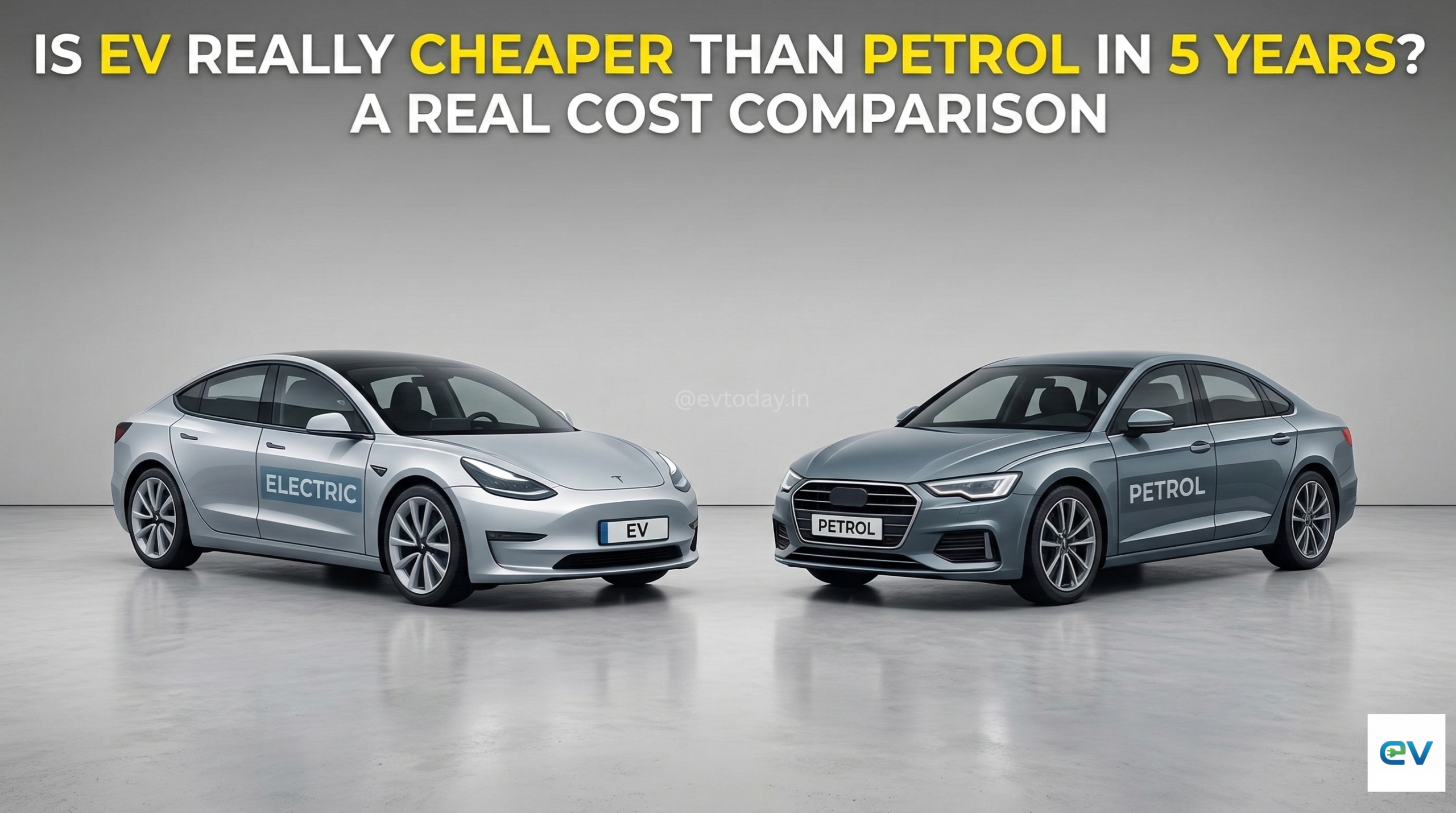
Electric vehicles are no longer a niche technology. Across India and many parts of the world, EV adoption is rising steadily as buyers look for alternatives to high petrol prices and increasing environmental concerns.
But one question still dominates discussions among potential buyers:

Is an EV actually cheaper than a petrol car over five years?
At first glance, EVs often appear more expensive because their purchase price is typically higher than comparable petrol cars. However, the real financial picture becomes clearer when you consider total ownership costs over several years.
Fuel savings, maintenance costs, government incentives, and electricity pricing all play a role. In this article, we examine whether an EV truly becomes cheaper than a petrol vehicle within a five-year ownership period.
Understanding the True Cost of Car Ownership
When comparing EVs and petrol cars, the purchase price alone doesn’t provide the full picture.
Experts typically evaluate Total Cost of Ownership (TCO), which includes:
- Vehicle purchase price
- Fuel or electricity cost
- Maintenance and servicing
- Insurance
- Taxes and incentives
- Depreciation over time
A five-year ownership period is often used because many car owners sell or upgrade their vehicles after that duration.
Running Cost: The Biggest Advantage of EVs
The largest cost difference between EVs and petrol cars comes from daily running expenses.
In India, petrol prices in many cities hover around ₹100–₹110 per litre, making fuel a major ongoing expense for car owners.
Electric vehicles, on the other hand, rely on electricity, which is significantly cheaper per kilometre.
Average running cost comparison
- Electric car: ₹1 – ₹1.5 per km
- Petrol car: ₹6 – ₹7 per km
In other words, driving an EV can cost 4–6 times less per kilometre than driving a petrol car.
This gap becomes significant when accumulated over thousands of kilometres each year.
Example: 5-Year Fuel vs Electricity Cost
Let’s consider a typical urban car owner in India who drives about 1,000 km per month (12,000 km annually).
Petrol car cost
- Average mileage: 15 km/l
- Petrol price: ₹100 per litre
- Cost per km: roughly ₹6.5
Annual fuel cost:
12,000 km × ₹6.5 = ₹78,000 per year
Five-year fuel cost:
₹3.9 lakh
EV charging cost
Most EVs consume around 12–15 kWh per 100 km, and electricity costs typically range from ₹6–₹8 per unit in India.
Average running cost:
₹1–₹1.5 per km.
Annual electricity cost:
12,000 km × ₹1.2 = ₹14,400 per year
Five-year charging cost:
₹72,000
Fuel savings over 5 years
Petrol car fuel cost: ₹3.9 lakh
EV electricity cost: ₹72,000
Savings: roughly ₹3.2 lakh in five years.
For drivers who travel more than 12,000 km annually, the savings can be even higher.
Purchase Price: Where Petrol Still Competes
Despite the running cost advantage, EVs usually have a higher upfront price.
For example:
- Petrol compact SUV: ₹9–12 lakh
- Electric SUV equivalent: ₹13–18 lakh
This difference is largely due to the battery pack, which is the most expensive component in an EV.
However, several factors can reduce the price gap:
Government incentives
Some states provide incentives such as:
- Purchase subsidies
- Road tax exemptions
- Registration fee waivers
These incentives can reduce the effective cost of EV ownership.
Tax benefits
Under India’s Income Tax Act Section 80EEB, buyers can claim deductions of up to ₹1.5 lakh on interest paid for EV loans.
Such incentives improve the financial case for EVs over the long term.
Maintenance Costs Over 5 Years
Maintenance is another area where EVs typically have an advantage.
Electric vehicles have fewer moving parts compared to petrol cars.
A traditional petrol engine includes:
- Engine oil
- Filters
- Spark plugs
- Transmission components
- Exhaust system
EVs eliminate many of these parts, which reduces servicing requirements.
Typical maintenance comparison
Petrol cars
- Regular engine oil changes
- More mechanical components
- Higher long-term servicing costs
Electric cars
- No engine oil
- Fewer mechanical parts
- Lower scheduled maintenance
In many cases, EV servicing costs can be 20–30% lower over five years.
However, EV insurance premiums can sometimes be slightly higher due to battery replacement costs.
Charging Costs vs Fuel Costs
Charging costs depend heavily on where you charge the vehicle.
Home charging
The cheapest option is charging at home using residential electricity tariffs.
Typical cost:
₹1 – ₹1.5 per km.
Public charging
Fast chargers are more expensive but still generally cheaper than petrol.
Public DC charging can increase costs to around ₹2–₹3 per km, depending on the provider.
Even with occasional public charging, EVs often remain cheaper to run.
Key Highlights
• EV running cost: ₹1–₹1.5 per km
• Petrol running cost: ₹6–₹7 per km
• Average 5-year fuel savings: ₹3–4 lakh
• EV maintenance typically lower
• Higher upfront purchase price remains the main barrier
Expert Insight: When Does an EV Become Cheaper?
Financially, the “break-even point” between an EV and a petrol car depends on driving distance.
EV becomes cheaper faster if:
- You drive more than 12,000–15,000 km per year
- You mostly charge at home
- Your state offers EV incentives
Petrol car may remain cheaper if:
- You drive very little each year
- You rely heavily on expensive public charging
- The EV purchase price is significantly higher
In practical terms, frequent commuters benefit the most from EV ownership.
For example:
- Ride-hailing drivers
- Office commuters
- Intercity travelers
For these users, the fuel savings accumulate quickly.
Other Factors That Influence the Cost
Beyond direct expenses, several other factors influence whether EVs become cheaper over time.
Fuel price volatility
Petrol prices fluctuate frequently due to global oil markets and taxes.
Electricity prices tend to be more stable, making EV running costs more predictable.
Battery life
Most EV batteries today come with warranties of around 8 years or 160,000 km, meaning battery replacement is unlikely during a typical five-year ownership period.
Resale value
The used EV market is still developing, but resale values are gradually improving as EV adoption grows.
Environmental and Practical Benefits
While cost is a major factor, EVs also offer several practical advantages.
Reduced emissions
EVs produce zero tailpipe emissions, helping reduce urban air pollution.
Quiet driving
Electric motors operate almost silently, improving driving comfort.
Instant torque
EVs deliver quick acceleration thanks to electric motors that provide immediate power.
These benefits may not directly translate into financial savings but influence purchasing decisions for many buyers.
Conclusion
So, is an EV really cheaper than a petrol car over five years?
In many real-world scenarios, the answer is yes — especially for drivers who travel regularly.
While EVs often cost more upfront, the dramatic difference in running costs can offset that price gap over time. Electricity is significantly cheaper than petrol, and EVs generally require less maintenance.
For drivers covering moderate to high annual distances, EV ownership can lead to savings of several lakhs over five years.
However, buyers should still consider their driving patterns, charging availability, and local incentives before making a decision. For some low-usage drivers, petrol vehicles may still remain financially competitive.
The shift toward electric mobility is not just about sustainability — it is increasingly becoming an economic choice as well.
FAQs
1. Are EVs cheaper than petrol cars in India?
Yes, EVs are generally cheaper to run because electricity costs around ₹1–₹1.5 per km compared to ₹6–₹7 per km for petrol cars.
2. How much can I save with an EV in 5 years?
Depending on your driving distance, you could save ₹2–₹4 lakh in fuel costs over five years.
3. Do EVs require less maintenance?
Yes. EVs have fewer moving parts and do not require engine oil changes, which lowers maintenance costs.
4. Is charging an EV at home cheaper?
Yes. Home charging is the most economical option and typically costs around ₹1 per kilometre.
5. When does an EV become cheaper than a petrol car?
EVs usually become financially beneficial for drivers who travel 12,000 km or more annually.