
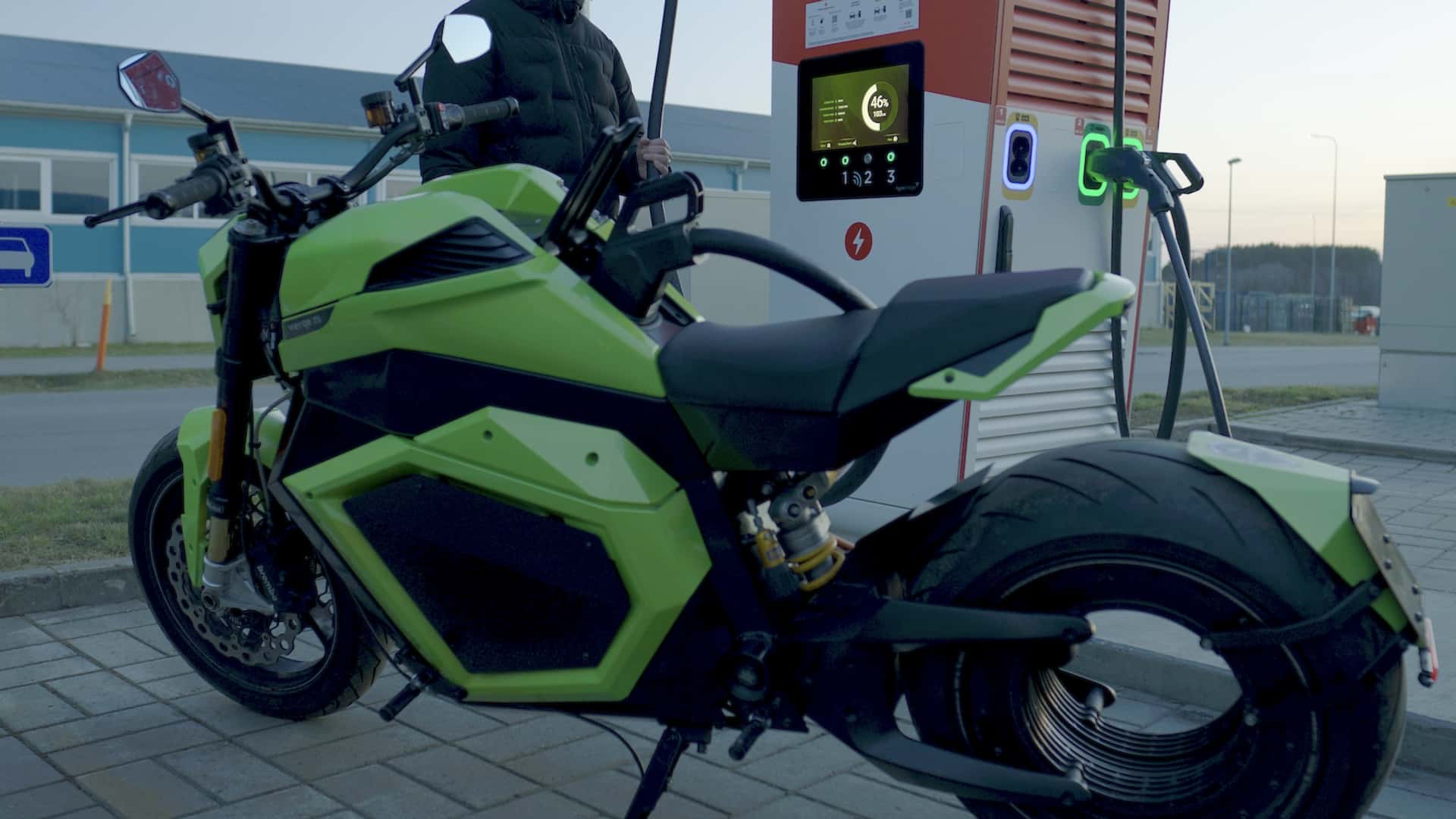
In a significant development for electric vehicle (EV) battery technology, Donut Lab has moved its much-discussed solid-state battery out of the laboratory and into a real-world charging scenario. The Finnish startup’s battery, integrated into an electric motorcycle, was demonstrated charging at a public DC fast-charging station, marking a crucial step in validating its performance beyond controlled testing environments.
Solid-State Battery Takes to the Road
The recent demonstration featured a Verge TS Pro electric motorcycle equipped with an 18 kWh nominal solid-state battery pack developed by Donut Lab. This venture into practical application follows a series of lab-based tests that have generated both excitement and skepticism within the industry. The Verge TS Pro, with this new battery, is projected to offer a manufacturer-estimated range of 217 miles.
Donut Lab’s CEO, Marko Lehtimaki, highlighted a key feature of the battery pack in a YouTube video: an “industry-defining 5C charging rate at the pack level, while only shockingly having air cooling.” This charging rate, explained in the context of EV charging, suggests that a 5C rate could theoretically fully charge the battery in approximately 12 minutes. Conventional charging rates, such as 1C, would require an hour for a full charge.
Performance Metrics in Public Charging Test
During the public charging test, the Verge TS Pro was plugged in at a 9% state of charge. The battery began drawing approximately 103 kilowatts (kW) of power. While modern electric cars can charge at significantly higher speeds, over 100 kW represents a robust charging capability, particularly for electric motorcycles where compact designs often limit the integration of advanced thermal management systems.
The power delivery of 103 kW is notable for a battery pack of this size relative to those found in electric cars. Typically, smaller battery packs manage current more conservatively to extend lifespan, often operating at lower voltages and facing stricter packaging constraints. It is also worth noting that this observed charging speed is about half of the 200 kW peak power Donut Lab claimed at the Consumer Electronics Show (CES).
The test results showed promising progress: the motorcycle reached approximately 50% state of charge in just five minutes, gaining about 7 kWh of energy. Subsequently, it reached 80% state of charge in 12 minutes, having added roughly 13 kWh in total. Donut Lab emphasized that this charging occurred using only air cooling, with two fans directed over heat sinks on either side of the battery pack.
Comparison with Existing Technologies
This charging performance contrasts sharply with current lithium-ion battery technology. For comparison, a similarly sized lithium-ion battery pack in the previous generation of the Verge TS Pro requires about 35 minutes to charge from 0% to 80%, according to independent assessments. Similarly, the LiveWire One, Harley-Davidson’s electric motorcycle offering, takes approximately 40 minutes to reach 80% charge at a fast-charging station.
The reliance on air cooling for such high charging rates is a significant point. Modern EVs predominantly utilize sophisticated liquid cooling systems, often supplemented by air cooling, to manage the heat generated during high-speed charging and demanding driving conditions. The inherent thermal stability of solid-state batteries, which lack flammable liquid electrolytes, is believed to contribute to reduced heat generation, potentially making simpler cooling methods more viable.
Lingering Questions and Future Outlook
Despite the public charging demonstration, several critical questions surrounding Donut Lab’s solid-state battery remain unanswered. The company has maintained a degree of secrecy regarding the specific battery chemistry. Furthermore, independent validation of its claimed longevity, such as the ability to withstand 100,000 charging cycles, is still pending.
The initial claims made by Donut Lab at CES included an energy density of 400 watt-hours per kilogram, 100,000 charge cycles, and the exclusion of rare-earth materials. However, these assertions faced scrutiny from battery experts and industry executives due to a perceived lack of verifiable proof, validation data, or patent filings.
While Donut Lab has begun releasing third-party test results, none have definitively confirmed the solid-state nature of the battery chemistry or substantiated the 400 Wh/kg energy density figure. Previous tests have shown ultra-fast charging capabilities and high-temperature resilience at the cell level, but the current public charging test is the first to assess pack-level performance on a vehicle.
Lehtimaki acknowledged that the Verge motorcycle used in the test may not yet represent the final production model. “Verge is doing system-level optimization and fine-tuning the charge profile on this new battery pack,” he stated, indicating ongoing development work.
With deliveries of Verge Motorcycles’ models equipped with these batteries slated to commence soon, the industry will be closely watching for further real-world performance data. It is anticipated that owners and independent reviewers may eventually provide more insights into the battery’s capabilities and long-term reliability.