Bentley, the renowned British luxury automaker, has significantly revised its ambitious electrification roadmap, abandoning plans for four of its five upcoming electric vehicles (EVs). The company will now concentrate on hybrid technology in the near term to maintain profitability while recalibrating its long-term EV strategy.
Electrification Strategy Re-evaluated
Originally, Bentley had committed to launching five new EVs by the year 2035. However, this comprehensive plan has been scaled back considerably. Only one all-electric model, an ‘Urban SUV’ slated for a 2027 reveal, remains on the development schedule.
This strategic pivot underscores the complex financial realities facing even ultra-luxury car manufacturers in the transition to electric mobility. Bentley’s decision highlights a broader trend in the automotive industry, where profitability and market demand are increasingly influencing the pace and scope of electrification.
Financial Prudence and Market Realities
The company reported its seventh consecutive profitable year in 2023, largely driven by the strong performance of its traditional internal combustion engine (ICE) models. Bentley’s leadership appears to be prioritizing these revenue streams, seeing heavy investment in new EV development as potentially less viable currently.
Bentley CEO Frank Walliser acknowledged the need for a strategic reassessment. “We have to rethink and recalculate our complete product line, and all future offers,” Walliser told Auto Express. “If you compare our planning with what it was two years ago, it looks completely different.”
Influence of Volkswagen Group’s Platform Decisions
A key factor influencing Bentley’s revised strategy is the decision by its parent company, the Volkswagen Group, to cancel the Scalable Systems Platform (SSP). This platform was intended to underpin several upcoming large vehicles, including a flagship SUV for Porsche. Initially envisioned as an EV, Porsche’s delay and subsequent cancellation of the SSP in favor of a combustion engine architecture have had a ripple effect.
The shift to the Premium Platform Combustion (PPC) platform, a gas-based architecture, by Porsche allows for greater flexibility in seating configurations (five and seven seats) and the integration of both gasoline and plug-in hybrid powertrains. This development directly impacts Bentley, which, as part of the VW Group, can leverage similar platform strategies.
Hybridization and Long-Term EV Ambitions
While Bentley is dialing back its immediate EV rollout, the company insists it remains committed to a fully electric future, contingent on market demand. In the interim, hybrid and plug-in hybrid (PHEV) models will receive increased attention and development resources.
“We have a very close eye on the development and acceptance of the EV market, especially in the upper segment. But the next car will not come before 2030,” Walliser stated, indicating that the company’s next truly all-electric offering is still several years away.
The Future Electric Urban SUV
The sole surviving EV from Bentley’s original five-model plan is the ‘Urban SUV,’ scheduled for introduction in 2027. Described as “the world’s first true luxury urban SUV,” this model is expected to share its underpinnings with the upcoming electric Porsche Cayenne.
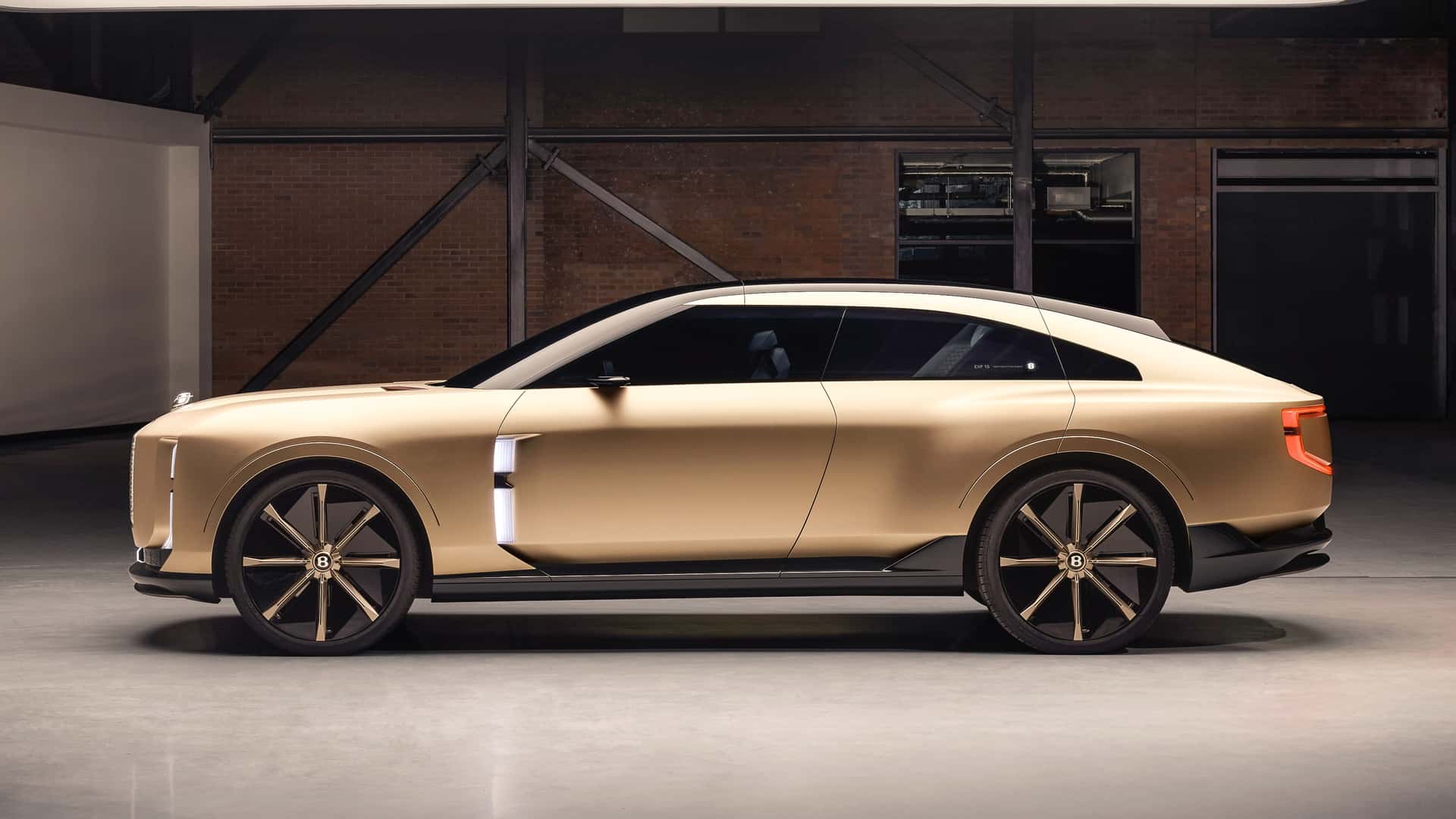
Drawing design inspiration from the concept EXP 15, the electric SUV is anticipated to offer rapid charging capabilities, with the potential to add approximately 100 miles of range in just seven minutes. While specific charging power and battery capacity details are yet to be confirmed by Bentley, expectations are high.
Drawing parallels with the Porsche Cayenne EV, which boasts a 400 kW charging input enabling a 10% to 80% charge in 18 minutes and a WLTP range of around 372 miles from its 108 kWh battery, Bentley’s offering is expected to deliver comparable performance and range for the luxury segment.