
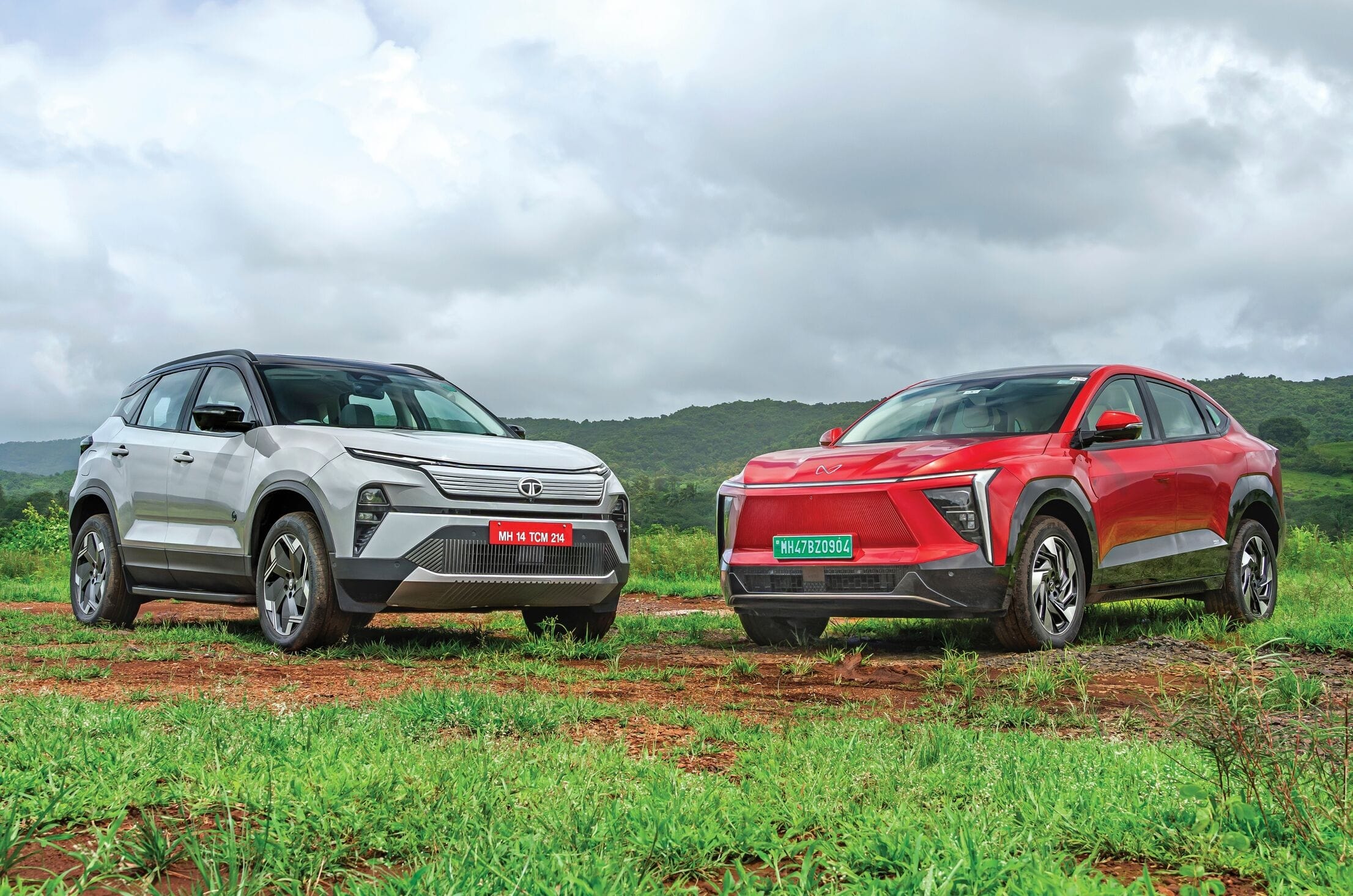
India’s automotive giants Tata and Mahindra are carving distinct paths in the burgeoning electric vehicle (EV) market. This comparison pits the new Tata Harrier EV, an electrified iteration of a familiar nameplate, against the radical and design-forward Mahindra XUV 9e. Both electric SUVs aim for the premium segment, hovering around the Rs 30 lakh mark, boasting advanced features, and claiming impressive ranges exceeding 600km. But which homegrown contender truly stands out?
Pricing and Variants: A Closer Look
The Tata Harrier EV offers a tiered approach with a single-motor rear-wheel-drive setup available with two battery options. The 65kWh battery pack is offered in variants priced between Rs 21.49 lakh and Rs 23.99 lakh, while the larger 75kWh battery is available from Rs 24.99 lakh to Rs 27.49 lakh. The range-topping dual-motor all-wheel-drive version, equipped with the 75kWh battery, comes in at Rs 28.99 lakh.
In contrast, the Mahindra XUV 9e presents a single rear-motor configuration but also offers two battery choices: 59kWh and 79kWh. The smaller 59kWh battery variants are priced from Rs 21.90 lakh to Rs 27.90 lakh. The larger 79kWh battery pack sees the XUV 9e priced between Rs 26.50 lakh and Rs 30.50 lakh. For this comparative review, the top-tier variants of both vehicles were selected.
Exterior Design and Engineering: Familiarity vs. Futurism
XUV 9e is longer and has a longer wheelbase, but the Harrier EV is wider and taller
The Tata Harrier EV retains the handsome, muscular, and well-proportioned silhouette of its internal combustion engine (ICE) sibling. However, beneath the familiar ‘top hat’ and shared interior elements lies a significantly re-engineered platform. It features a new floorpan, revised suspension, and dedicated EV hardware. While the ICE Harrier is front-wheel-driven, the Harrier EV is primarily rear-wheel driven. The dual-motor variant tested here incorporates a motor on each axle, endowing the Harrier EV with all-wheel-drive capability.
The Mahindra XUV 9e adopts a dramatically different design philosophy. Its styling is bold, futuristic, and undeniably head-turning, diverging significantly from the Harrier EV’s more conventional SUV approach. The XUV 9e is longer than the Harrier EV, boasting a longer wheelbase as well. Despite its increased length, the Harrier EV is wider and taller than the Mahindra contender.
| Specification | Tata Harrier EV | Mahindra XUV 9e |
|---|---|---|
| Length (mm) | 4607 | 4789 |
| Width (mm) | 2132 | 1907 |
| Height (mm) | 1740 | 1694 |
| Wheelbase (mm) | 2741 | 2774 |
| Front/rear boot capacity (litres) | 35/50 | 150/663 |
| Tyre size | 245/55 R19 | 244/55 R19 |
| Battery capacity (kWh) | 75 | 79 |
| Power (hp) | 158 (front), 238 (rear) | 286 |
| Torque (Nm) | 504 | 380 |
| Drive layout | AWD | RWD |
Interior Space and Comfort: Tech and Ergonomics
Both are feature-rich, but the XUV 9e gets features like reclining rear seats and an HUD
The Harrier EV’s cabin greets occupants with a wide, horizontally oriented dashboard dominated by a sharp 14.5-inch Samsung QLED touchscreen. The user interface is praised for its intuitiveness, and the 360-degree camera feed is crisp and responsive. A Land Rover-inspired digital inner rear-view mirror doubles as a dash camera, offering good depth perception, though reflections can be an issue. Touch-based shortcut keys alongside physical controls for climate and front seat ventilation enhance user experience.
However, some ergonomic challenges persist. The wireless phone charger can be fiddly, the broad centre console might impinge on taller drivers’ knees, and the front seats offer limited thigh support. Rear passengers benefit from a flat floor and ample space, aided by winged headrests, but thigh support remains a point of concern.
The XUV 9e’s cabin stands out with its brighter upholstery and a distinctive three-screen layout. The front seats offer better support than those in the Harrier EV. However, seat ventilation controls are buried within touchscreen menus, proving inconvenient while driving. The infotainment system itself is complex, requiring a learning curve. Additionally, the steering wheel’s haptic buttons can inadvertently trigger the horn.

Access to the rear is facilitated by wide-opening doors, and space is generous, though headroom might be tight for very tall occupants. The flat rear seat base and recline function contribute to comfort. Notably, all three rear passengers get individual adjustable head restraints, unlike the Harrier EV’s two.
When it comes to storage, the Mahindra XUV 9e significantly outperforms the Harrier EV. It boasts a capacious 663-litre boot with a flat load bay and a surprisingly large 150-litre front boot (frunk). The Harrier EV’s boot capacity is smaller at 502 litres, featuring a raised load floor and a minimal 35-litre frunk (the 2WD version offers up to 67 litres).
Performance: Acceleration and Top Speed
Harrier EV AWD accelerates quicker, but XUV 9e reaches a higher top speed
On paper, the Tata Harrier EV’s dual-motor setup is the powerhouse, delivering a combined 313 hp and 504 Nm of torque. In typical driving, it operates in rear-wheel-drive mode for efficiency, with the front motor engaging only under load or when traction loss is detected. Power delivery is linear, and its substantial 2.3-tonne kerb weight tends to mask the vehicle’s speed. Despite this, the Harrier EV is genuinely rapid, accelerating from 0-100 kph in just 6.74 seconds, making it 0.71 seconds faster than the lighter XUV 9e.
While the Harrier EV is marginally quicker off the line, the Mahindra XUV 9e boasts a higher top speed, reaching over 200 kph compared to the Harrier EV’s 180 kph.

| Performance Metric | Harrier EV | XUV 9e |
|---|---|---|
| 0-20 kph (s) | 1.26 | 1.42 |
| 0-40 kph (s) | 2.43 | 2.78 |
| 0-60 kph (s) | 3.62 | 4.14 |
| 0-80 kph (s) | 4.93 | 5.59 |
| 0-100 kph (s) | 6.74 | 7.45 |
| 0-120 kph (s) | 9.19 | 9.86 |
| 80-0 kph braking distance (m) | 24.36 | 25.88 |
| 80-0 kph braking time (s) | 2.23 | 2.64 |
| 80-20 kph Level 1 regen braking distance (m) | 29.26 | 29.72 |
| 80-20 kph Level 2 regen braking distance (m) | 16.14 | 17.45 |
| 80-20 kph Level 3 regen braking distance (m) | 13.06 | 13.49 |
Ride Comfort and Handling: Agility and Refinement
XUV 9e gets a single-pedal drive mode, though both have three levels of brake regen
The Harrier EV impresses with its sharp steering and substantial grip, attributes to its all-wheel-drive system and a taut chassis that ensures confident body control. At low speeds, the ride quality is remarkably absorbent. However, at higher speeds, particularly on highways, the ride can become somewhat floaty, especially from the rear.
The Mahindra XUV 9e’s single rear motor produces 286 hp and 380 Nm, outputs lower than the Harrier EV’s combined figures. Yet, the XUV 9e’s motor responds more assertively, giving it a more sprightly and lighter feel. Its variable gear ratio steering is a standout feature, offering lighter weighting and greater precision. Coupled with a tight 5-meter turning radius, the XUV 9e exhibits remarkable manoeuvrability for its size. Its semi-adaptive dampers, linked to drive modes, strike an excellent balance between ride comfort and handling, making the vehicle feel surprisingly nimble and composed.
Both SUVs feature drive modes that tailor powertrain and steering responses. The XUV 9e’s drive modes also adjust its semi-adaptive dampers, which firm up noticeably in ‘Race’ mode. Additionally, both vehicles offer terrain modes that recalibrate throttle response and ESP settings for optimal traction in various conditions like wet, sand, mud, or snow.
Regarding regenerative braking, both models offer multiple levels, including an off setting. In testing, the Harrier EV achieved shorter deceleration distances across its three regen modes when braking from 80 kph to 20 kph, indicating stronger regenerative braking. The Mahindra XUV 9e, however, provides a single-pedal driving mode, a more aggressive setting that can bring the vehicle to a complete stop without using the brake pedal.
In the 80 kph to 0 kph braking test, the Harrier EV stopped in a shorter distance despite its higher weight. However, its brake pedal feel was found to be less desirable compared to the XUV 9e.
Range and Charging: Real-World Efficiency
XUV 9e 79kWh has more real-world range than the Harrier EV AWD
To assess real-world range capabilities beyond manufacturer claims of over 600km, both vehicles underwent rigorous testing. The Harrier EV demonstrated a slightly higher city efficiency of 5.5 km/kWh compared to the XUV 9e’s 5.4 km/kWh. However, on the highway, the Mahindra significantly outperformed the Tata, achieving 6.2 km/kWh against the Harrier EV’s 5.2 km/kWh. Extrapolating these figures, the XUV 9e is capable of delivering an average of 456 km on a single charge, surpassing the Harrier EV’s average of 401 km.
For DC fast charging, the Mahindra’s 409V architecture supports charging speeds of up to 175kW, whereas the Harrier’s 377V system is limited to 107kW. This means the XUV 9e, particularly with its larger 79kWh battery, can achieve faster charging times on chargers rated 120kW or higher. Furthermore, the Harrier EV is equipped with a 7.2kW onboard charger, while the Mahindra features a more capable 11.2kW unit for quicker AC charging. Both manufacturers offer optional AC fast chargers at an additional cost: Rs 49,000 for a 7.2kW unit with the Tata, and Rs 50,000 for 7.2kW or Rs 75,000 for 11.2kW with the Mahindra.
| Efficiency Metric | Tata Harrier EV | Mahindra XUV 9e |
|---|---|---|
| City efficiency (km/kWh) | 5.5 | 5.4 |
| Highway efficiency (km/kWh) | 5.2 | 6.2 |
| Range (average) (km) | 401 | 456 |
Price and Verdict: The Deciding Factor
The progress made by both homegrown brands in the electric vehicle sector is commendable. The Tata Harrier EV presents a stylish package, equipped with expected modern features, a comfortable ride, and mature driving dynamics. It also offers strong value, with even the AWD variant priced competitively against the Mahindra. It stands as a sensible and well-rounded choice for many buyers.
However, the Mahindra XUV 9e emerges as the more compelling and forward-thinking option. Its futuristic design is a significant draw, it is packed with features, offers superior seating comfort, boasts a larger boot, delivers better real-world range, and supports faster charging. While it comes at a higher price point, the enhanced driving experience and its sheer emotional appeal justify the premium for those seeking the cutting edge in electric SUVs.