
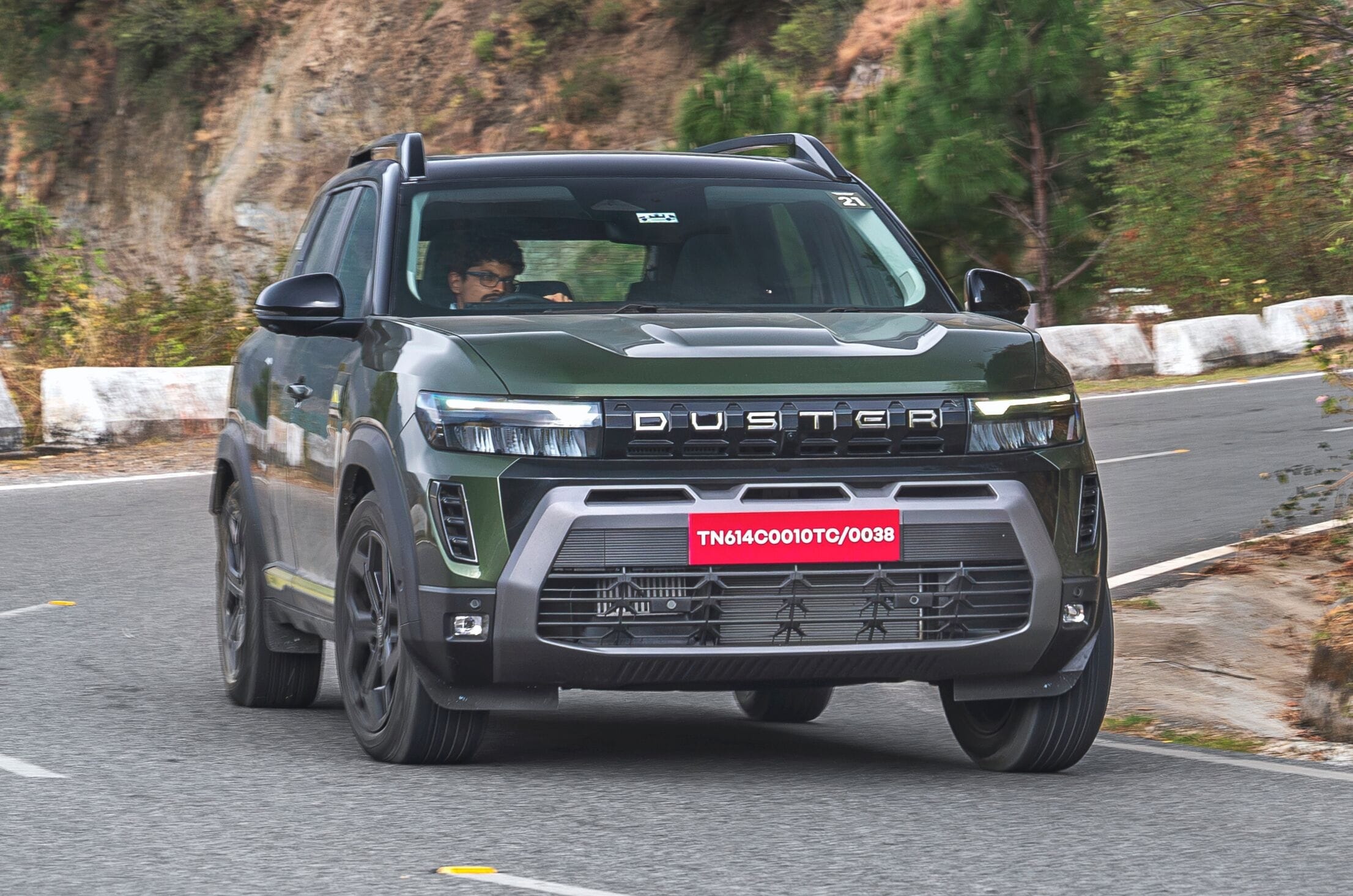
The Renault Duster, a name synonymous with the birth and definition of the mid-size SUV segment in India, is back after a significant hiatus. Revered for its butch stance, rugged appeal, and potent diesel engine, the Duster cultivated a devoted following and became a distinct brand in itself. Now, with a lot riding on its shoulders, the new Duster faces the Indian market with a significantly updated persona. Notably absent is the diesel engine option, replaced by a choice of two turbo-petrol powertrains. This review delves into whether the latest iteration can meet the considerable expectations and uphold its storied legacy, focusing on drives of the top-spec 1.3 turbo-petrol variants in both manual and automatic transmissions.
Renault Duster Exterior Design: A Modern Evolution of Ruggedness
Renault appears to have hit the mark squarely with the new Duster’s design, skillfully blending nods to its iconic predecessor with contemporary styling cues. The India-specific model draws heavily from the third-generation Duster sold internationally but has been thoughtfully adapted for the nuances of the Indian market. The front fascia commands attention with large LED headlights, distinguished by distinctive eyebrow-shaped LED Daytime Running Lights (DRLs) that also function as turn indicators. The grille is a unique touch for India, eschewing the traditional Renault logo in favour of a prominent ‘Duster’ badge, a testament to its strong brand recognition.

A palpable sense of nostalgia emanates from the front bumper’s design, featuring a protruding silver skid plate reminiscent of the first-generation model. Complementing this are pixel-style fog lamps neatly integrated at the edges. Sculpted bonnet lines and air curtains integrated into the bumper’s edges further enhance the vehicle’s substantial and purposeful appearance.
The Launch Edition model distinguishes itself with vibrant neon green accents, adding a striking contrast to its rugged aesthetic. This visual flair extends to various design elements, underscoring its adventurous spirit.
A Profile Defined by Durability and Practicality
In profile, the new Duster emphatically leans into its rugged mandate. Pronounced black cladding encircles the wheel arches and runs along the lower body, amplifying its imposing and durable character. The rear door handles are cleverly integrated into the C-pillar, maintaining clean lines. Functional roof rails, boasting a 50kg load capacity, are a practical addition, although their utility for common accessories like roof boxes is noted to be restricted by current regulations.
The Duster rides on stylish 18-inch alloy wheels, contributing to its assertive stance. It also boasts an impressive 212mm of ground clearance, ensuring it’s well-equipped to handle varied terrains. Further India-specific design elements include subtle Himalayan motifs subtly embossed on the front fenders and an accent strip on the side cladding bearing ‘Iconic’ lettering, celebrating its connection to the Indian landscape.
On the Launch Edition model, the 18-inch alloys are finished in a stealthy black, complementing the vehicle’s overall aggressive look.
Rear Design: A Blend of Simplicity and Distinctive Touches
The rear design is characterized by its relative simplicity, yet it incorporates several noteworthy elements. The distinctive triangular tail lamps are unified by an LED light bar, a feature not present on the global version, adding a modern and cohesive look. A roof-mounted spoiler lends a sporty edge, while the license plate housing features a textured finish for added detail. The black rear bumper, artfully contrasted by a silver insert, effectively breaks up the otherwise clean design and reinforces its rugged appeal.

Overall, the new Renault Duster makes a significant statement with its commanding road presence. The available colour palette includes Sunset Red, Pearl White, River Blue, Moonlight Silver, Stealth Black, and Jade Mountain Green. The featured ‘Launch Edition’ is easily identifiable by its all-around neon green accents and the aforementioned blacked-out alloy wheels.
Underpinnings: The Robust RGMP Platform
Crucially, the India-spec Duster deviates from its European counterpart, which is built on the Common Module Family – B (CMFB) platform. Instead, the Indian model is constructed on the Renault Global Modular Platform (RGMP). This platform is augmented by a new electrical and electronics (E&E) architecture, developed in collaboration with Google. The RGMP platform is designed for future versatility, capable of underpinning sub-4-meter cars and accommodating a range of powertrains, including full electrification, hybrids, and CNG, without compromising packaging efficiency.
A notable distinction is the India-spec Duster’s connected LED tail light, a feature absent in its global counterpart, enhancing its modern appeal.
Dimensions and Practicality: Optimized for India
In terms of dimensions, the Duster measures 4343mm in length, 1813mm in width, and 1659mm in height, with a substantial 2657mm wheelbase. These figures place it squarely within the competitive landscape of its mid-size SUV rivals. The new Duster occupies a middle ground in size, fitting between larger models like the Tata Safari and smaller rivals such as the Skoda Kushaq and Volkswagen Taigun.

An interesting adaptation for the Indian market is the 50mm increase in overall height compared to its overseas counterpart. This elevation is largely attributed to the panoramic sunroof, which necessitated a raised roofline to accommodate its mechanism while ensuring ample headroom. Consequently, the Indian Duster’s cabin benefits from approximately 40mm of additional height, contributing to its enhanced ground clearance.
Cargo Capacity and Off-Road Prowess
The electrically operated tailgate opens to reveal a class-leading 518 litres of boot space, expandable to 700 litres up to the roofline, offering substantial cargo-carrying capability. However, a point of consideration is the absence of a standard spare tyre, with buyers receiving a puncture repair kit instead.
Further underscoring its go-anywhere heritage, the Duster boasts an approach angle of 26.9 degrees and a departure angle of 34.7 degrees. These figures, demonstrated on a specially curated off-road course during the drive, highlighted the vehicle’s inherent capability to tackle challenging terrains with confidence.
Renault Duster Interior: A Refined and Feature-Rich Cabin
Mirroring the exterior’s thoughtful evolution, the Duster’s cabin has been comprehensively reimagined from the international version to cater to local preferences. The dashboard presents an entirely unique design, featuring a striking dual-screen layout. This is complemented by a sophisticated mix of textured and soft-touch materials, elevating the overall ambiance and perceived quality. Accents of silver, faux carbon fibre trim, and contrast green stitching are liberally applied, injecting a sense of dynamism and flair into the otherwise functional interior architecture.
The dashboard is enhanced by silver accents, faux carbon fibre trim, and contrast green stitching, contributing to its dynamic appeal.
Balanced Technology and Tactile Controls
Significantly, Renault has avoided an over-reliance on digitization, striking a sensible equilibrium between advanced screens and intuitive physical controls. A bank of physical buttons on the centre console manages key vehicle functions, including climate control, ensuring ease of use. Notably, the centre consoles differ between the automatic and manual variants. The automatic transmission features a high-set, enclosed panel housing a deep, cooled storage area with cupholders, alongside a compact gear selector, electronic parking brake, and wireless charger.
In contrast, the manual transmission variant sports a lower-set centre console with a traditional manual parking brake. It also offers an additional shelf for device storage just below the physical controls on the dashboard. The manual gear lever itself receives special commendation for its aesthetics and tactile feel.
Practicality is further enhanced by thoughtful touches: the front armrest is slide-adjustable and contains a storage compartment, the glovebox is generously sized, and the door bins can easily accommodate 1-litre bottles.
The MT variant features a lower-set centre console with a manual handbrake, emphasizing its driver-focused nature.
Ergonomics and Driver Interface
The steering wheel, designed with a flat bottom and top, offers a pleasant grip and integrates controls for the instrument cluster and cruise control. Audio system controls are conveniently located on a separate stalk behind the wheel, a design cue familiar to previous Duster owners.
The digital instrument cluster boasts bright colours and high resolution, offering customisation options. However, its layout might not resonate with all users, and traditional Duster enthusiasts might find themselves missing the simplicity of the older model’s round dials. The plastic, card-like key fob, identical to those found in the more affordable Triber and Kiger, detracts slightly from the overall premium feel.
The 10.25-inch digital cluster is customisable, though some drivers may prefer the classic round dials of previous models.
Seating Comfort and Space
The seats are upholstered in a dual-tone black and dark green fabric, accented with neon green contrast stitching, creating an appealing visual. The front seats are well-padded and supportive, designed for long-drive comfort, and feature electric adjustment and one of the most effective seat ventilation systems available in the segment.
The rear seat comfortably accommodates two adults, though fitting a third person for extended journeys may prove challenging due to limited shoulder room and the presence of the transmission tunnel. Decent kneeroom and ample headroom are provided for occupants up to six feet tall. The large sunroof and windows contribute to an enhanced sense of spaciousness. Rear passengers benefit from a centre armrest with cupholders, dedicated AC vents, and charging ports, though rear window sunblinds are conspicuously absent. The higher window line compared to the previous Duster’s more expansive glass area does impact outward visibility.
Despite adequate kneeroom and headroom for most, the cabin might not feel as expansive as some key rivals.
Renault Duster Features and Safety: Comprehensive and Modern
Renault has equipped the new Duster with a comprehensive suite of features expected in the contemporary mid-size SUV segment. The infotainment system supports wireless smartphone integration, featuring bright colours and high-resolution graphics that match the digital cluster. However, the 10.1-inch touchscreen, while functional, feels somewhat modest in an era where larger displays are becoming standard.
The touchscreen offers high resolution and vibrant colours, but its user interface could be more intuitive.
Integrated Google Services: A Seamless Experience
The standout feature is the seamless integration of Google services. Google Maps, Google Assistant, and the Google Play Store are built directly into the system, offering direct access and smooth operation. The interface is visually appealing and responsive, although its navigation structure and menu flow could be more intuitive, especially when compared to the offerings from rivals like Hyundai and Kia.
Advanced Comfort and Convenience Features
Beyond the already mentioned ventilated and powered front seats, other significant convenience features include a panoramic sunroof, wireless phone charging, and a 360-degree parking camera. While the camera provides a comprehensive view, its resolution could be sharper. Additional amenities include a powered tailgate, automatic headlamps and wipers, dual-zone climate control, and connected car technology, among others.
The 360-degree camera’s resolution could be improved for greater clarity.
Robust Safety Suite and ADAS Implementation
The Duster’s safety credentials are strong, featuring six airbags as standard, front and rear parking sensors, a tyre-pressure monitoring system (TPMS), an electronic parking brake (on DCT models), three-point seatbelts, and adjustable headrests. It also incorporates disc brakes on all four wheels.
A significant advancement is the Duster’s introduction of a Level 2 Advanced Driver Assistance Systems (ADAS) suite in India, a first for Renault in the country. Initial impressions suggest the ADAS features are well-calibrated and not overly intrusive, although the lane-keep assist was observed to be somewhat aggressive. A practical addition is a dedicated button on the driver’s side to quickly disable all ADAS functions, eliminating the need to navigate through sub-menus.
Renault has stated its intention to achieve a full 5-star crash safety rating for the new Duster, underscoring its commitment to occupant safety.
Both front seats are equipped with electric adjustment and ventilation for enhanced comfort.
Feature Allocation and Value Proposition
While the Duster is comprehensively equipped, there’s room for improvement in feature distribution across the trim levels. Mid-range or second-to-top variants could benefit from the inclusion of features like ventilated seats and leatherette upholstery to enhance their value proposition.
Renault Duster Performance and Refinement: Turbocharged Potency
The new Duster offers two turbo-petrol engine options. The entry-level is a 1.0-litre, three-cylinder unit producing 100hp and 160Nm, exclusively available with a 6-speed manual gearbox. The more potent option is a 1.3-litre, four-cylinder turbo-petrol engine, delivering an impressive 163hp and 280Nm – segment-leading figures. This engine can be paired with either a 6-speed manual or a 6-speed Dual Clutch Transmission (DCT), both of which were tested.
It’s noteworthy that the 1.3-litre turbo-petrol engine powers the vast majority of Duster bookings, accounting for 91 percent of all orders.
Future Powertrain Options: Hybrid and Beyond
Renault is also poised to introduce a strong hybrid option later, pairing a 1.8-litre petrol engine (109hp) with electric motors and a 1.4kWh battery, resulting in a combined output of 160hp and 172Nm. This powertrain is slated for launch around Diwali and has already seen bookings extend into 2026, indicating strong customer interest.
Significantly, unlike its predecessor, the new Duster will not offer a diesel engine or an All-Wheel Drive (AWD) option.
1.3 DCT: Smoothness and Driveability
The 1.3 DCT variant emerges as the preferred choice for its blend of convenience and driving pleasure. The engine itself is commendably refined, exhibiting minimal vibration at idle and maintaining smoothness throughout the rev range. Cabin insulation is also exceptionally effective, largely masking the engine’s presence. Only under aggressive acceleration does the engine note become discernibly audible.
While there is a noticeable turbo lag, a significant surge in power delivery occurs around the 2,500rpm mark, followed by a strong mid-range punch. The engine continues to pull strongly towards its redline.
The 1.3-litre turbo-petrol engine is praised for its refinement and strong performance.
The wet-clutch DCT automatic gearbox, while not as rapid-shifting as some competitors’ dual-clutch systems, offers impressive smoothness, akin to a torque converter. This characteristic enhances low-speed city driving, where the Duster DCT operates seamlessly. Paddle shifters are included, providing responsive control and adding to the engagement during spirited driving. In terms of acceleration, a preliminary 0-100kph time of 10.4 seconds was recorded, placing it competitively within the segment.
The car’s tall gearing, however, can lead to a slightly sluggish response at lower revs, particularly noticeable in the manual transmission variant.
1.3 Manual: Driver Engagement and Control
For driving purists, the 1.3 manual variant offers superior engagement and control, particularly evident on winding roads. The clutch is light with a consistent bite point, preventing jerky movements, and the well-defined gearshift gates ensure precise shifts. The test drive, conducted on ghat roads in the Himalayas, highlighted the manual’s prowess in such environments.
However, powering uphill out of tight corners reveals more pronounced turbo lag in the manual compared to the DCT. The tall gearing necessitates frequent downshifts to maintain optimal engine speed and momentum. The manual version was marginally slower in the 0-100kph sprint, recording 10.8 seconds.
Both variants feature drive modes (Comfort and Eco), though the absence of a Sport mode is a missed opportunity for enhanced driving dynamics.
Renault Duster Mileage and Efficiency
Renault has yet to officially disclose the claimed mileage figures for either engine. Consequently, real-world fuel efficiency could not be accurately assessed during the limited test drive. However, based on the small-capacity turbo-petrol engines, city efficiency is anticipated to range from the high single digits to low double digits, while highway efficiency is expected to be in the mid-teens. Actual mileage will, as always, be contingent on driving styles and traffic conditions.
Renault Duster Ride Comfort and Handling: A Signature Duster Trait
The renowned ride comfort of the previous Duster has been successfully carried over to the new generation. The test drive route, spanning from Dehradun to New Tehri in Uttarakhand, presented a diverse mix of smooth highways, challenging ghat roads, and rough patches littered with rocks, characteristic of landslide-prone areas. The Duster navigated these conditions with remarkable composure, demonstrating its inherent resilience.
While there’s a subtle European hint of firmness at lower speeds, it does not detract from the overall comfort. The Duster effectively absorbs rough patches and large potholes without significant intrusion into the cabin, and importantly, it no longer exhibits the steering kick-back issues of its predecessor.
The ample sidewall height of the 225/55 R18 tyres contributes significantly to this absorbent ride quality. At highway speeds, the Duster maintains impressive stability and composure, instilling confidence in the driver.
Despite being a front-wheel-drive vehicle, the Duster retains its legendary off-road capability.
Cornering Prowess and Steering Feedback
The Duster proves to be an enjoyable car to drive around corners. Body control is commendable, though under hard cornering, some degree of body roll is present, preventing it from feeling as flat and tightly controlled as rivals like the Skoda Kushaq or Volkswagen Taigun. The steering, while favouring lightness, is precise and provides good feedback on twisty roads. The inclusion of selectable steering modes, including a configurable ‘Individual’ setting, allows for added weight and engagement during spirited driving.
Renault Duster Value for Money: Competitive Pricing and Ownership Benefits
Renault is offering the new Duster across five trim levels: Authentic, Evolution, Techno, Techno+, and Iconic. Pricing starts at Rs 10.29 lakh and extends up to Rs 18.49 lakh (ex-showroom), positioning it competitively within the mid-size SUV segment. While models like the Citroen C3 Aircross and MG Astor are more accessible at the lower end, premium offerings like the Hyundai Creta, Kia Seltos, Tata Safari, and Maruti Grand Vitara command higher prices at the top end.
The brand is enhancing the initial purchase appeal with an ‘R Pass’ pre-booking benefit, offering reduced effective prices of Rs 20,000-40,000 per variant and priority delivery, among other advantages.
The Duster is available in five trim levels, with prices ranging from Rs 10.29 lakh to Rs 18.49 lakh (ex-showroom).
Innovative Ownership Models and Warranty
Renault is also introducing a new subscription program designed to eliminate down payments, bundling on-road costs and servicing into a single monthly fee. This flexible ownership model allows customers to choose from various tenure and mileage options, with the flexibility to extend, return, or even purchase the vehicle at the end of the term.
Adding further value, the Duster comes with an impressive warranty package of up to 7 years or 1,50,000 km, providing long-term peace of mind for owners.
Conclusion: A Worthy Successor?
While Renault may have taken its time, the new Duster arrives exceptionally well-prepared to challenge the established players in the highly competitive mid-size SUV arena. It successfully blends rugged, appealing styling with a modern, feature-rich interior and a genuinely engaging driving experience, largely thanks to its superb 1.3-litre turbo-petrol engine. Its robust construction also suggests it’s built to withstand the rigors of real-world use.
However, loyalists of the original Duster might lament the absence of a diesel engine and AWD option. Additionally, slightly more rear-seat space could have broadened its appeal. Nevertheless, the new Duster adeptly builds upon its predecessor’s strengths, incorporating enough modern updates to feel fresh, relevant, and highly desirable in today’s market.