
As the automotive landscape continues its shift towards electrification, hybrid SUVs are emerging as a compelling option for consumers seeking a balance between fuel efficiency and the practicality of an SUV. These vehicles offer the best of both worlds, combining electric power for urban driving and acceleration with the long-range capability of a gasoline engine, effectively eliminating range anxiety.
Hybrid technology has seen significant advancements over the past two decades, leading to established supply chains and a wide array of models from virtually every major automaker. Whether buyers are looking for compact, mid-size, full-size, or performance-oriented options, there is a hybrid SUV to suit diverse needs and budgets.

For those not yet ready to commit to a fully electric vehicle (EV), a hybrid SUV represents a logical next step. While they still rely on fossil fuels, their running costs are typically lower than their gasoline-only counterparts, and they offer an accessible introduction to electrified powertrains.
Methodology: How We Select the Best Hybrid SUVs
Our selection process is informed by the extensive experience of automotive journalists who have spent years testing and reviewing vehicles across various powertrains and body styles. This background provides a comprehensive understanding of hybrid technology within the broader automotive context.
We conduct rigorous efficiency tests in diverse conditions, from coastal highways to challenging backroads, and evaluate vehicles in urban, highway, and off-road scenarios. For hybrid SUVs, our primary focus is on factors most important to consumers: price, fuel economy, comfort, and overall practicality. Our aim is to identify vehicles that genuinely enhance the user’s driving experience.
Market Landscape: Japanese Automakers Lead the Pack
Japanese automakers continue to dominate the traditional hybrid SUV segment. Toyota, in particular, boasts a vast electrified lineup, with nearly a million hybrids sold in the U.S. last year alone. Honda’s hybrid offerings, though smaller, are consistently strong, exemplified by the excellent CR-V Hybrid.
Hyundai is also expanding its hybrid presence, with models like the Tucson and Santa Fe Hybrids achieving record sales. In contrast, many American and European manufacturers are focusing more on plug-in hybrids (PHEVs) and mild hybrids, or have opted to transition directly to full EVs, bypassing traditional hybrids for the U.S. market.
This guide focuses exclusively on traditional, self-charging hybrid SUVs. These vehicles combine a combustion engine with one or more electric motors and a small battery. They do not require external charging and utilize regenerative braking and engine power to keep the battery topped up, significantly boosting fuel efficiency.

Best Overall Hybrid SUV: 2026 Hyundai Tucson Hybrid
While the Toyota RAV4 Hybrid and Honda CR-V Hybrid are popular choices, the 2026 Hyundai Tucson Hybrid stands out for its overall capability and value. It offers a competitive price point, robust features, and impressive fuel economy, achieving up to 38 miles per gallon combined (city/highway).
The Tucson Hybrid is powered by a 1.6-liter turbo engine paired with a 64-horsepower electric motor, delivering a combined output of 231 horsepower and 271 pound-feet of torque. Its 1.49-kWh lithium-ion battery allows for short, low-speed electric-only driving.
Key features include standard all-wheel drive, dual 12.3-inch displays with wireless Apple CarPlay and Android Auto, wireless charging, adaptive cruise control, and a hands-free liftgate. Its distinctive styling offers a futuristic alternative to more conventional designs found in rivals like the RAV4 and CR-V.
Starting at $33,465 before fees and destination, the Tucson Hybrid represents a significant value proposition, offering advanced features and enhanced efficiency over its gasoline-only counterpart.

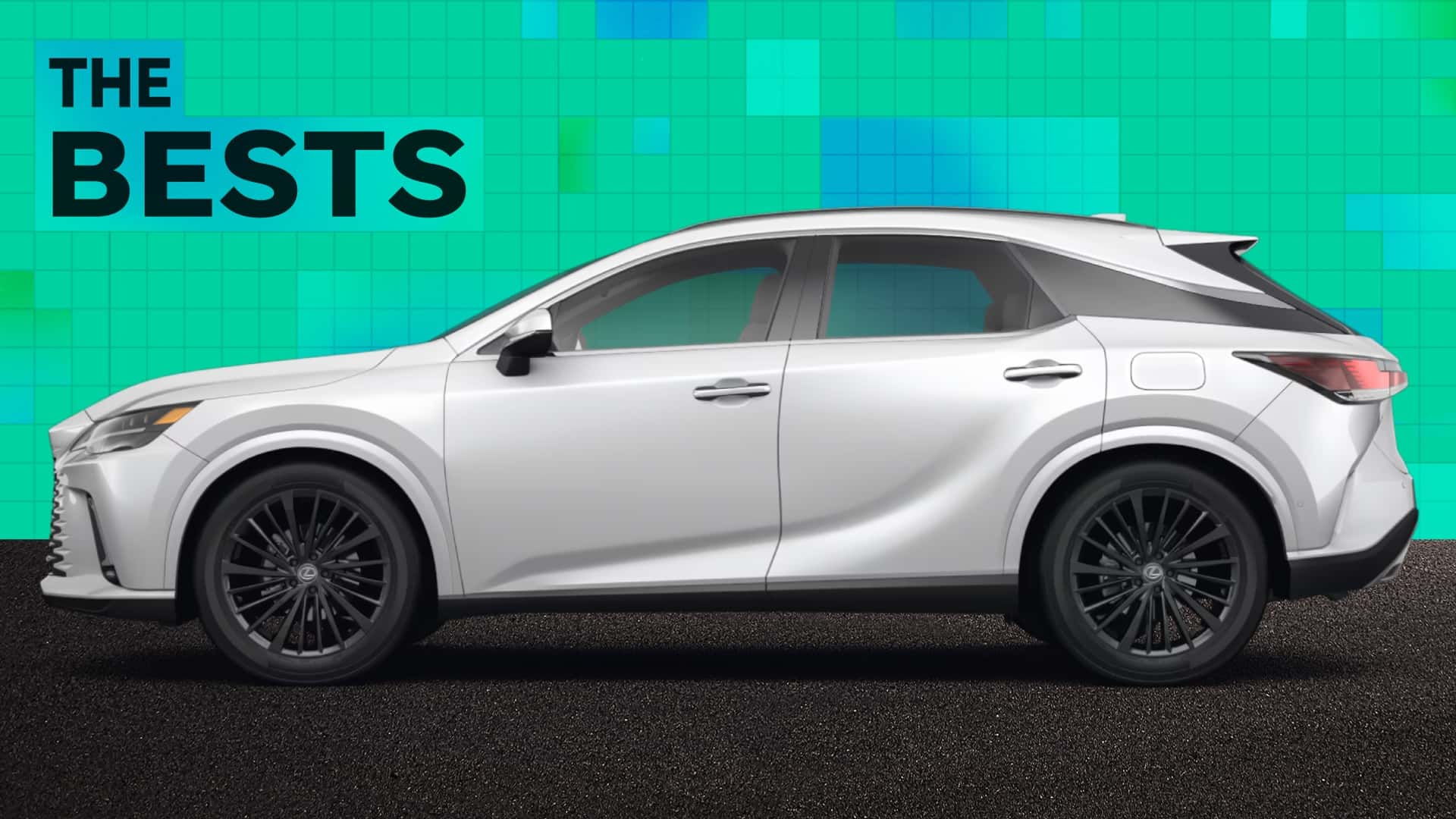
Best Luxury Hybrid SUV: 2025 Lexus RX Hybrid
For buyers prioritizing refinement and quiet operation, the 2025 Lexus RX Hybrid is an exceptional choice. This model is Lexus’s best-seller, with a substantial portion of its sales attributed to hybrid and plug-in hybrid variants. Its starting price of approximately $52,000 (before fees and destination) is comparable to the gasoline-only RX 350 AWD.
The RX 350h achieves an impressive 36 mpg combined, a significant improvement over the gas-only RX 350’s 21 mpg. This enhanced efficiency is coupled with a quieter cabin and a more refined driving experience, making it a superior option for luxury seekers.
Higher trims, such as the Luxury trim, offer premium amenities like plush leather seats, suede door trims, ambient lighting, 10-way power-adjustable front seats, and a panoramic sunroof. For those needing more space, the Lexus TX offers a larger, three-row alternative.
Best Three-Row Hybrid SUV: Toyota Grand Highlander Hybrid
The Toyota Grand Highlander Hybrid delivers exceptional space and capability in the three-row SUV segment, offering significant value and a premium feel. It achieves up to 37 mpg combined, matching the efficiency of the smaller RAV4.
Configurable with captain’s chairs in the second row for a six-seater layout or bench seats for up to eight occupants, it caters to families with diverse seating needs. The starting price of $44,000 (before fees and destination) provides access to a 2.4-liter naturally aspirated engine and hybrid system producing 245 hp and 175 lb-ft of torque.
Its on-demand electronic all-wheel-drive system enhances traction when needed, while prioritizing front-wheel-drive efficiency for daily driving. Competitors in this space include the Hyundai Santa Fe Hybrid and Kia Sorento Hybrid.
Best Affordable Hybrid SUV: Kia Niro Hybrid
The Kia Niro Hybrid stands out as the most budget-friendly hybrid SUV, starting at $26,990 before fees and destination. It boasts an impressive EPA-rated fuel economy of 53 mpg combined, rivaling some plug-in hybrids.
While the Toyota Corolla Cross Hybrid is another strong contender in this category, the Niro offers superior overall value, a more premium interior, and more standard features for its price. The Niro uses a conventional parallel hybrid system, whereas the Corolla Cross Hybrid employs a more complex power-split system.
Under the hood, a 1.6-liter four-cylinder engine works with the hybrid powertrain to produce 139 hp and 195 lb-ft of torque, prioritizing efficiency over outright performance. Higher trims feature dual 12.3-inch displays with wireless Apple CarPlay and Android Auto, alongside generous passenger and cargo space.
Best Hybrid Off-Road SUV: Toyota Land Cruiser
The 2025 Toyota Land Cruiser is reborn as a hybrid, combining formidable off-road prowess with enhanced efficiency. While its fuel economy is rated at 25 mpg combined, its capabilities on challenging terrain are unparalleled in its class.
The new Land Cruiser features a 2.4-liter turbocharged four-cylinder engine, a 1.87 kWh lithium-ion battery, and dual electric motors, delivering a combined 326 hp and 465 lb-ft of torque. Its off-road hardware includes full-time four-wheel drive and multi-terrain modes designed for various conditions.
For those seeking a more compact and accessible off-road hybrid, the Subaru Forester Hybrid presents a compelling alternative, offering Subaru’s renowned all-wheel-drive system in a more manageable package.
Upcoming Hybrid SUV Releases
2026 Toyota RAV4
An all-new generation of the highly popular Toyota RAV4 is slated for 2026, with a hybrid-only powertrain. This redesign promises updated styling, a more modern interior, and potentially improved fuel efficiency, aiming to maintain its dominant market position. An estimated price range of $35,000-$50,000 is anticipated, with combined fuel economy expected to exceed 38 mpg.
2026 Hyundai Palisade Hybrid
Hyundai’s second-generation Palisade will introduce a hybrid option for the 2026 model year. This new hybrid system, known as TMED-II, offers EV-like features such as ‘Stay Mode,’ which allows for extended use of in-car systems without engaging the gasoline engine. It is expected to deliver 34 mpg combined and over 600 miles of total range, with a projected output of 329 hp, surpassing the current V6 engine’s performance.
Electrification continues to transform the automotive industry, making vehicles more efficient, powerful, and desirable across all segments. As new hybrid SUV models continue to emerge, consumers have an expanding array of choices to meet their evolving needs for practicality and sustainability.