
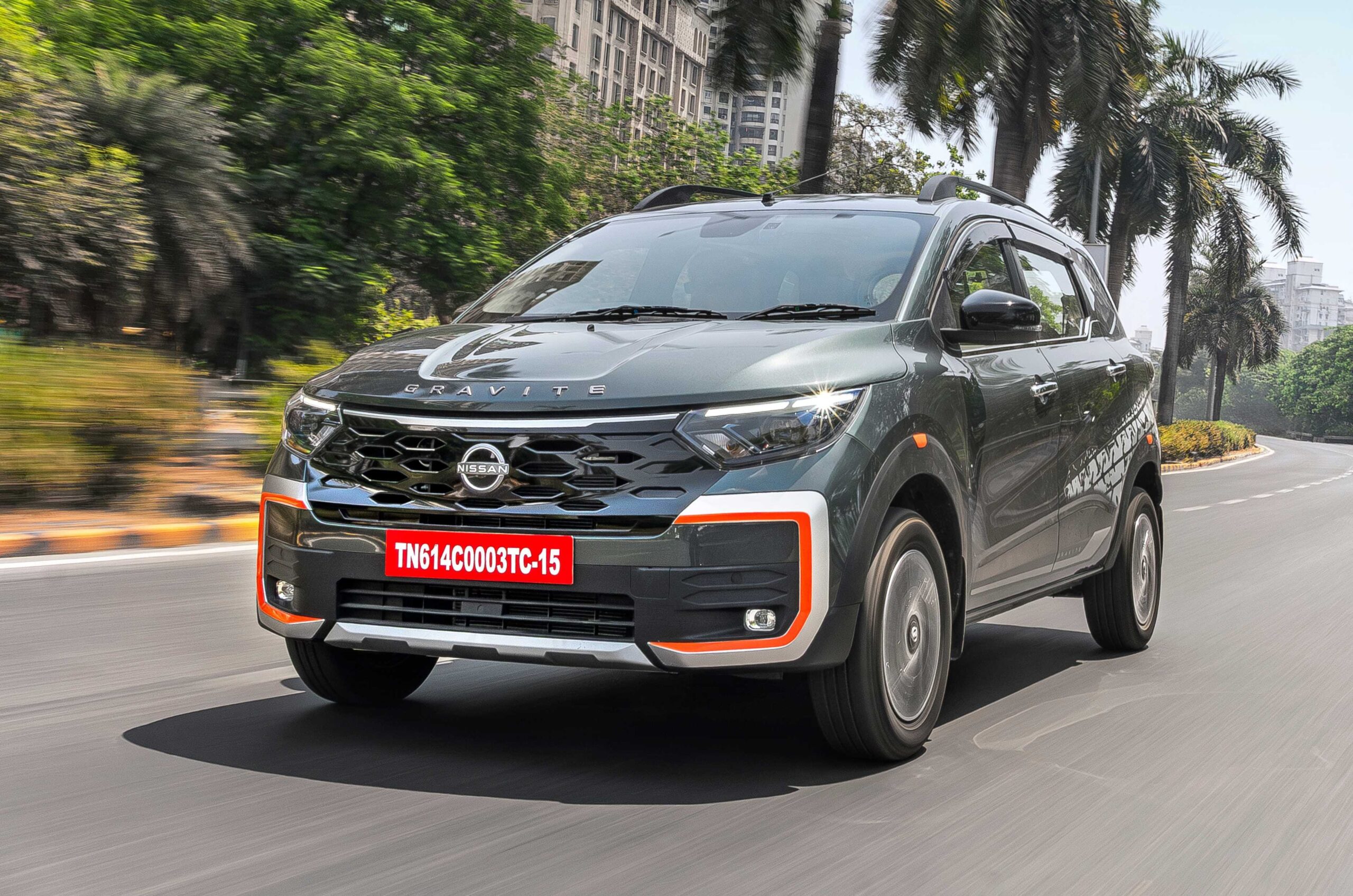
Nissan has launched the Gravite, a new compact MPV positioned to attract budget-conscious buyers with its aggressive starting price of Rs 5.65 lakh (ex-showroom). Offering seating for up to seven occupants within a sub-4-metre footprint, the Gravite aims to redefine practicality and value in its segment. This review explores its design, interior, features, performance, and overall appeal.
Design and Engineering: A Familiar Foundation
Badge-Engineered from Renault Triber on CMF-A+ Platform
The Nissan Gravite is a product of the ongoing Renault-Nissan joint venture. Unlike models such as the Magnite and Kiger, which boast distinct sheet metal and interior designs, the Gravite is essentially a badge-engineered version of the Renault Triber. Consequently, the alterations are concentrated on ‘soft parts’ like bumpers, alloy wheels, and interior upholstery. The Gravite shares the CMF-A+ platform with the Triber, resulting in near-identical dimensions.
The Launch Edition variant features distinctive orange detailing and side decals, enhancing its visual appeal.
Distinctive Exterior Touches
At the front, the Gravite is characterized by a prominent gloss-black grille housing the 2D Nissan logo. The sculpted bonnet carries ‘Gravite’ lettering, and the LED headlamps feature a unique DRL signature. The front bumper differentiates itself from the Triber with larger, C-shaped elements at its outer edges. The Launch Edition further accentuates this with orange accents on both front and rear bumpers, along with side decals.
The 15-inch dual-tone wheels are designed to mimic the appearance of alloy wheels, a clever touch that enhances perceived value.
Side and Rear Profile Updates
Along the sides, the most apparent change from the Triber is the redesigned 15-inch wheels, with Nissan effectively disguising wheel covers to resemble alloys. Functional roof rails with a 50kg load capacity are also present. The rear design also incorporates a distinct bumper with C-shaped elements, Gravite badging on the tailgate, and updated LED elements within the beak-shaped tail-lamps.
Interior Space and Comfort: Versatility Takes Centre Stage
Practical Cabin Seats Up to Seven, Third Row Removable for Enhanced Boot Space
The interior of the Gravite echoes the Triber’s layout, featuring a dual-tone black-and-beige dashboard theme and ivory-and-blue suede and leatherette upholstery. The dashboard design, drawing from an earlier Triber iteration, places AC vents at the top and the touchscreen lower down. The seats, while flat, offer good support and cushioning, complemented by a driver’s armrest for added comfort. The light upholstery, however, may prove challenging to maintain.
The second-row bench slides and reclines, offering ample space for three adults thanks to a nearly flat floor. It also includes adjustable headrests for the outer seats, dedicated AC vents with a blower control, and a 12V socket.
Surprising Third-Row Usability and Storage Solutions
Access to the third row is facilitated by the tumble-folding action of the second row. Remarkably, the third row offers sufficient space for adults on shorter journeys, provided a compromise is found in legroom in the first two rows. The third row is equipped with adjustable headrests, dedicated AC vents, and a 12V socket, although the proximity to the tailgate might be a minor concern for some.
Practicality is further enhanced by numerous storage solutions, including dual gloveboxes (the lower one is cooled), a cooled box between the front seats, a smartphone tray in the centre console, and well-sized door bins. The Gravite boasts impressive cargo flexibility; while boot space with all rows up is limited to a few backpacks, removing the third row entirely liberates a substantial 625 litres of space. The second row can also be split-folded in a 60:40 ratio for additional cargo capacity.
However, the driver’s footwell feels cramped, lacks a dead pedal, and signs of cost-cutting are evident in the simple woven roofliner and basic interior light. The hard and scratchy plastics, while noticeable, are deemed acceptable given the Gravite’s competitive pricing.
Features and Safety: Well-Equipped for the Price
Infotainment, Convenience, and Safety Suite
The top-tier Tekna+ variant is equipped with an 8-inch touchscreen featuring wireless Android Auto and Apple CarPlay. It also includes a 7-inch digital driver’s display, wireless phone charger, push-button start/stop, cruise control (manual transmission only), auto LED headlamps, auto wipers, front and rear parking sensors, a rear camera, and a cooled glovebox. Safety features comprise 6 airbags, traction control, hill-start assist, a rear camera, and a tyre pressure monitoring system.

The reviewed Launch Edition adds a JBL audio system (though its performance is described as ordinary), front and rear dash cameras, configurable ambient lighting, and an air purifier, making the Nissan Gravite a well-featured vehicle for its price point.
Performance and Refinement: City-Focused Powertrain
1.0-Litre Naturally Aspirated Engine Struggles on Highways and Under Load
The Gravite is powered by the same 1.0-litre, three-cylinder naturally aspirated petrol engine found in the Renault Triber, Kiger, and Nissan Magnite. This engine produces 72hp and 96Nm of torque and is available with a 5-speed manual or a 5-speed AMT automatic transmission. Performance is best described as adequate for city driving, with a 0-100kph time of 16.55 seconds. Mid-range acceleration figures, such as 20-80kph in 3rd gear (12.98 seconds) and 40-100kph in 4th gear (16.79 seconds), highlight its leisurely pace.
The lack of power becomes apparent on highways and when the vehicle is fully occupied. Overtaking manoeuvres require significant planning and downshifting. To achieve brisk acceleration, the engine needs to be revved hard, which in turn exposes its refinement shortcomings, with the engine noise becoming quite intrusive inside the cabin.
Manual Transmission Quirks and Braking Performance
The manual transmission features a relatively heavy clutch with a high bite point, requiring an adjustment period. Gearshifts also demand more effort than expected. The braking system provides decent stopping power, bringing the Gravite to a halt from 80kph in 28.13 metres.
Nissan plans to introduce a factory-fitted CNG option for the Gravite soon. The company, along with Renault, decided against using the more powerful 100hp, 1.0-litre turbo-petrol engine from the Kiger/Magnite to maintain cost-effectiveness and avoid positioning the MPV too close to larger vehicles like the Maruti Ertiga.
Ride Comfort and Handling: Composed but Lacks Steering Feel
Predictable Handling and Composed Ride Quality
The Gravite’s steering is light, which is beneficial for low-speed city driving and parking. However, at higher speeds, it lacks feedback and feels disconnected. While there is noticeable body roll around corners, the handling remains predictable and inspires confidence.
The ride quality exhibits a subtle firmness, which translates into a more pliant and composed feel when the vehicle is fully loaded. High-speed stability is a notable strong point, especially considering the Gravite’s sub-one-tonne weight. While sharp bumps and larger potholes can be felt, they do not result in discomfort. Overall, the Gravite offers a mature ride that belies its compact size and weight.
Mileage: Claimed Figures Provided
Promised Efficiency for Manual and AMT Variants
Official figures indicate that the manual transmission variant of the Gravite is expected to deliver 19.3kpl, while the AMT automatic version is rated at 19.6kpl. Real-world fuel efficiency is anticipated to be lower than these claimed figures.
Price and Verdict: A Strong Contender for Value Seekers
Excellent Packaging and Practicality at an Attractive Price Point
The Nissan Gravite is priced between Rs 5.65 lakh and Rs 8.93 lakh (introductory, ex-showroom). The higher end of this range corresponds to the limited-run Launch Edition. For comparison, the Renault Triber starts at Rs 5.76 lakh, with its top variant priced at Rs 8.39 lakh. Nissan offers a standard warranty of 3 years or 1,00,000km, extendable up to 10 years or 2,00,000km.
In essence, the Nissan Gravite serves as a compelling alternative to the Renault Triber, sharing its strengths and weaknesses. The choice between them largely depends on personal preference for design and interior aesthetics. The Gravite, much like the Triber, has successfully carved a niche by offering a legitimate 7-seat MPV experience within a sub-4-metre length and at a price point competitive with hatchbacks. Despite drawbacks such as an underpowered engine and visible cost-saving measures, the Gravite excels in its practical and versatile cabin, excellent packaging, composed ride, and usable third row. For buyers seeking a budget-friendly, comfortable, and well-equipped people mover, the Nissan Gravite presents a strong case for consideration.