
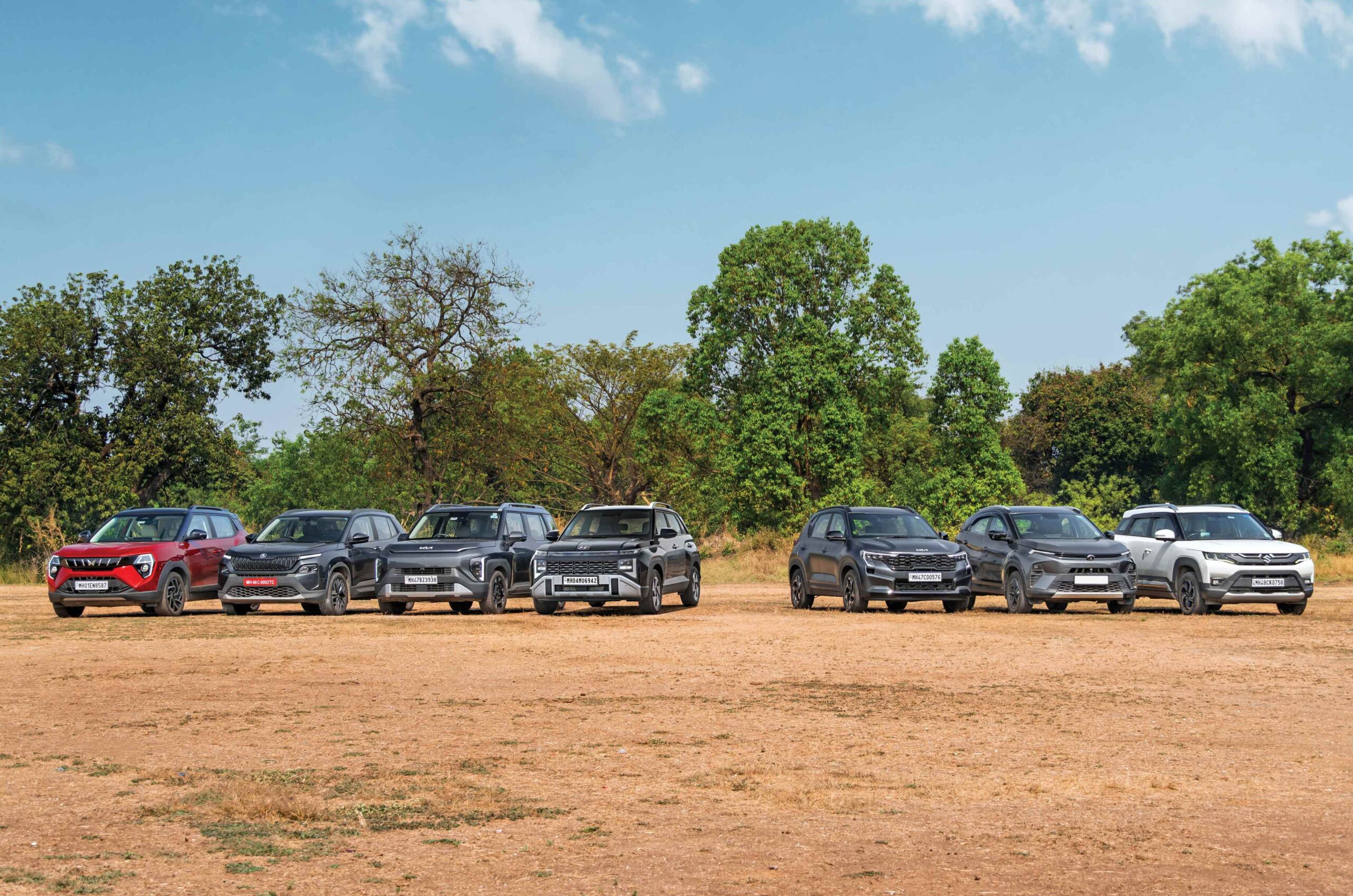
The sub-four-meter compact SUV segment in India is a fiercely contested arena, boasting more than seven contenders vying for buyer attention. These vehicles are designed to appeal to owner-drivers, demanding a blend of practicality, user-friendliness, and a rich feature set, all while exuding aspirational qualities. Hyundai has now entered this crowded space with the second-generation Venue, built on a new platform and engineered to enhance the strengths of its predecessor. This comprehensive comparison pits the new Venue against key rivals including the Maruti Suzuki Brezza, Tata Nexon, Kia Sonet, Skoda Kushaq, Mahindra XUV 3XO, and the related Kia Seltos to determine its standing.
Compact SUV Comparison: Dimensions and Pricing
Dimensionally, the SUVs in this comparison exhibit only marginal differences. The Maruti Brezza stands tallest among the group, while the Mahindra XUV 3XO is the widest and possesses the longest wheelbase. In terms of ground clearance, the Tata Nexon leads with 208mm, closely followed by the Kia Sonet at 205mm.

When it comes to pricing for automatic turbo-petrol variants, the Tata Nexon emerges as the most affordable. Its 6-speed AMT versions range from Rs 8.78 lakh to Rs 10.98 lakh. For this comparison, the more premium 7-speed dual-clutch automatic (DCT) variants are considered, priced between Rs 11.16 lakh and Rs 13.53 lakh.
The Skoda Kushaq offers an attractive entry point for its automatic variants, starting at Rs 9.25 lakh and topping out at Rs 12.99 lakh, making it one of the more affordable options in this comparison.
Mahindra has also managed to keep the starting price of the XUV 3XO automatic variants under Rs 10 lakh, at Rs 9.71 lakh. However, this price point is for the less powerful 1.2-litre turbo-petrol engine paired with a 6-speed torque converter. The more potent 1.2-litre GDI turbo AT, which was part of the testing, is priced between Rs 12.84 lakh and Rs 14.55 lakh, placing it among the pricier contenders.
Due to its larger 1.5-litre petrol engine, which incurs a higher tax bracket, the Maruti Brezza’s automatic variants are priced between Rs 10.60 lakh and Rs 12.85 lakh.
The Hyundai Venue, the latest entrant, is available in both standard and N Line variants. Both share the same 1.0-litre turbo-petrol engine and 7-speed dual-clutch automatic transmission. For this evaluation, the standard Venue version was considered, with prices ranging from Rs 10.82 lakh to Rs 14.56 lakh.
The Kia siblings, Sonet and Seltos, command the highest starting prices. The Sonet turbo-DCT begins at Rs 9.89 lakh and extends up to Rs 13.65 lakh. The Seltos starts at Rs 11.93 lakh and reaches Rs 15.29 lakh, making it the most expensive SUV in this lineup and Rs 73,000 pricier than the top-spec Venue.

Compact SUV Comparison: Interior Experience
The interior ambiance of the new Hyundai Venue represents a significant upgrade over its predecessor. The quality, fit, and finish have noticeably improved. Its new twin-screen setup offers a modern aesthetic, and enhanced packaging, along with a 20mm longer wheelbase, contributes to a more spacious cabin, particularly for rear passengers. Six-footers can comfortably sit one behind another.
The Kia Seltos and Sonet, however, hold a distinct advantage in terms of cabin quality and overall premium feel. The tactility of switches, buttons, and controls, along with the air vents and overall cabin finesse, makes the Seltos and Sonet hard to match. The Seltos, benefiting from a newer Electrical/Electronic (E/E) architecture shared with the Venue, has a considerable edge. Its boxy dimensions contribute to a spacious interior, offering a sense of room comparable to cars from a segment above. The largest-in-class panoramic sunroof further enhances this feeling. Its flexible rear seat, which can slide and recline, positions it as a leader in space and comfort. It offers the most shoulder room, and the rear bench can comfortably seat three abreast, although the middle seat lacks an adjustable headrest.
Mahindra has enhanced the XUV 3XO’s cabin with light upholstery and soft-touch materials, contributing to its premium appeal. However, the dashboard design reflects the age of the underlying platform. The front seats could be more accommodating for broader frames, but the rear seat is among the most comfortable, particularly for seating three adults across. Despite its premium feel, the cabin design looks somewhat dated.
Skoda’s Kushaq delivers a familiar sense of European solidity, right down to the reassuring thud of its doors. It incorporates elements from its larger siblings, the Kamiq and Scala, including the steering wheel, instrument cluster, touchscreen, and climate control console with touch sliders. Its front seats are among the best and most supportive in this segment. While the heavily sculpted rear seats are very comfortable for two occupants, the rear-seat space is the most limited among the tested vehicles.

Tata has consistently worked to keep the Nexon competitive, incorporating elements from its newer, more premium models. While this elevates its appeal, limitations in storage, average seat support, and some ergonomic shortcomings are noticeable in this comparison. The sloping roofline and dark interior further reduce the sense of interior space. Although width is adequate, the sculpted rear backrest makes it more comfortable for two occupants than three.
The Maruti Brezza adopts a more functional, no-fuss approach. While it may not dazzle with cutting-edge technology, its excellent ergonomics, large and comfortable seats, and generous rear space make it one of the most user-friendly cabins. It can accommodate three occupants comfortably across the rear bench, though it lacks a centre head restraint.
Compact SUV Comparison: Boot Space Analysis
On paper, the Kia Seltos offers the largest boot capacity, partly due to its sliding rear seats. Measurement-wise, it boasts the deepest boot. The Hyundai Venue’s boot is the widest, and the Skoda Kushaq offers the most height up to the parcel shelf. The Kushaq also features the lowest loading lip, simplifying the process of loading heavy luggage.
In a practical luggage test, the Seltos, Sonet, Venue, and Kushaq performed well, accommodating one medium suitcase, four cabin bags, a backpack, and a laptop bag. The remaining SUVs managed to fit a medium suitcase, two cabin bags, and a backpack.
Compact SUV Comparison: Feature Highlights
At the top-spec level, the feature lists across these SUVs are broadly similar, but specific inclusions differentiate them. The Kia Seltos emerges as the most comprehensively equipped, featuring rear-seat ventilation and adjustable rear seating. While the XUV 3XO and Nexon also offer panoramic sunroofs, the Seltos’ is the largest.
The Maruti Brezza and XUV 3XO miss out on ventilated seats. The Skoda Kushaq lacks a 360-degree camera and has a sub-par reversing camera display. While most other SUVs offer wireless connectivity for Apple CarPlay and Android Auto, the Kia Sonet still relies on wired connections. Paddle shifters are absent on the XUV 3XO, and Advanced Driver-Assistance Systems (ADAS) are missing on the Kushaq and Brezza.
Compact SUV Comparison: Performance Metrics
The Hyundai Venue, Kia Sonet, and Kia Seltos share a 1.0-litre, 3-cylinder turbo-petrol engine producing 120hp and 172Nm, mated to a 7-speed dual-clutch automatic transmission. This powertrain is smooth and refined, performing commendably on the open road. In heavy traffic, the gearbox can occasionally feel hesitant, particularly during downshifts. All three vehicles are equipped with paddle shifters for manual gear control and offer drive modes (Eco, Normal, and Sport) to adjust performance characteristics.
In acceleration tests, the Venue and Sonet performed similarly, ranking fourth and third respectively among the tested vehicles. The Seltos, being approximately 90kg heavier than the Sonet, exhibits noticeably blunted outright acceleration. It accelerates from 0 to 100kph in 13.62 seconds, which is 2.1 seconds slower than the Sonet, placing it sixth out of seven.
The Mahindra XUV 3XO is the quickest in this comparison, powered by a 1.2-litre turbo-petrol engine producing 131hp and 230Nm, paired with a 6-speed torque converter. Characteristic of Mahindra SUVs, throttle responses are sharp. While this engine may not feel as eager to rev as some others, its strong mid-range performance provides an enjoyable and effortless driving experience. The refinement of this 3-cylinder unit is also noteworthy. The automatic transmission operates smoothly, although downshifts are conservative, leading to a desire for paddle shifters. It does, however, feature a Tiptronic mode. The XUV 3XO completes the 0-100kph sprint in just 11.10 seconds.
The Skoda Kushaq, with its 1.0-litre turbo-petrol engine delivering 115hp and 178Nm, paired with a 6-speed torque converter, is only 0.2 seconds slower than the Mahindra. Its TSI engine punches above its weight, feeling significantly stronger than its specifications suggest. Its strong mid-range and paddle shifters contribute to an engaging driving experience. However, compared to the Mahindra, this powertrain feels less responsive, especially at lower speeds. The Kushaq’s engine is also noticeably noisier.
Tata’s 1.2-litre turbo-petrol engine, producing 120hp and 170Nm, paired with a 7-speed dual-clutch automatic, accounts for less than 4 percent of total Nexon sales. This is noteworthy, as this configuration is the smoothest and most refined version of the Nexon. The gearbox complements the engine’s character well, mitigating inconsistencies in power delivery. While not overtly sporty, it can hesitate before downshifting to avoid abrupt performance surges. Even with manual intervention via the paddles, it avoids aggressive downshifts. Refinement is not the Nexon’s strongest suit, with vibrations noticeable at idle and low speeds.
The Maruti Brezza stands apart with its 1.5-litre, four-cylinder naturally aspirated petrol engine. While it produces the lowest output—103hp and 137Nm—it performs admirably in terms of drivability. This engine is responsive in urban conditions, and the 6-speed torque converter ensures a seamless driving experience. However, demanding more performance reveals its limitations. Mid-range performance is notably flat compared to its turbocharged rivals. While the engine is rev-happy, it becomes quite vocal at higher RPMs, detracting from its otherwise refined nature. Its outright acceleration is the slowest in this group.
Compact SUV Comparison: Ride and Handling Dynamics
Mahindra has achieved an excellent balance in the XUV 3XO’s ride and handling, delivering mature driving dynamics. A characteristic of Mahindra SUVs, the XUV 3XO feels robust and capable of handling rough terrain. Its stable stance and good mechanical grip contribute to confident handling, although the steering feel, which is somewhat inert, slightly diminishes the sporty character.
The Skoda Kushaq is arguably the better-equipped car for driving enthusiasts in this segment. Its chassis feels taut, the suspension is well-balanced, and its steering offers reasonable weighting, instilling confidence when pushing hard around corners.
Both the Maruti Brezza and Tata Nexon exude an inherent toughness, evident when navigating poor and broken roads. The Brezza impresses with its low-speed ride comfort and bump absorption. In contrast, the Nexon feels firmer and slightly more jittery. At higher speeds, the Nexon demonstrates superior stability, though its steering can feel overly sharp, particularly for highway driving.
Despite being built on different platforms, the Hyundai Venue and Kia Sonet exhibit very similar driving characteristics. They possess an underlying firmness at low speeds and offer a composed ride at higher speeds. The Kia Seltos’ suspension setup feels slightly softer than the Venue’s, tuned more for comfort than sportiness. However, the suspension on these three Korean models does not feel as well-cushioned as the other four rivals. In terms of handling, they are predictable, with the Seltos displaying a bit more body roll around corners due to its taller stature and softer setup.
Compact SUV Comparison: Verdict
The Maruti Brezza, being one of the older models, shows its age. While it remains highly user-friendly, offering excellent ride quality, a spacious cabin, and predictable power delivery, its naturally aspirated engine struggles to match the performance and effortless cruising ability of its turbocharged competitors. Nevertheless, the Brezza remains a highly practical option, bolstered by Maruti’s extensive service network, making it a reliable choice. With a facelift expected soon, its appeal is likely to increase.
The Tata Nexon also performs well, offering the widest range of powertrain options, including turbo-petrol, CNG, diesel, and electric. The turbo-DCT combination is the most pleasing within the ICE range. While the Nexon has evolved significantly, incorporating modern features like large screens, seat ventilation, and a panoramic sunroof, its design and cabin architecture now feel somewhat dated compared to newer rivals.
The Kia Sonet, despite its tenure, continues to feel like one of the most polished and sophisticated offerings. Its interior quality, extensive feature list, boot space, and powertrain performance are strong suits, exuding a sense of finesse. The primary drawback is its relatively tight rear seat, which might be a deterrent for family-oriented buyers.
The Mahindra XUV 3XO is positioned at the pricier end. However, characteristic of Mahindra, it feels robust and well-built, with an impressive ride and handling balance. The cabin is among the most spacious, and its outright performance is the strongest. While it features a panoramic sunroof, it misses out on ventilated seats and paddle shifters. Its dual-screen setup, though functional, does not appear as contemporary as those in some rivals.
For those seeking ‘big-car’ space within a sub-four-meter footprint, the Kia Seltos is an impressive package. Its strengths lie in space and practicality. Features like sliding and reclining rear seats with ventilation, along with the largest panoramic sunroof in the group, make it the best-equipped car here. While its performance is not class-leading, its steep price tag—the highest in this comparison—and a design that may not appeal to everyone could be potential deterrents.
The Skoda Kushaq’s excellent driving dynamics will appeal to keen drivers. Its composed handling, strong engine-gearbox pairing, and well-judged ride make for an enjoyable experience. The front seats are among the best, and while the rear seat is comfortable for two, seating three would be a squeeze. Its top-spec variant is also the most affordable, though it omits ADAS and certain other features.
The new Hyundai Venue marks a significant improvement over the outgoing model, albeit with a price increase, placing it among the costlier vehicles. However, it now boasts the latest technology and features, addressing a key shortcoming of its predecessor: cabin space. Rear-seat room is now competitive, boot space is generous, performance is adequate, and it drives well. While the Venue doesn’t dominate in any single area, it performs all tasks exceptionally well. Its well-rounded nature makes it a true jack of all trades and the winner of this comparison.
Hyundai Venue: A well-rounded modern offering that performs superbly. Rating: 8/10.
Skoda Kushaq: Solidly built and easily the most fun to drive. Rating: 8/10.
Kia Seltos: Big on space and features, but the priciest. Rating: 8/10.
Mahindra XUV 3XO: Excellent ride-handling balance and has the strongest engine. Rating: 8/10.
Kia Sonet: High-quality interiors make it feel the most sophisticated. Rating: 8/10.
Tata Nexon: Despite its age, its cabin and features keep it competitive. Rating: 7/10.
Maruti Brezza: Low on frills, but high on user-friendliness and practicality. Rating: 7/10.
Dimensions (L/W/H in mm): Venue: 3995/1800/1665; Kushaq: 3885/1783/1619; Seltos: 3995/1805/1680; XUV 3XO: 3990/1821/1647; Sonet: 3995/1790/1642; Nexon: 3995/1804/1602; Brezza: 3995/1790/1685.
Wheelbase (mm): Venue: 2520; Kushaq: 2566; Seltos: 2550; XUV 3XO: 2600; Sonet: 2500; Nexon: 2498; Brezza: 2500.
Boot Capacity (litres): Venue: 375; Kushaq: 360; Seltos: 390; XUV 3XO: 295; Sonet: 385; Nexon: 382; Brezza: 328.
Engine: Venue, Seltos, Sonet: 3-cyls, 997cc, turbo-petrol; Kushaq: 3-cyls, 999cc, turbo-petrol; XUV 3XO: 3-cyls, 1197cc, turbo-petrol; Nexon: 3-cyls, 1199cc, turbo-petrol; Brezza: 4-cyls, 1462cc, petrol.
Power: Venue, Seltos, Sonet: 120hp at 6000rpm; Kushaq: 115hp at 5000-5500rpm; XUV 3XO: 131hp at 5000rpm; Nexon: 120hp at 5500rpm; Brezza: 103hp at 6000rpm.
Torque: Venue, Seltos, Sonet: 172Nm at 1500-4000rpm; Kushaq: 178Nm at 1750-4000rpm; XUV 3XO: 230Nm at 1500-3750rpm; Nexon: 170Nm at 1750-4000rpm; Brezza: 137Nm at 4400rpm.
Transmission: Venue, Seltos, Sonet: 7 DCT; Kushaq: 6 AT; XUV 3XO: 6 AT; Nexon: 7 DCT; Brezza: 6 AT.
Ground Clearance (mm): Venue: 190; Kushaq: 189; Seltos: 189; XUV 3XO: 201; Sonet: 205; Nexon: 208; Brezza: 198.
Price (ex-showroom, India): Venue: Rs 14.56 lakh; Kushaq: Rs 12.99 lakh; Seltos: Rs 15.29 lakh; XUV 3XO: Rs 14.55 lakh; Sonet: Rs 13.65 lakh; Nexon: Rs 13.53 lakh; Brezza: Rs 12.85 lakh.