
The Kia EV9 has garnered significant attention, praised for its role as a much-needed three-row electric crossover in the American market. Its appeal is further amplified by competitive lease deals that can make it more accessible than its gasoline-powered counterpart, the Kia Telluride. The EV9’s accolades include ‘World Car/EV of the Year’, ‘North American Utility Vehicle of the Year’, and a ‘Car and Driver’ 10Best commendation. Beyond its utility and value, the EV9 has also been recognized for its design, earning Red Dot’s “Best of the Best” award.
Notably, the vehicle’s technology, often a point of contention in previous Kia models, has also received critical acclaim. Kia’s updated infotainment software, known as ‘Ki’, which is based on Hyundai’s new Connected Car Navigation Cockpit (ccNC), has been honored with prestigious Red Dot and iF Design awards, signalling a significant advancement in the brand’s in-car technology offerings.
Kia EV9 Infotainment Graphics and Interface Deep Dive
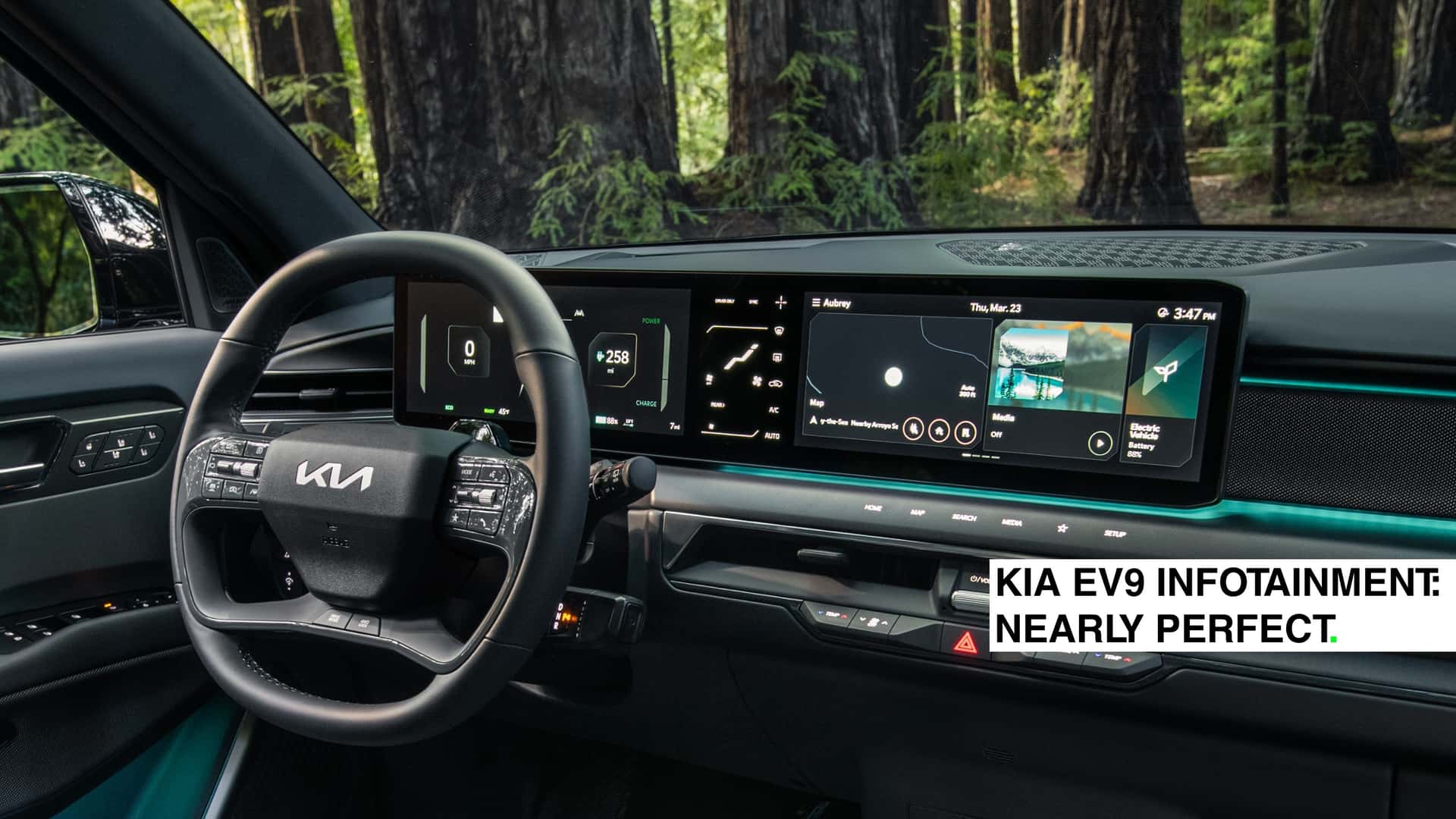
The Kia EV9 features a visually striking panoramic display that integrates two 12.3-inch screens: one serving as the digital instrument cluster directly behind the steering wheel and the other as the central infotainment touchscreen. Positioned between these screens, in what is often considered otherwise unused space, are the digital climate controls. Both screens adopt a landscape orientation, a design choice that keeps the driver’s eyes closer to the road and facilitates the simultaneous display of multiple functions, such as navigation and audio settings, or various camera feeds during reversing maneuvers.
Kia’s previous infotainment operating system was criticized for its dual rows of similarly colored pictograms, making it difficult for users to quickly scan and locate desired functions. The new ‘Ki’ software addresses this issue by presenting a single row of larger icons, with six icons fitting across the screen’s width. This layout is complemented by larger text labels, improving overall readability and ease of use.
While extensive use of swiping is sometimes discouraged in vehicle infotainment systems, the EV9’s design makes it intuitive and safe to do so while driving. The ability to skim through six options efficiently means less time is spent with eyes diverted from the road. The main screen, which prominently displays audio, navigation, and EV status buttons, ensures that Kia EV9 owners will rarely need to navigate to secondary screens for common tasks.
Voice Control and Software Updates
Voice commands in the Kia EV9 are activated via a dedicated button on the steering wheel. This approach is preferred by many drivers over ‘wake word’ activated systems, which can often trigger accidentally due to conversational speech. The system’s ability to display spoken commands as text on the screen provides a crucial confirmation that the user’s input is being accurately registered.
Kia has indicated its commitment to ongoing improvement through over-the-air (OTA) software updates. These updates are designed to download while the vehicle is in motion and install once the car is stopped and turned off. Although no OTA updates were experienced during the review period, Kia has already utilized this feature to update the wireless phone charger and LED headlights for reduced energy consumption, suggesting a promising future for meaningful software enhancements.
Assessment of Kia EV9’s Physical Controls
The physical interfaces within the Kia EV9 did not meet expectations during the review. To achieve its competitive pricing, compromises were evidently made in material quality, with the touchpoints, often featuring flat or glossy plastic, feeling like the least premium components of the vehicle, even in the top-tier GT-Line AWD model.
Certain design choices regarding physical controls also impacted usability. The placement of climate controls between the two main screens, while freeing up center console space, positions them partially obscured by the steering wheel from the driver’s typical line of sight. Furthermore, this area presents a cluster of graphics that can appear similar, making quick identification challenging. Kia mitigates this by offering accessible toggle controls for temperature and fan speed located below the primary infotainment screen.
Similar to the Nissan Ariya, the EV9 incorporates buttons along the top edge of the dashboard beneath the main screen. However, these buttons lack haptic feedback, requiring a noticeable press into the dashboard to activate. This actuation method felt unnatural, even after a week of use, and led to several inadvertent presses, as this area is a common resting place for the palm when interacting with the touchscreen.
EV-Specific Functionality and User Experience
The EV9’s infotainment system excels in its handling of electric vehicle-specific functions. The ‘Ki’ interface was clearly designed with the EV transition in mind, making EV data readily accessible via the third button on the main screen. A single tap provides a concise overview of range, charge status, and nearby charging stations. An additional swipe reveals a more detailed menu covering energy consumption and battery temperature.
A significant advantage is the manual battery preconditioning option, allowing drivers to optimize battery temperature for charging regardless of whether the in-car navigation is set to a DC fast charger. This offers greater flexibility compared to systems that only initiate preconditioning when a DC fast charger is programmed into the route.
While charging, the instrument cluster displays a persistent readout of current range, battery level, charging speed, and the estimated time remaining for a full charge or until a pre-set charge level is reached. Charging information can also be accessed through the EV menu on the infotainment screen when the vehicle is powered on.
Onboard Navigation and Route Planning for EVs
The EV9’s onboard navigation system offers multi-stop route planning specifically tailored for electric vehicles. While an improvement over previous Hyundai group software, it still falls short of the seamless experience provided by Tesla’s Supercharger route navigation.
During testing, a long-distance trip from north of Detroit to Hyannis, MA, which necessitates routing through Canada, was used to evaluate the system. Kia’s navigation proposed a multi-stop route estimated to take 17 hours and 40 minutes. However, the initial plan involved extended charging stops to reach 100% capacity, including a lengthy stop at a slower charger in Ontario. The route also calculated ending the journey with only 2% battery charge upon arrival in Nantucket. For such complex, extended journeys, relying on third-party route-planning applications might prove more efficient for most EV9 owners.
Smartphone Integration: Seamless Connectivity
Smartphone integration in the Kia EV9 performs admirably, offering wireless Apple CarPlay and Android Auto. The convenience of USB-C ports for wired connections eliminates the need for older USB-A adapters. The vehicle provides an ample number of ports throughout the cabin, capable of charging multiple devices simultaneously.
Apple CarPlay functioned exceptionally well in the EV9. The landscape screen orientation translates to larger, more legible graphics. Latency, particularly when using Google Maps, appeared reduced compared to previous Kia systems. The EV9’s default home screen proved to be the preferred interface during driving, with Apple CarPlay primarily used for changing audio sources.
Verdict: A Top-Tier Infotainment System with Room for Physical Improvement
The Kia EV9’s infotainment system stands out as one of the most impressive encountered. Its visual presentation is excellent, and operation is consistently fast, smooth, and intuitive. The thoughtful upgrades specifically cater to the needs of EV owners, creating a highly purposeful user experience. The system is so user-friendly that consulting the manual or giving it much thought during operation is unnecessary.
The primary area for improvement lies in the physical layout and execution of the controls. While the software’s operation is seamless, the tactile interaction with the vehicle’s technology is less so. Kia has an opportunity to elevate the EV9’s user interface to market-leading status with refinements to its physical controls in future updates or model refreshes.