
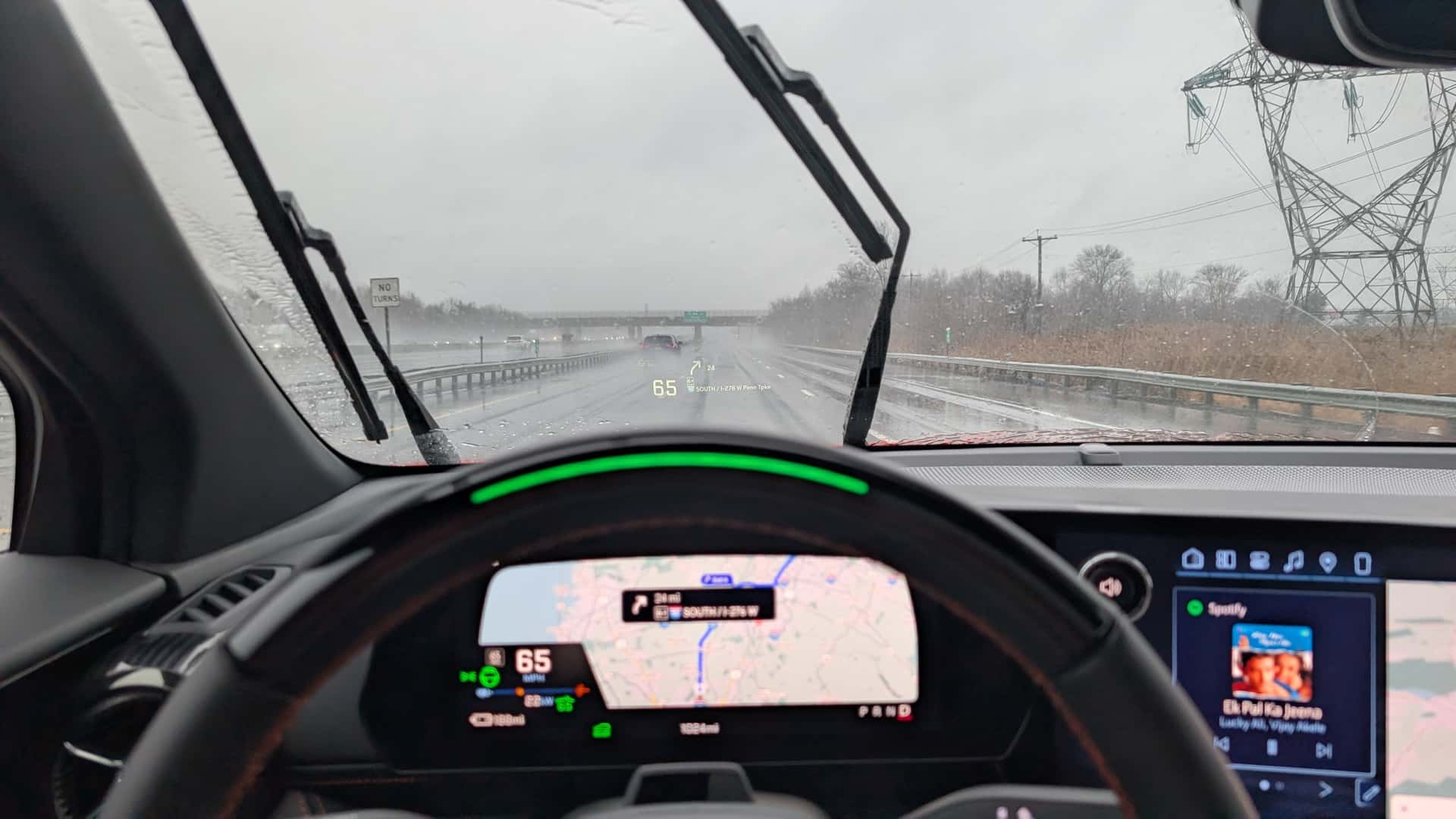
General Motors’ Super Cruise, a leading advanced driver-assistance system (ADAS), has been tested under challenging conditions, demonstrating significant progress in autonomous driving technology. The hands-free system, designed for accelerating, braking, and steering on mapped roads, currently boasts over 625,000 active users across the U.S. and Canada, covering more than 750,000 miles of designated routes.
Super Cruise: A Stepping Stone to Higher Autonomy
This widespread deployment is a crucial step for GM as it aims to develop Level 3 autonomy, a future where drivers may be able to remove their eyes from the road. The company plans to introduce this advanced functionality in the Cadillac Escalade IQ by 2028, incorporating lidar technology. However, current Super Cruise remains a Level 2 ADAS, mandating continuous driver supervision.
The Super Cruise system is offered as standard on select premium models like the Blazer EV SS and Cadillac Lyriq. It is also available as an optional upgrade on various other GM electric vehicles, including the Silverado EV, Equinox EV, and Sierra EV, as well as several gasoline-powered cars. After an initial trial period, typically three years, users are required to subscribe, with costs around $40 per month or $400 annually.
Testing Super Cruise Under Adverse Weather Conditions
To assess the system’s capabilities beyond ideal conditions, a real-world test was conducted. The evaluation focused on Super Cruise’s performance during heavy rainfall, a scenario that often challenges driver assistance technologies. The test vehicle was a 615-horsepower Chevrolet Blazer EV SS, undertaking a roughly 200-mile round trip from New York City to Philadelphia.
The drive, initially anticipated to be scenic, quickly transformed into an unexpected stress test due to unforecasted heavy downpours. This situation provided a critical opportunity to evaluate how Super Cruise handles precipitation and reduced visibility.
Hardware and Software: The Super Cruise Approach
Unlike Tesla’s Autopilot and Full Self-Driving systems, which heavily rely on cameras and artificial intelligence, Super Cruise utilizes a more conventional hardware and sensor suite. This includes high-definition maps, cameras, radar, and GPS to interpret the vehicle’s environment and execute driving maneuvers.
GM’s official guidance advises against using Super Cruise in adverse conditions such as heavy rain, poor road conditions, unclear lane markings, or slippery environments. Drivers are strongly encouraged to heed these recommendations. Despite these warnings, the system’s performance during the test was unexpectedly capable.
Performance on the Road in the Rain
The test routes, including the New Jersey Turnpike and Delaware Expressway, featured clear lane markings, which are optimal for ADAS functionality, provided visibility remains adequate. With moderate traffic, the driver decided to engage Super Cruise.
Engaging Super Cruise is a straightforward process. A button on the steering wheel activates the system if the vehicle is on an eligible, mapped road with clear lane markings. A green light bar on the steering wheel and accompanying dashboard graphics indicate activation, allowing the driver to remove their hands from the wheel while maintaining road awareness.
The system performed surprisingly well in moderate to heavy rain, provided the lane markings were visible to the driver. When lane markings became obscured, Super Cruise disengaged promptly. This behavior is attributed to the front ADAS camera’s position, high and centered behind the windshield, offering protection from wipers and good visibility.
As long as the camera could detect lane lines, Super Cruise maintained the Blazer EV’s position within the lane, adhered to the set speed, and smoothly adjusted speed in response to traffic. The system also demonstrated stability against heavy crosswinds, keeping the vehicle centered.
Automatic Lane Changes and Limitations
Super Cruise also managed automatic lane changes, using blind-spot monitoring and the rear ADAS camera to assess surrounding traffic. Drivers can override a lane change by slightly moving the steering wheel or activating the turn signal.
However, the experience was not without its challenges. When vehicles ahead generated significant water spray, Super Cruise deactivated. While increasing the following distance provided some mitigation, it highlighted the system’s substantial reliance on visible lane markings.
Even when human drivers could navigate using other cues like taillights, vehicle silhouettes, and general environmental awareness, Super Cruise would disengage the moment lane lines were undetectable. This underscores the current limitations of ADAS systems in truly replicating human judgment in complex conditions.
Comparison with Other Advanced Driver-Assistance Systems
This reliance on lane markings differentiates Super Cruise from systems like Tesla’s Full Self-Driving (FSD). FSD operates beyond highways, in urban environments, and handles more complex traffic situations using point-to-point navigation integrated with vehicle maps. FSD is designed to manage greater uncertainty, which can be both advantageous and problematic.
Tesla’s FSD can function even when lane markings are faded, utilizing curbs, shoulders, and barriers as navigational cues. This technology is also being employed in Tesla’s robotaxi service, which is gradually rolling out in the U.S. with safety monitors present.
Honesty in Limitations: The Strength of Super Cruise
Super Cruise appears to be some distance from such capabilities. It remains a highway-only system, and its requirement for clear lane markings means drivers must be prepared to take over when prompted, especially when lines disappear. Despite this, the system’s adherence to its operational limits is commendable.
Super Cruise performs as advertised by GM and, in this instance, even exceeded expectations by operating effectively at the boundary of its designed capabilities. This transparency regarding its limitations offers a degree of optimism for GM’s upcoming Level 3 system, which is intended to allow drivers to disengage from driving in specific scenarios.
Conclusion: Competent, Not Flawless
For drivers encountering adverse weather on a road trip, Super Cruise is unlikely to become entirely useless. While it may disengage in conditions of very poor visibility, it can still manage significant highway distances, provided the driver remains alert and ready to resume control when necessary.
Contact the author: suvrat.kothari@insideevs.com