
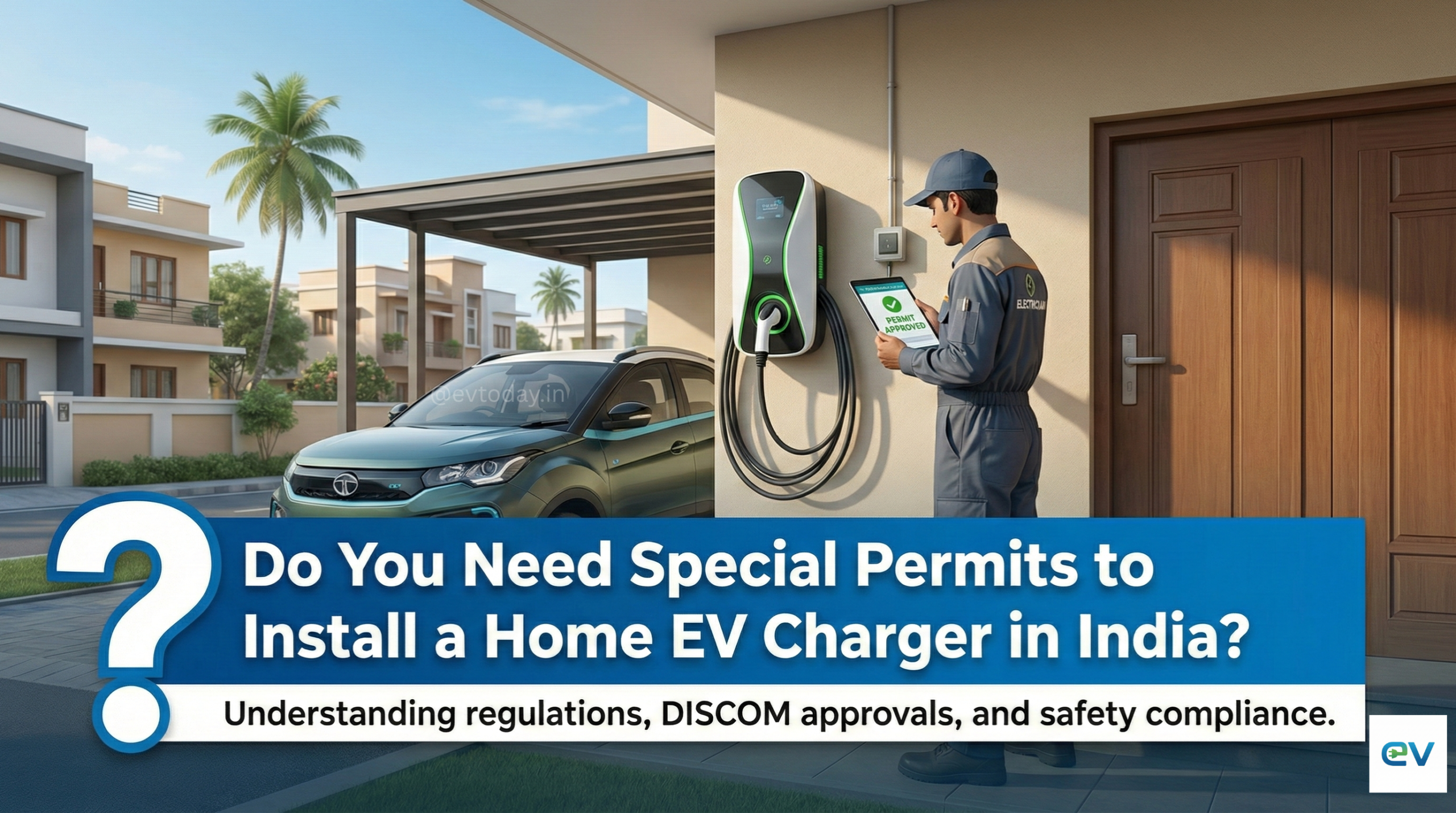
As electric vehicles (EVs) gain momentum in India, many owners are opting to install EV chargers at their homes. Charging at home offers unmatched convenience and reduces reliance on public chargers — especially as the national EV count continues to grow. However, a key question persists: Does India require special permits to install a home EV charger? In this comprehensive, journalist-style guide, we unpack the latest regulatory stance, practical steps, and real-world considerations you should know in 2026.
Understanding EV Charging Permits in India
1. Government Permit: Not Required for Home EV Chargers
According to the Ministry of Power’s consolidated Guidelines and Standards for EV Charging Infrastructure (EVCI) — 2024, installing a charging point for private use is not subject to a special license or central government permit. This aligns with India’s broader EV adoption goals, where charging infrastructure is treated as a service rather than a commercial electricity business requiring formal licensing.
Similarly, independent EV charger solutions and industry insights confirm that no government approval is needed solely for installing a personal EV charger at home. The main requirement is that your home’s existing electrical supply can safely support the charger.
Why No Permit Is Needed for Home Charging
India’s EV policy and supporting regulations aim to remove barriers to EV adoption. Charging at home is considered non-commercial and privately consumed electricity, so it doesn’t fall under the more stringent licensing categories necessary for public charging stations or electricity sale.
This means:
- Homeowners can install an EV charger without applying for a license or permit from the central government.
- Installation is treated similarly to other household electrical upgrades, requiring standard safety checks but not regulatory clearance.
Key Practical Requirements Before Installation
1. Electrical Load and Safety Compliance
Even though no special permit is mandated, your home electrical system must be able to safely supply the charger’s power. Electrical safety and capacity assessments typically include:
- Sanctioned Load: Ensuring your current electricity sanction supports the charger’s load — especially for Level 2 chargers that use ~3.3kW – 7.4kW.
- Professional Assessment: A qualified electrician should inspect wiring, earthing, breaker configuration (MCB/RCCB), and ensure compliance with safety practices.
- Load Enhancement Request: If your existing sanctioned load is insufficient, you may need to request a load enhancement from your local DISCOM (electricity distribution company) — not a permit, but a standard electricity board process.
This is a practical compliance step, not a special government license for EV charging.
2. RWA/Society NOC for Apartment Residents
For those living in apartments or gated housing societies, the biggest hurdle isn’t central permits — it’s getting approval from your RWA or society management.
Recent state guidelines (e.g., in Maharashtra and Karnataka) make it clear that residents can install EV chargers in designated parking, provided safety standards are met and the RWA issues a No Objection Certificate (NOC) in a timely manner.
Many societies are now mandated to grant NOC within statutory timelines once all safety and technical compliance boxes are checked. This has been strengthened through judicial interpretations and regulatory clarifications to prevent arbitrary refusals.
Key points for societies:
- NOC should be provided if safety and load conditions are met.
- Denials must be backed by valid safety or technical concerns, not arbitrary rules.
- New building bye-laws now increasingly require adequate parking areas to be EV-ready.
How to Safely Install a Home EV Charger
Installing a home EV charger requires a systematic approach:
1. Choose Charger Type
- Level 1 (AC via 15A outlet): Basic charging using a standard socket — minimal electrical upgrades needed.
- Level 2 (AC Wallbox): Offers faster charging and usually requires dedicated wiring and possibly higher capacity load.
- DC Fast Chargers: Not suitable for most home installations due to high power and infrastructure needs.
2. Assess Load and Wiring
A professional electrician should:
- Evaluate the existing electrical panel and sanctioned load.
- Recommend upgrades if needed.
- Install appropriate breakers and electrical protection (e.g., RCCB).
3. Placement and Environment
- Ideally, the charger should be installed in a sheltered or covered parking space to protect it from weather elements.
- Ensure cable routing minimizes trip hazards.
4. Earthing and Safety
Strong earthing is critical — weak or improper earthing can create serious safety risks including electrical faults and fire hazards.
Costs and Subsidies (Practical Perspective)
While this article is focused on permits and compliance, it’s worth noting some real cost considerations:
- AC Wallbox Chargers (3.3kW): ₹15,000 – ₹25,000 approx.
- Higher Capacity Chargers (7.4kW): ₹30,000 – ₹60,000 or more.
- Installation and Wiring: ₹5,000 – ₹15,000 depending on upgrades and components.
There are also solar integration options and subsidy schemes (like rooftop solar incentives) that homeowners can explore to reduce long-term electricity costs.
Key Highlights
✔️ No special government permit is required to install a home EV charger in India in 2026.
✔️ Home EV charging is treated as private electricity consumption, not a charged service requiring licensing.
✔️ Local load capacity checks and potential DISCOM load upgrades are standard — not special permits.
✔️ Apartment residents often need an RWA/Society NOC before installation.
✔️ Safety standards, wiring upgrades, and professional installation are critical for safe operation.
Expert Insight – What Practitioners Say
Electrical contractors and EV installation specialists emphasize that the real compliance work revolves around safe electrical execution, not regulatory clearance. Load assessment, circuit protection, earthing, and proper placement invariably determine whether a charger installation succeeds without future issues.
Housing association leaders and legal experts have also pointed out that while societies used to have discretionary power to deny installations, evolving guidelines and regulations increasingly require RWAs to provide space and approvals when safety conditions are met.
Conclusion
Installing a home EV charger in India is significantly more straightforward than many assume. There’s no requirement for a special government permit or license — the process primarily involves ensuring electrical safety, compatibility with your home’s supply, and obtaining local approvals (like an RWA NOC where necessary). As EV adoption rises, these steps are becoming standardized and widely supported by policy, regulators, and industry players alike.
Whether you’re a first-time EV buyer or upgrading your charging infrastructure in 2026, understanding this regulatory landscape will help you plan smartly, avoid delays, and ensure your vehicle gets the reliable charging it deserves.
FAQs
1. Do I need a government permit to install an EV charger at my home in India?
No — for private use, there is no special government permit required beyond normal electrical compliance.
2. Does the residential electricity board need to approve home EV charger installation?
If your load needs to increase, you may need to apply for load enhancement with your DISCOM; this is standard electrical compliance, not an EV permit.
3. Can my housing society refuse to let me install a charger?
They cannot arbitrarily refuse if safety and load criteria are met; many state rules require societies to grant NOC within specific time frames.
4. Do I need a professional electrician to install an EV charger?
Yes — professional installation ensures safety, compliance with electrical standards, and avoids future issues.
5. Are special permits needed for public EV charging stations?
Yes — public or commercial chargers require permits and compliance approvals from DISCOMs and local authorities, unlike home chargers.