
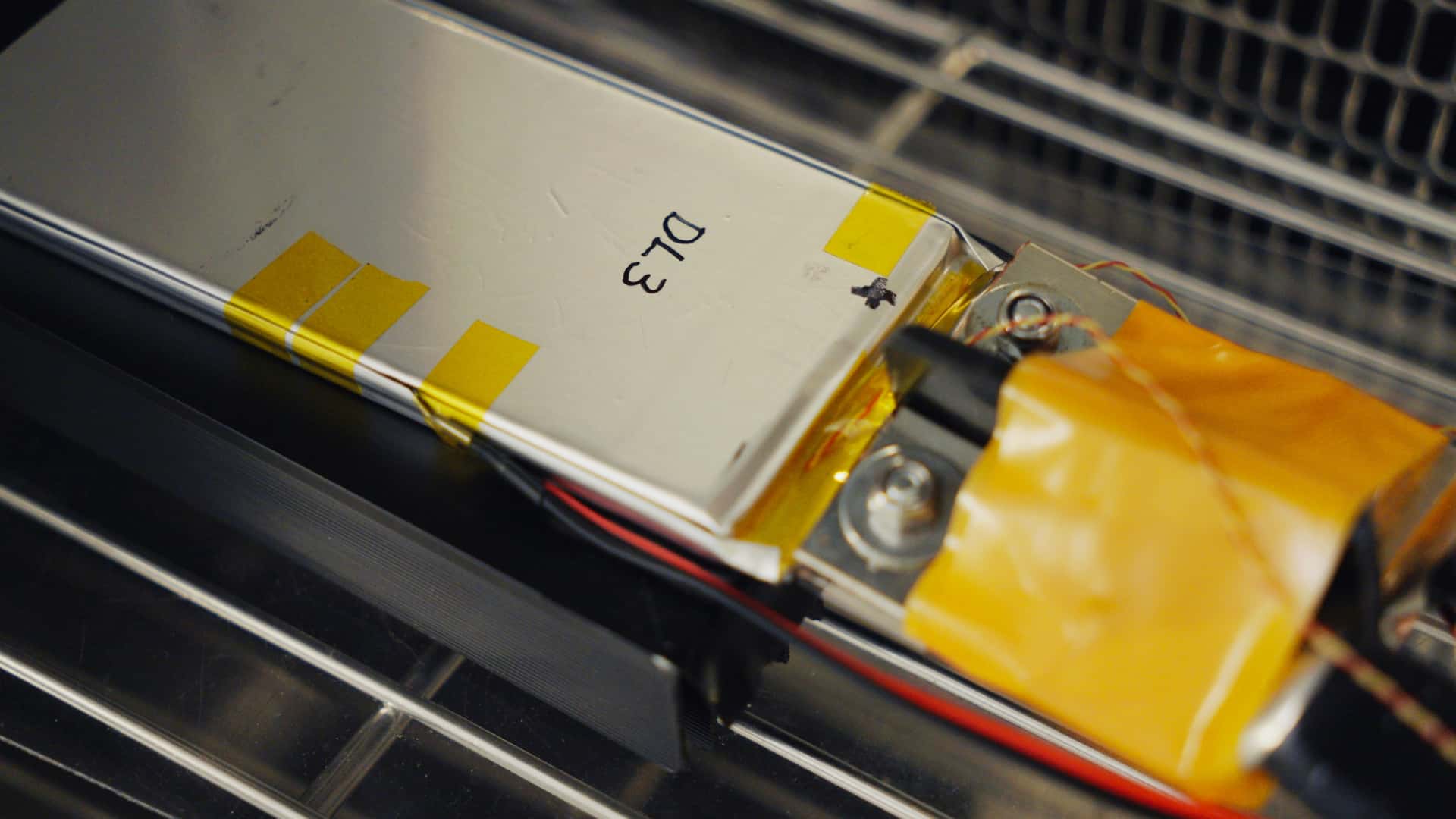
Finnish startup Donut Lab has released the results of its second independent test for its claimed all-solid-state battery technology. While initial data suggests stability at high temperatures, battery experts are urging caution due to insufficient information, raising questions about the technology’s real-world applicability.
High-Temperature Performance Under Scrutiny
The latest test involved subjecting Donut Lab’s pouch cell battery to extreme temperatures, reaching up to 100 degrees Celsius (212 degrees Fahrenheit), which is the boiling point of water and significantly higher than the optimal operating range for conventional lithium-ion batteries.

During the tests, the battery cell demonstrated an ability to perform better at elevated temperatures. At 80 degrees Celsius (176 degrees Fahrenheit), the cell reportedly delivered 110.5% of its normal capacity. It was then recharged without visible damage, suggesting continued normal performance.
The testing was further intensified to 100 degrees Celsius (212 degrees Fahrenheit). Even at this extreme temperature, the cell purportedly outperformed its room-temperature performance, delivering 107% of its normal capacity and successfully recharging afterward.
This resilience in high heat contrasts sharply with conventional lithium-ion batteries, which typically lose efficiency and can become unstable or sustain permanent damage at similar temperatures. Studies indicate that lithium-ion batteries perform optimally between 25-40 degrees Celsius (77-104 degrees Fahrenheit).
Expert Concerns Over Data Sufficiency
Despite the seemingly positive results at high temperatures, battery scientists have expressed significant reservations about the value and interpretation of the data. Eric Wachsman, a professor at the University of Maryland’s Department of Materials Science and Engineering specializing in solid-state batteries, highlighted the limitations of the current findings.
“The cells are not violating any law of thermodynamics,” Wachsman stated in an email. “But the data presented leaves a lot to be desired for many reasons,” he added, emphasizing that the limited information does not adequately represent automotive applications.
Wachsman pointed out that for any battery technology to be commercially viable, it must maintain stability over thousands of cycles, with minimal capacity fade. “To be commercially relevant, the cells need to be stable with less than 10-20% of capacity fade for thousands of cycles,” he explained. “Without that, the tests are essentially meaningless.”

Potential Swelling and Seal Integrity Questions
A notable observation following the 100 degrees Celsius test was the loss of vacuum in the battery’s outer pouch. Wachsman suggested this could be a potential red flag, indicating that the cell might have lost its “hermetic seal”—the critical barrier protecting the internal chemistry from external air.
“Pouch cells will tend to expand due to internal pressure as they can give off gas during cycling,” Wachsman elaborated. He noted evidence of “excessive swell” after comparing images from this test with previous fast-charging results.
It remains unclear whether this swelling represents a significant safety concern or an expected characteristic of solid-state cells. However, the loss of seal integrity could impact long-term performance and safety.
Donut Lab’s Ambitious Claims and Industry Context
Solid-state batteries are widely regarded as a “holy grail” technology in the electric vehicle sector, promising enhanced driving range, reduced charging times, and significantly lower fire risks. These advancements could potentially alleviate range anxiety and accelerate EV adoption.
The race to develop and mass-produce solid-state batteries is intense, but manufacturers face considerable challenges in achieving defect-free production at scale. Many startup leaders have acknowledged that mass manufacturing remains an unresolved hurdle.
Donut Lab, based in Helsinki, has positioned itself as a frontrunner, claiming to have developed the world’s first production-ready all-solid-state battery. The company has stated that its batteries will be integrated into Verge Motorcycles EVs starting this quarter.
The startup’s previously stated specifications are exceptionally ambitious: an energy density of 400 watt-hours per kilogram (roughly double that of current lithium-ion cells), a five-minute charge time, an operating temperature range from -22 to 212 degrees Fahrenheit (-30C to 100C), a lifespan of 100,000 cycles, and the absence of rare earth materials.
Skepticism and Future Outlook
Donut Lab’s initial announcement was met with considerable skepticism from industry experts, who questioned the bold claims made without supporting evidence, patent disclosures, or public demonstrations. The recent independent test results are part of the company’s effort to address this skepticism.
While the high-temperature stability test provides some data, industry observers are still awaiting crucial information. Key among these are verifiable figures for energy density and detailed disclosures about the battery’s chemistry. Without this evidence, the true potential and viability of Donut Lab’s technology remain uncertain.
Donut Lab has indicated that further independent test results are expected in the coming weeks. The scientific and automotive communities will be closely monitoring these disclosures for concrete evidence supporting the company’s extraordinary claims.