
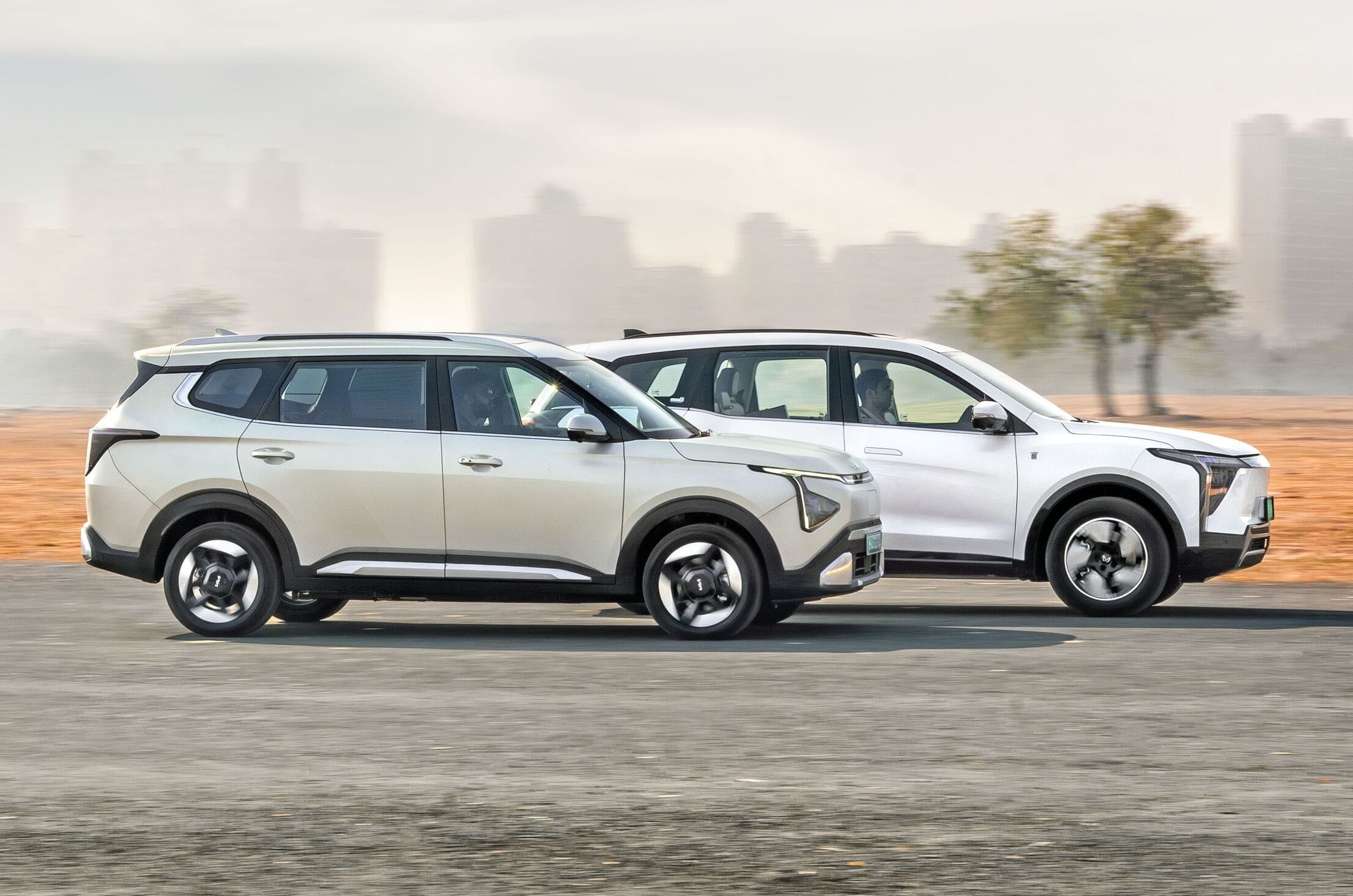
The burgeoning electric vehicle (EV) market in India now offers compelling choices for families seeking three-row transportation. The primary contenders are the Kia Carens Clavis EV and the recently launched Mahindra XUV.e9s. Both vehicles are available with various battery configurations, presenting a significant overlap in their offerings and pricing. The Kia Clavis EV ranges from Rs 17.99 lakh to Rs 24.49 lakh, while the Mahindra XUV.e9s is priced between Rs 19.95 lakh and Rs 29.45 lakh. To determine which electric family vehicle offers a better proposition, long-range versions of both were subjected to an exhaustive testing regime.
Exterior Design and Engineering: SUV Stance vs. MPV Elegance
The Mahindra XUV.e9s adopts a distinctly SUV-like appearance, characterized by a closed-off front grille, prominent LED daytime running lights, and a design that echoes the XUV700. Aerodynamically designed alloy wheels, a blacked-out tailgate, and unique LED taillamps further differentiate it from its internal combustion engine counterparts.
In contrast, the Kia Carens Clavis EV maintains the understated elegance of an MPV. Subtle visual cues set it apart from its ICE sibling, including green number plates, a light bar above the grille, a centrally located charging port, a redesigned bumper with active aerodynamic elements, ‘ice-cube’ style fog lamps, and a revised scuff plate. The XUV.e9s projects the image of a modern SUV, whereas the Clavis EV’s stance and proportions clearly define it as an MPV.
Dimensionally, the XUV.e9s is larger than the Clavis EV across length, width, and height. Its 18-inch wheels appear more substantial compared to the Kia’s 17-inch units. However, the Clavis EV boasts a 18mm longer wheelbase, which is crucial for optimizing interior space. A closer inspection reveals that the Kia’s underfloor battery pack remains visibly exposed, detracting from its overall aesthetic.
Interior Space and Comfort: A Tale of Two Approaches
The Mahindra XUV.e9s features a dashboard layout shared with the XUV.e9e, presenting both advantages and disadvantages. Positively, the triple-screen display, beige leatherette upholstery with olive accents, and abundant use of soft-touch and piano black finishes create a premium and high-tech cabin ambiance. On the negative side, the user interface remains confusing, with many functions buried deep within menus. The steering-mounted controls are susceptible to accidental horn activation, and the passenger screen lacks a privacy filter, which can be a distraction during video playback.
Despite the UI challenges, comfort levels in the XUV.e9s are excellent. The front seats are wide and supportive, although the driver’s seat is positioned slightly high even in its lowest setting. The middle row is spacious and comfortable, benefiting from a flat floor and ample width, making it accommodating for three occupants. The outboard seats offer ventilation, and a sliding function allows occupants to adjust legroom for either the second or third row.
Accessing the third row involves compromises. It is most convenient via the kerbside, where a 40 percent section of the middle-row bench tumbles forward, while the remaining 60 percent simply folds flat. Third-row comfort is restricted; adults will find themselves sitting low with their knees raised, and headroom is limited regardless of the seatback angle. It is suitable for short journeys, but for longer trips, the Clavis EV offers superior comfort.
In terms of boot space with all seats deployed, it is limited to accommodating soft bags. However, the generous 150-litre frunk provides additional storage capacity.

Features and Safety: Intuitive Design Meets High-Tech Appeal
The Kia Carens Clavis EV’s interior prioritizes a clean and intuitive design. The beige color scheme, twin-screen setup, and backlit touch panels contribute to a modern aesthetic. However, its true strength lies in its ease of use. Physical knobs and buttons for essential functions, a logical layout, and a straightforward touchscreen interface enhance the user experience. A notable omission is the lack of wireless Android Auto and Apple CarPlay, requiring a wired connection.
Seat comfort is a strong suit across all rows in the Clavis EV. The driver’s seat is comfortable, though it is only partially powered and lacks a memory function. The middle row offers fore-aft sliding and a greater recline angle compared to the Mahindra’s. While the cabin is narrower, three adults can still sit abreast without excessive cramping. The absence of an adjustable headrest for the middle passenger is a minor drawback.
Access to the third row is facilitated by one-touch tumble-forward seats on both sides, aided by pneumatic struts. The Clavis EV impresses by offering genuinely usable third-row space, even for tall adults, with ample headroom and comfortable recline options. Boot space with all seats up is marginally better than the XUV.e9s. The frunk, however, is significantly smaller, suitable only for a charging cable or a small bag.
Safety features are robust in both vehicles. The XUV.e9s includes a driver’s knee airbag, powered front seats with memory, rear seat ventilation, a head-up display, and dual-zone climate control in its top-tier variants. The Clavis EV counters with electric folding mirrors, one-touch power windows, ambient lighting, and leatherette upholstery.

Value Proposition: Feature-Rich vs. Spacious Proposition
The Mahindra XUV.e9s is offered with three battery options: 59kWh, 70kWh, and 79kWh, with prices commencing at Rs 19.95 lakh. The Kia Carens Clavis EV comes with two battery options: 42kWh and 51.4kWh, starting at Rs 17.99 lakh.
Crucially, the long-range 79kWh XUV.e9s is priced at Rs 21.95 lakh, closely matching the Rs 21.99 lakh starting price of the Clavis EV 51.4kWh. At this price point, both vehicles offer a strong foundation of safety and features, including six airbags, ESP, hill-start assist, a panoramic sunroof, a touchscreen infotainment system, a digital instrument cluster, cruise control, a reverse camera, and TPMS.
The XUV.e9s boasts wireless Android Auto/Apple CarPlay and a passenger-side display as key advantages. The Clavis EV offers electric folding mirrors, one-touch power windows, ambient lighting, and leatherette upholstery.
At the higher end of the price spectrum, the XUV.e9s reaches Rs 29.45 lakh, while the Clavis EV caps out at Rs 24.49 lakh. The Mahindra’s more expensive top variant includes a driver’s knee airbag, powered front seats with memory, rear seat ventilation, a sophisticated head-up display, and dual-zone climate control, which offer compelling reasons for the price difference.
Performance and Refinement: Power Delivery and Driving Modes
The XUV.e9s utilizes Mahindra’s established born-EV powertrain, featuring a 79kWh Blade LFP battery and a rear-wheel-drive motor generating 286hp and 380Nm of torque. Its performance is robust, with brisk acceleration and a selection of drive modes: Range, Default, Everyday, and Race. Engaging Race mode unleashes the vehicle’s full capabilities, enabling a 0-100kph sprint in just 7.54 seconds and a top speed exceeding 190kph.
The Clavis EV employs a smaller 51.4kWh NMC battery paired with a front-mounted motor producing 171hp and 255Nm. While it lacks the outright power of the Mahindra, its performance is more than sufficient for family duties. Throttle response varies significantly across Eco, Normal, and Sport modes. Despite its lower power output, the Clavis EV does not feel underpowered, even when fully laden. It achieves the 0-100kph sprint in 8.44 seconds, with a top speed of 168kph.
Both vehicles offer five levels of regenerative braking, including an off setting and a single-pedal mode. Testing revealed that the Clavis EV’s Level 3 and single-pedal regeneration were more aggressive, whereas the XUV.e9s exhibited stronger deceleration in Level 1 and Level 2.
Range and Efficiency: Balancing Battery Size and Aerodynamics
The XUV.e9s, being the larger vehicle, is nearly half a tonne heavier than the Kia Carens Clavis EV due to its larger 79kWh battery. This increased mass impacts its efficiency, with the XEV returning 6.05 km/kWh in city driving and 6.04 km/kWh on the highway in ‘Range’ mode. Nevertheless, its substantial battery capacity contributes to an impressive real-world average range of 477km on a single charge.
The lighter Clavis EV demonstrates noticeably superior efficiency. It achieved 7.45 km/kWh during urban driving and 6.71 km/kWh on the highway. Given its smaller 51.4kWh battery, this translates to a real-world range of approximately 364km, a deficit of 113km compared to the XUV.e9s.
Charging capabilities also highlight a significant difference. The XUV.e9s’s 409V electrical architecture supports DC fast charging speeds of up to 175kW. In contrast, the Clavis EV has an average DC charging rate of only 42kW. Both manufacturers offer an optional 11kW AC wallbox charger, priced at Rs 75,000 for the Mahindra and Rs 62,000 for the Kia. Kia also provides an optional 7.2kW AC charger for Rs 54,000.
Ride Comfort and Handling: Composure on Different Terrains
Mahindra’s dedicated EV platform contributes to an impressive ride and handling balance in the XUV.e9s. Equipped with 18-inch high-profile tires and semi-adaptive dampers, it prioritizes comfort at lower speeds. However, compared to its platform siblings, the suspension is softer, leading to noticeable vertical movement at highway speeds, which can be unsettling for some occupants.
Despite this, the XUV.e9s feels robust and confidence-inspiring over uneven roads, effectively absorbing large potholes. Its light steering and tight turning radius, remarkable for its size, enhance maneuverability and ease of parking.
The Carens Clavis EV features a firmer suspension tune. At low speeds, it does not absorb bumps as smoothly as the Mahindra but never feels harsh. As speeds increase, the Kia exhibits greater stability and composure. Neither vehicle is exceptionally sporty, but the Clavis EV rolls less in corners. The XUV.e9s steering offers slightly more engagement. Both vehicles are equipped with disc brakes all around. In emergency braking tests from 80kph, the lighter Kia consistently achieved shorter stopping distances.
Verdict: Practical MPV vs. Feature-Rich SUV
The Kia Carens Clavis EV excels in its core purpose as a family vehicle. Its cleverly designed interior offers spaciousness, and its third row provides more room than that of the XUV.e9s. Combined with a more stable highway ride, an intuitive user interface, ergonomic design, and a top-spec variant priced considerably lower than the XUV.e9s, the Clavis EV presents itself as a practical and well-rounded family EV. However, its significantly lower real-world range and slower DC fast-charging capabilities are considerable drawbacks.
The Mahindra XUV.e9s makes a strong case with a starting price comparable to the Kia, while offering a more powerful motor, quicker acceleration, and a substantially larger battery that translates to a longer real-world range—a critical factor for vehicles undertaking occasional highway journeys. It also boasts a stronger road presence and an undeniable ‘X-factor’ that enhances its appeal. Considering the lower variants, which are similarly priced and still generously equipped, including the triple-screen setup, the XUV.e9s delivers considerably more vehicle for the money, ultimately emerging as the more compelling electric vehicle choice.