
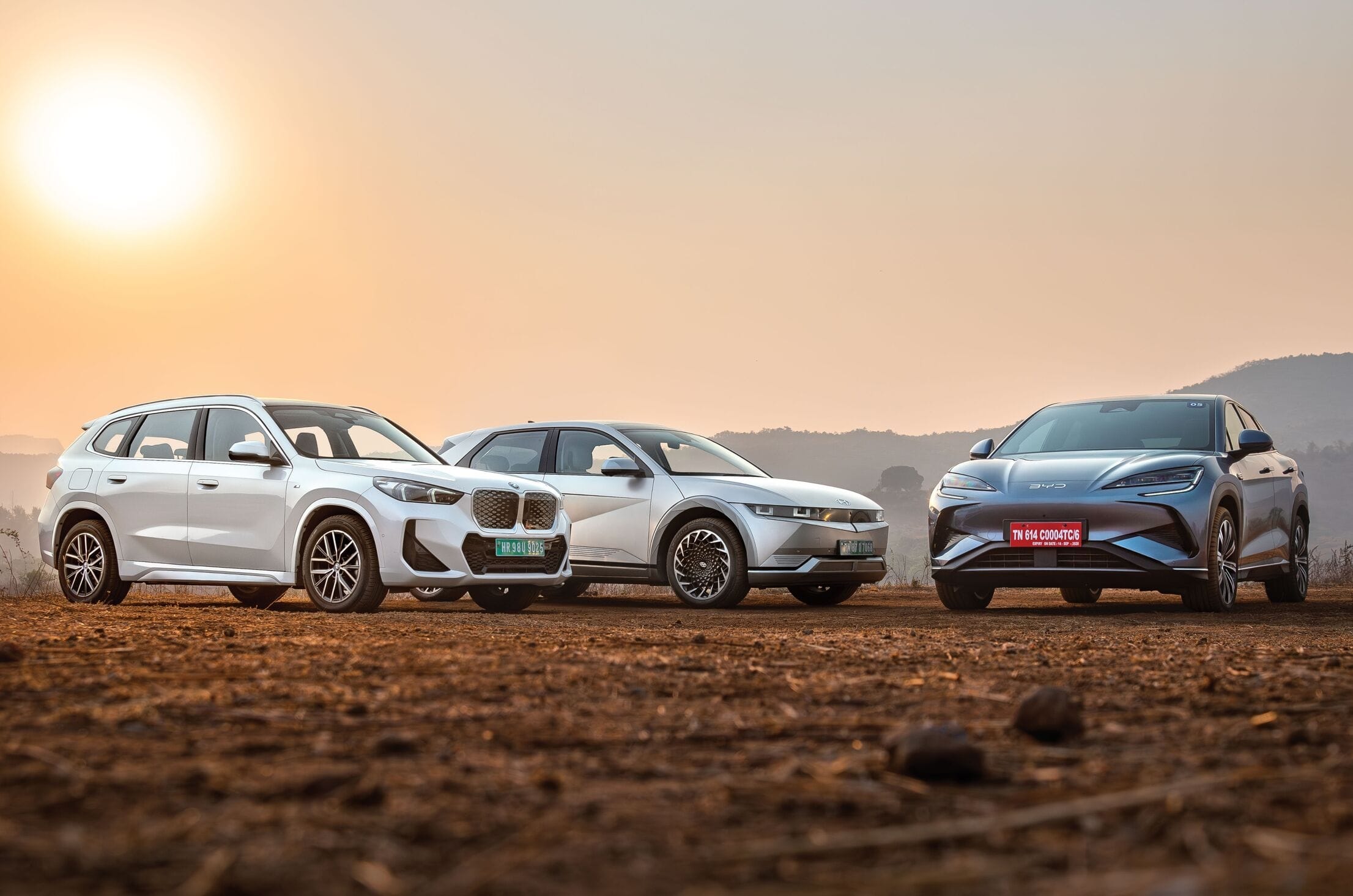
The premium electric vehicle (EV) segment in India is experiencing a significant surge in competition. Previously, the gap between the INR 25 lakh MG ZS EV and the INR 1 crore Mercedes-Benz EQC left a void in the market. However, this landscape has dramatically changed, with a new wave of six EVs now available in the approximate INR 50 lakh price bracket. Among these newcomers, the Hyundai Ioniq 5, the recently introduced BYD Sealion 7, and the locally manufactured BMW iX1 LWB have emerged as particularly strong contenders. We brought these three premium electric SUVs together for an in-depth comparison, subjecting them to rigorous real-world testing to determine which truly deserves a place in discerning Indian garages.
Design and Engineering: A Trio of Distinct Approaches
All three electric vehicles presented here share substantial dimensions, each measuring over 4.6 meters in length, exceeding 1.8 meters in width, and boasting a wheelbase of 2.8 meters or more. The BYD Sealion 7 leads in length and width, while the BMW iX1 is the tallest. The Hyundai Ioniq 5 distinguishes itself with the longest wheelbase. Underpinning the BYD and Hyundai is a dedicated electric platform, allowing for optimized packaging and greater interior space. This inherent design advantage grants both models a practical ‘frunk’ (front trunk), a feature notably absent in the BMW iX1, which is based on a platform adapted from internal combustion engine (ICE) vehicles.
Exterior Styling: Hatchback, SUV, and Coupe-SUV Forms
Each of these electric SUVs adopts a unique silhouette. The Hyundai Ioniq 5 presents itself as a large hatchback with a distinctive neo-retro aesthetic, characterized by sharp design lines, dual-tone alloy wheels, and striking rectangular lighting elements. In contrast, the BYD Sealion 7 features a more rounded design language, aligning with BYD’s family look. While its front might appear somewhat substantial, its large alloy wheels and tapering roofline add a touch of sportiness. The rear incorporates a connected lighting element with intricate detailing. The BMW iX1, by far the most conventional, embodies the upright stance of a traditional SUV. It sports BMW’s signature kidney grille, which appears oversized, complemented by prominent LED headlights. Its side profile, with the longer wheelbase and relatively smaller 18-inch wheels, may not seem perfectly proportioned. The rear design closely resembles the standard X1, featuring large, L-shaped LED tail lamps.
Interior Space and Comfort: A Focus on User Experience
The interior design and execution of each EV are as distinct as their exteriors, offering unique environments for occupants.
BYD Sealion 7: Tech-Rich Cabin with Premium Feel
The BYD Sealion 7 welcomes occupants with a relatively conventional dashboard layout, integrating screens for the infotainment system and driver’s display. The 15.6-inch touchscreen, a signature BYD feature, can rotate between landscape and portrait orientations. It offers a fluid user experience, high-resolution graphics, and an updated interface. While most vehicle functions are controlled via this screen, the inclusion of physical controls on the center console and an intuitive AC adjustment system (three-finger swipes on the screen) is a thoughtful touch. The driver’s display, though high-resolution, can appear cluttered with small fonts for critical information. However, BYD’s commitment to premium material quality and fit-and-finish is evident, rivaling established European luxury brands.
The center console provides dual wireless charging pads, cup holders, and additional storage. The front seats are exceptionally comfortable, offering ventilation and ample cushioning suitable for occupants of all sizes. The rear seats are equally plush, with a recline function and generous legroom, enhanced by large windows and a panoramic glass roof that amplifies the sense of space.
Feature-wise, the Sealion 7 is comprehensively equipped, including wireless smartphone integration, a 12-speaker Dynaudio sound system, powered front seats, automatic headlamps and wipers, a gesture-controlled powered tailgate, and dynamic ambient lighting. Safety is paramount, with 11 airbags (including a front-center airbag), Level 2 Advanced Driver Assistance Systems (ADAS), a high-definition 360-degree camera, and a sensitive driver-attention monitor.
BMW iX1 LWB: Familiar Design with Practicality Concerns
The BMW iX1 LWB shares its dashboard design with the ICE-powered X1 and the iX1 xDrive30, featuring a large curved display that houses both the infotainment and instrument cluster. Horizontal AC vents are positioned on the passenger side, with a sizable wireless charging pad located below. The center console integrates key vehicle functions. While the screens boast high resolution, navigating the interface can be complex, especially while driving. Despite good overall fit and finish, some lower cabin materials feel less premium and are prone to scratching.

The front seats offer good support but might feel narrow for larger occupants and lack ventilation, a feature present in its rivals. The cushioning is firmer compared to the BYD, though it proves well-judged on longer journeys. The extended wheelbase significantly benefits rear-seat passengers, offering ample legroom despite a slightly lower seating position due to the underfloor battery. The rear seat base is slightly longer, and the backrest can recline up to 28.5 degrees, enhancing comfort. However, the BMW feels narrower inside than the BYD, and the rear backrest cushioning is firmer. The absence of rear sun blinds is a missed convenience.
While the least feature-rich among the three, the BMW iX1 includes a large panoramic glass roof, ambient lighting, auto LED headlamps, connected car technology, a smartphone-enabled key, leather upholstery, eight airbags, and Level 2 ADAS.
Hyundai Ioniq 5: Spacious, Sustainable, and User-Friendly
Stepping into the Hyundai Ioniq 5 immediately conveys a sense of spaciousness, amplified by its expansive glass area, light interior colors, flat floor, and the absence of a conventional center console. Hyundai has prioritized sustainability by using recycled materials, and the fit, finish, and tactile quality of the interior elements are excellent. However, the light-colored upholstery is susceptible to staining.
The dashboard is dominated by two 12.3-inch screens for the instrument cluster and infotainment system. These displays are crisp, easily legible, and feature an intuitive user interface that is simpler to navigate than its competitors. The steering wheel is a two-spoke unit with a round drive-mode selector, while the gear selector is positioned below the headlamp stalk. A unique feature is the sliding center console, allowing for flexible space utilization and access. Ample storage solutions are provided, including a large drawer-style glovebox, spacious door bins, and the versatile center console itself.
The front seats are broad, exceptionally comfortable, and offer extensive electric adjustments, including extendable leg rests that transform them into lounge-like seating. They also feature heating and ventilation. The rear seats, while not as supremely comfortable as the front, are wide enough to accommodate three adults comfortably, with the outer two seats offering heating and electric adjustment. Similar to the BMW, the rear seating position is somewhat knees-up due to the underfloor battery.
The Ioniq 5 is equipped with a panoramic fixed glass roof, an 8-speaker Bose sound system, a 360-degree parking camera, dual-zone climate control, an electric tailgate, ESP, six airbags, and ADAS. The inclusion of wired smartphone integration is a minor drawback.
Features and Safety: Advanced Tech and Comprehensive Protection
All three EVs are well-appointed with modern features and robust safety systems, catering to the demands of the premium segment.
BYD Sealion 7 Performance
The Sealion 7 stands out with its 11 airbags, including a unique front-center airbag and rear side bolsters. It features a 15.6-inch touchscreen, wireless Apple CarPlay/Android Auto, a Dynaudio sound system, ventilated front seats, wireless charging, ambient lighting, and Level 2 ADAS. Its 20-inch alloy wheels contribute to its imposing stance.
BMW iX1 eDrive20L
The iX1 offers a 12.3-inch touchscreen, wireless Apple CarPlay/Android Auto, an 18-inch alloy wheel setup, and a panoramic glass roof. It is equipped with eight airbags and Level 2 ADAS, along with a Harman Kardon audio system and ambient lighting.
Hyundai Ioniq 5
The Ioniq 5 boasts two 12.3-inch screens, a Bose sound system, and 20-inch alloy wheels. It features ventilated and heated front seats, wireless charging, ambient lighting, and Level 2 ADAS. Notably, it includes rear sunshades for added passenger comfort. The provision of paddle shifters for adjusting regenerative braking is a functional highlight. While it offers six airbags, its wired smartphone integration is a comparative disadvantage.
Performance and Refinement: Power Delivery and Driving Dynamics
The performance figures reveal significant differences in acceleration and power output among the three EVs.
BYD Sealion 7 Performance
This all-wheel-drive variant of the Sealion 7 is the most potent, generating 530hp and 690Nm of torque. It achieves the 0-100kph sprint in a rapid 4.43 seconds. Its power delivery is smooth and progressive, making it feel quick and responsive. However, at higher speeds, road and wind noise become more noticeable despite acoustic front windows.
BMW iX1 eDrive20L
The front-wheel-drive iX1 produces 204hp and 250Nm. It is the slowest of the trio, completing the 0-100kph run in 11.30 seconds. While it offers a relaxed driving experience, it can feel underpowered during overtakes. Some torque steer is noticeable during aggressive acceleration. Its cabin insulation is not as effective as the Ioniq 5’s but superior to the Sealion 7’s.
Hyundai Ioniq 5
The rear-wheel-drive Ioniq 5 delivers 217hp and 350Nm, achieving 0-100kph in 7.48 seconds. Its power delivery is smooth and well-modulated, feeling sprightly in Sport mode and akin to a conventional ICE vehicle. The cabin remains exceptionally quiet, with minimal road and tyre noise intrusion.
Range and Efficiency: Real-World Performance
Battery capacity and claimed ranges vary, but real-world testing provides a clearer picture of their endurance.
Battery and Claimed Range
The BYD Sealion 7 is equipped with an 82.56kWh LFP battery, offering a claimed range of 542km. The Hyundai Ioniq 5 features a 72.6kWh NMC battery, with a claimed range of 631km, the longest among the three. The BMW iX1 has the smallest battery at 66.4kWh (NMC chemistry) and a claimed range of 531km.
Real-World Range Test
In our real-world range tests, the Hyundai Ioniq 5 emerged as the leader, achieving an impressive 457km. The BMW iX1 followed with 398km, while the BYD Sealion 7 delivered 371km, attributed partly to its higher power output in the tested variant.
Regenerative Braking and Charging
All three EVs offer multiple regenerative braking modes. The BMW iX1 provides four modes, including an adaptive mode that can be less intuitive. The Hyundai Ioniq 5 offers three modes and the unique ability to turn off regen entirely for free coasting, adjustable via paddle shifters. The BYD Sealion 7 has two regen modes, with its ‘High’ setting being the least aggressive.
The Hyundai Ioniq 5 leads significantly in charging speeds, supporting DC fast charging up to 350kW, capable of an 10-80% charge in just 18 minutes. The BYD Sealion 7 supports up to 150kW DC fast charging, while the BMW iX1 can charge at up to 130kW. Both the Ioniq 5 and Sealion 7 offer Vehicle-to-Vehicle (V2V) and Vehicle-to-Load (V2L) capabilities.
Ride Comfort and Handling: Dynamics on Indian Roads
The ride and handling characteristics showcase the distinct engineering philosophies of each manufacturer.
BYD Sealion 7
The Sealion 7 exhibits a slightly firm ride, managing road imperfections reasonably well. However, the 20-inch wheels on the AWD variant can lead to a crashy sensation over sharp bumps. Its considerable mass and high center of gravity result in noticeable body roll in corners, and the steering feels overly quick.
Hyundai Ioniq 5
The Ioniq 5 feels stable at all speeds, exhibiting a mature driving demeanour. Its steering is direct and well-weighted, though not overtly sporty, aligning with its comfort-oriented focus. Despite the large 20-inch wheels, the ride is comfortable and well-damped, effectively handling rough surfaces with only minor, well-controlled vertical movements over expansion joints.
BMW iX1 LWB
The long wheelbase of the BMW iX1 impacts its agility compared to its shorter-wheelbase counterpart. Nevertheless, it maintains impressive grip in corners with minimal body roll. The ride quality is excellent, absorbing road imperfections and ensuring a composed experience across various surfaces, a hallmark of BMW’s suspension tuning.
Price and Verdict: The Ultimate Electric SUV?
BMW iX1 LWB: Badge Appeal vs. Value Proposition
The BMW iX1 LWB, priced at INR 49 lakh, benefits from BMW’s brand prestige and offers ample rear-seat space along with the most dynamic driving experience. However, its equipment levels lag behind its competitors. The infotainment system is overly complex, with many essential functions integrated into it. The rear seat cushioning is firm, and certain interior plastics detract from the premium BMW feel.
BYD Sealion 7: A Well-Rounded, Feature-Packed Contender
The BYD Sealion 7 represents BYD’s most comprehensive offering in India to date, translating the strengths of the Seal sedan into a more practical SUV body style. Its interior quality, fit-and-finish, technological features, and rear-seat comfort are exceptional. The most powerful drivetrain offers smooth performance. The AWD variant is priced at INR 54.90 lakh, while a RWD version with a higher claimed range is available for INR 48.90 lakh, still pricier than the Hyundai. Downsides include the lowest real-world range, higher cabin noise levels, a less plush ride, a cluttered driver display, and BYD’s comparatively less extensive aftersales network.
Hyundai Ioniq 5: The Clear Winner
The Hyundai Ioniq 5 emerges as the most accessible and well-rounded package, clinching the win in this comparison. Its cabin offers generous space, the seats are uniquely comfortable, and the infotainment system is intuitive. The Ioniq 5 is the most natural to drive, delivers the best real-world range, and boasts the fastest charging capabilities. Furthermore, it is the most affordable, priced at INR 46 lakh (ex-showroom, India). These factors, combined with its previous recognition, saw the Hyundai Ioniq 5 win our Car of the Year 2024 award and triumph in this head-to-head contest.