
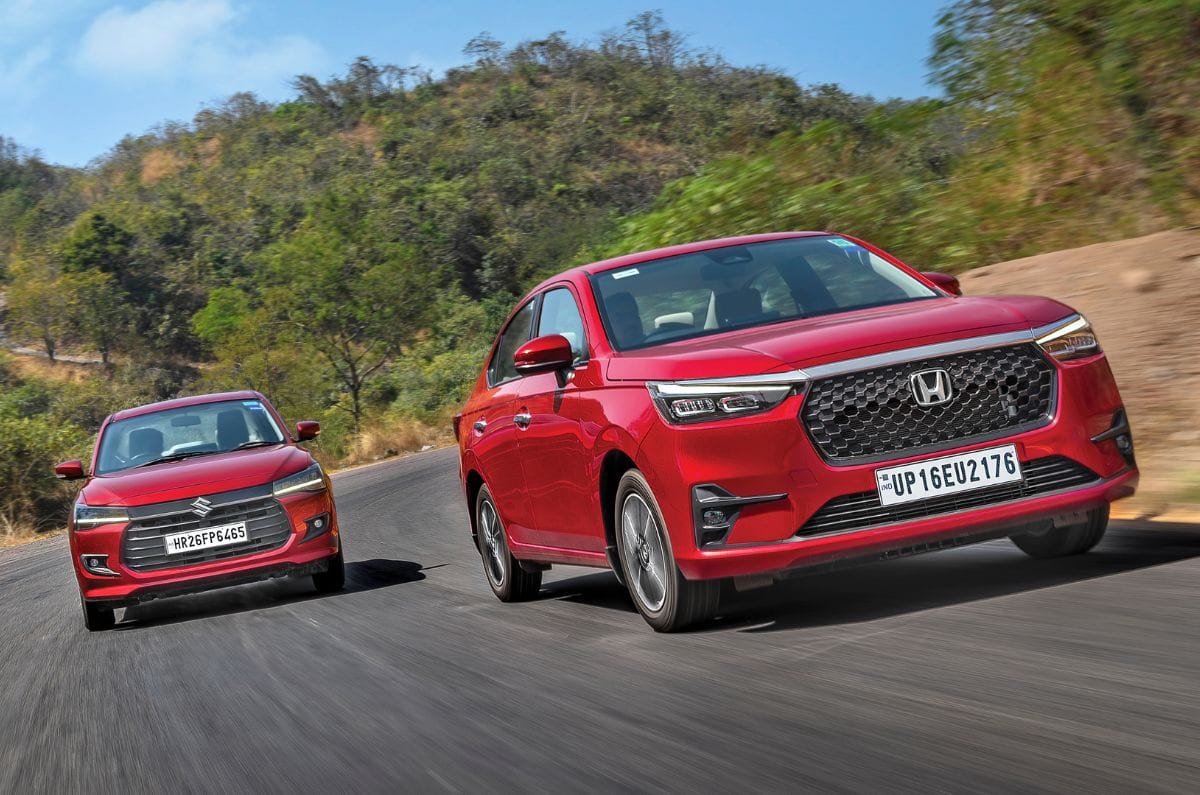
Maruti Suzuki and Honda have launched updated versions of their popular compact sedans, introducing the fourth-generation Dzire and the third-generation Amaze, respectively. These new models aim to maintain their strong market presence amidst a growing preference for SUVs.
Safety Takes Center Stage in New Compact Sedans
Both manufacturers have significantly prioritized safety in these latest iterations. Standard across both the new Dzire and Amaze are Electronic Stability Program (ESP), six airbags, and hill-start assist. The Honda Amaze further distinguishes itself with a camera-based Advanced Driver-Assistance Systems (ADAS) suite. Adding to its safety credentials, the Maruti Dzire has achieved a commendable 5-star rating in Global NCAP crash tests. With these advancements, the two sedans present a compelling package, prompting a head-to-head comparison of their petrol-automatic variants.

Exterior Design: A Blend of Familiarity and Modernity
The Honda Amaze adopts Honda’s latest design language, drawing clear visual links to its larger siblings. Its front fascia echoes the design of the Elevate SUV, while the rear profile is reminiscent of the City sedan. While the side profile remains distinctly Amaze, contemporary elements like door-mounted ORVMs and stylish 185/60 R15 diamond-cut alloy wheels add a modern flair.
The new Maruti Dzire boasts an imposing Audi-inspired grille and sleek LED headlamps. Similar to the Amaze, its side profile carries over from the previous generation. However, distinctive tri-arrow LED signature tail-lights and a subtle boot lip spoiler provide a fresh character to the rear.
Dimension Check: Dzire is Taller, Amaze Offers More Ground Clearance
In terms of dimensions, both sedans are closely matched in length and width. The Dzire is approximately 25mm taller than the Amaze and features slightly higher profile 185/65 R15 tyres. The Amaze, however, offers a 20mm longer wheelbase and a more generous ground clearance of 172mm, compared to the Dzire’s 163mm. The Dzire AMT variant weighs 960kg, making it 26kg lighter than the Amaze.
Interior Appeal: Space, Comfort, and Ergonomics
The Amaze’s interior design, inspired by the Elevate, presents a minimalist aesthetic. A dual-tone beige-black color scheme lends an airy feel to the cabin. Honda’s renowned ergonomic expertise is evident in the thoughtfully placed storage compartments and excellent all-around visibility. The part-analogue, part-digital instrument cluster and the neat, buttoned climate control console are also carried over from the Elevate.
However, the front seat comfort in the Amaze falls short in direct comparison, with a noticeable lack of adequate seat base support. The rear seats offer better support and a more comfortable backrest angle than the Dzire. The inclusion of three fixed headrests enhances passenger comfort and provides whiplash protection. While neither car is ideal for seating three adults abreast, the Amaze’s rear air-con console intrudes upon the middle passenger’s legroom. Taller individuals might also find the headroom to be somewhat limited in the Amaze.
Dzire’s Cabin: A More Spacious and Comfortable Ambiance
The Maruti Dzire’s interior conveys a greater sense of spaciousness, attributed to its design and lighter interior color palette. The inclusion of textured trim elements enhances its premium feel, complemented by a larger 9-inch touchscreen and a sunroof. The seats in the Dzire are broader and offer more supportive cushioning, providing excellent comfort for shorter journeys. However, this softer cushioning might lead to fatigue on extended long drives.

The rear seat experience in the Dzire is comparable to the Amaze, but with a slight advantage in headroom due to a scooped-out roofline, making it more accommodating for taller passengers. Both vehicles offer ample storage solutions throughout the cabin. The Dzire’s boot capacity stands at 382 litres, which is less than the Amaze’s 416-litre boot.
Pricing and Key Features: A Competitive Landscape
The Honda Amaze CVT is offered in three variants, with prices ranging from Rs 9.35 lakh to Rs 11.20 lakh. In contrast, the Maruti Dzire AMT variants are priced between Rs 8.34 lakh and Rs 10.19 lakh, making the Dzire a significantly more affordable option.
Top-spec variants of both sedans share a comprehensive list of features, including auto LED headlamps, 15-inch alloy wheels, keyless entry, wireless charging, automatic climate control, rear air vents, cruise control, wireless Android Auto and Apple CarPlay, ESP, and six airbags.
The Dzire AMT further enhances its appeal with a 360-degree camera, a sunroof, and a larger 9-inch infotainment screen compared to the Amaze’s 8-inch unit. However, the Dzire’s infotainment system encountered occasional freezing issues during testing when connected to Android Auto.

Amaze’s Edge: Advanced Driver Assistance Systems
For a premium of approximately Rs 1 lakh over the Dzire AMT, the Amaze CVT includes paddle shifters, a partial digital instrument cluster, and a suite of ADAS features. This includes lane-keeping assist, blind-spot monitoring, autonomous emergency braking, and adaptive cruise control. These ADAS functionalities are reportedly well-calibrated for Indian driving conditions, operating unobtrusively to enhance safety and convenience during highway travel.
Performance Metrics: Engine and Transmission Dynamics
The Honda Amaze is powered by a familiar 1.2-litre, 4-cylinder petrol engine. This unit offers a strong mid-range and a free-revving character, though it exhibits weakness at lower RPMs, particularly below 2,000rpm. The Continuously Variable Transmission (CVT) effectively keeps the engine in its optimal power band, delivering seamless shifts. However, aggressive acceleration can induce a noticeable ‘rubber-band’ effect, where engine revs increase without a proportional surge in vehicle speed, amplifying the engine’s inherent buzziness.
The new Maruti Dzire is equipped with Maruti’s latest 1.2-litre Z12E petrol engine, a three-cylinder unit that produces 82hp – 8hp less than the Amaze and its own predecessor. This engine’s design prioritizes low-end torque, contributing to improved drivability and a crisper throttle response, as seen in its debut on the Swift.
Dzire’s AMT Transmission: A Point of Contention
These characteristics make the Dzire feel exceptionally agile in city traffic. However, its 5-speed Automated Manual Transmission (AMT) is a notable drawback. While it provides the convenience of clutch-less driving and performs adequately for an AMT, drivers will experience a distinct lag between gear shifts. This is considerably less smooth and seamless compared to the Amaze’s CVT.
In performance tests, the Amaze accelerated from 0-100kph in 13.12 seconds, outperforming the Dzire AMT by 2.09 seconds. However, their rolling acceleration times (20-80kph and 40-100kph) were remarkably similar. The Honda CVT reached a top speed of 148kph, while the Dzire AMT achieved a higher top speed of 170kph.
Fuel Efficiency: Dzire Leads in Real-World Figures
Honda officially claims an ARAI-rated efficiency of 19.46kpl for the Amaze CVT, while Maruti Suzuki claims an impressive 25.71kpl for the Dzire AMT. In real-world testing, the Amaze CVT and Dzire AMT achieved average figures of 13.28kpl and 15.41kpl, respectively. The Amaze CVT recorded 16.62kpl on the highway and 9.94kpl in the city, whereas the Dzire delivered superior figures of 19.22kpl on the highway and 11.61kpl in the city.
Neither car features an Eco mode. The Dzire incorporates an automatic engine start-stop system to reduce fuel consumption during idling. However, this system faced challenges maintaining the set cabin temperature under extreme heat conditions (45 degrees Celsius) due to the air conditioning’s high fan speed requirements in full-auto mode. The Amaze, conversely, maintained cabin temperature effectively with a lower fan speed setting.
Ride and Handling: Comfort Versus Responsiveness
The Honda Amaze features a comfort-oriented suspension setup that effectively absorbs minor bumps and road imperfections. However, sharper impacts from potholes can result in a noticeable ‘thwack’ sound from the suspension. At higher speeds, the car exhibits a tendency to bounce on its soft springs, leading to considerable vertical movement on undulating surfaces, which might be uncomfortable for motion-sensitive passengers.
Dzire Offers a Plusher Low-Speed Ride
The Maruti Dzire provides a more comfortable ride, particularly at lower speeds, with a slightly more absorbent suspension that operates more silently. While sharp movements are noticeable at highway speeds, leading to a somewhat busy ride, the Dzire recovers better after encountering dips and exhibits less floating sensation than the Amaze. Driving enthusiasts might appreciate the Honda’s steering, which feels more direct and fluid. However, the Dzire’s lighter steering and relatively shorter turning radius are likely to appeal to a broader range of buyers.
Verdict: Which Compact Sedan Reigns Supreme?
Honda Amaze ZX CVT: 8/10
Maruti Dzire ZXi+ AMT: 8/10
The Honda Amaze petrol-automatic excels with its significantly smoother driving experience and superior outright performance, which will be highly appealing to self-driven individuals. Its inclusion of segment-first ADAS features further enhances its appeal. However, the powertrain could benefit from improved refinement, the front seats require better support, and the highway ride could be less bouncy.
The Maruti Dzire, despite its drawbacks such as the jerky AMT gearbox, offers a more premium and spacious interior feel, along with more comfortable seats. Its ride quality is plusher, the engine is more refined, and it boasts desirable features like a sunroof and a 360-degree camera. Coupled with its better fuel efficiency and a considerable price advantage of Rs 1 lakh, the Maruti Dzire emerges as the more well-rounded package and the winner in this comparison.