
Key Takeaways
TL;DR: Mercedes-Benz maintained its lead in India’s luxury car sales for FY2026, reporting 19,363 units sold, though its market share saw a slight decrease. BMW experienced robust growth, driven by models like the iX1 LWB and 5 Series LWB, significantly boosting its EV sales. JLR also posted a sales increase of 6.5 percent, primarily led by Land Rover models. Audi faced a substantial sales decline of nearly 40 percent.
Luxury Vehicle Sales Overview in FY2026
The Indian luxury car market in Fiscal Year 2026 (January 2026 to March 2026) largely mirrored the sales hierarchy of the preceding year. Mercedes-Benz successfully defended its premier position, achieving modest year-on-year sales growth. Following closely behind were BMW and Jaguar Land Rover (JLR), which also reported positive sales trends.
Despite the stable pecking order, individual brand performances varied, with some manufacturers experiencing significant growth while others faced considerable declines. This detailed analysis, sourced from original equipment manufacturers (OEMs) and the Federation of Automotive Dealers Association (FADA), offers insights into the specific sales figures and market share shifts for the period.
Mercedes-Benz: Holding the Top Position
Mercedes-Benz India concluded FY2026 as the undisputed leader in the luxury car segment, selling 19,363 units. This figure represents a marginal year-on-year (YoY) increase of 2.3 percent compared to FY2025.
While sales volume grew, Mercedes-Benz’s overall market share saw a slight contraction, dropping from 0.43 percent in FY2025 to 0.39 percent in FY2026. This indicates increased competition within the premium automotive space.
The brand’s growth in FY2026 was primarily propelled by its top-end vehicle segment, which recorded an impressive 16 percent YoY surge. Conversely, sales for its entry-level models experienced an 18 percent YoY decline.
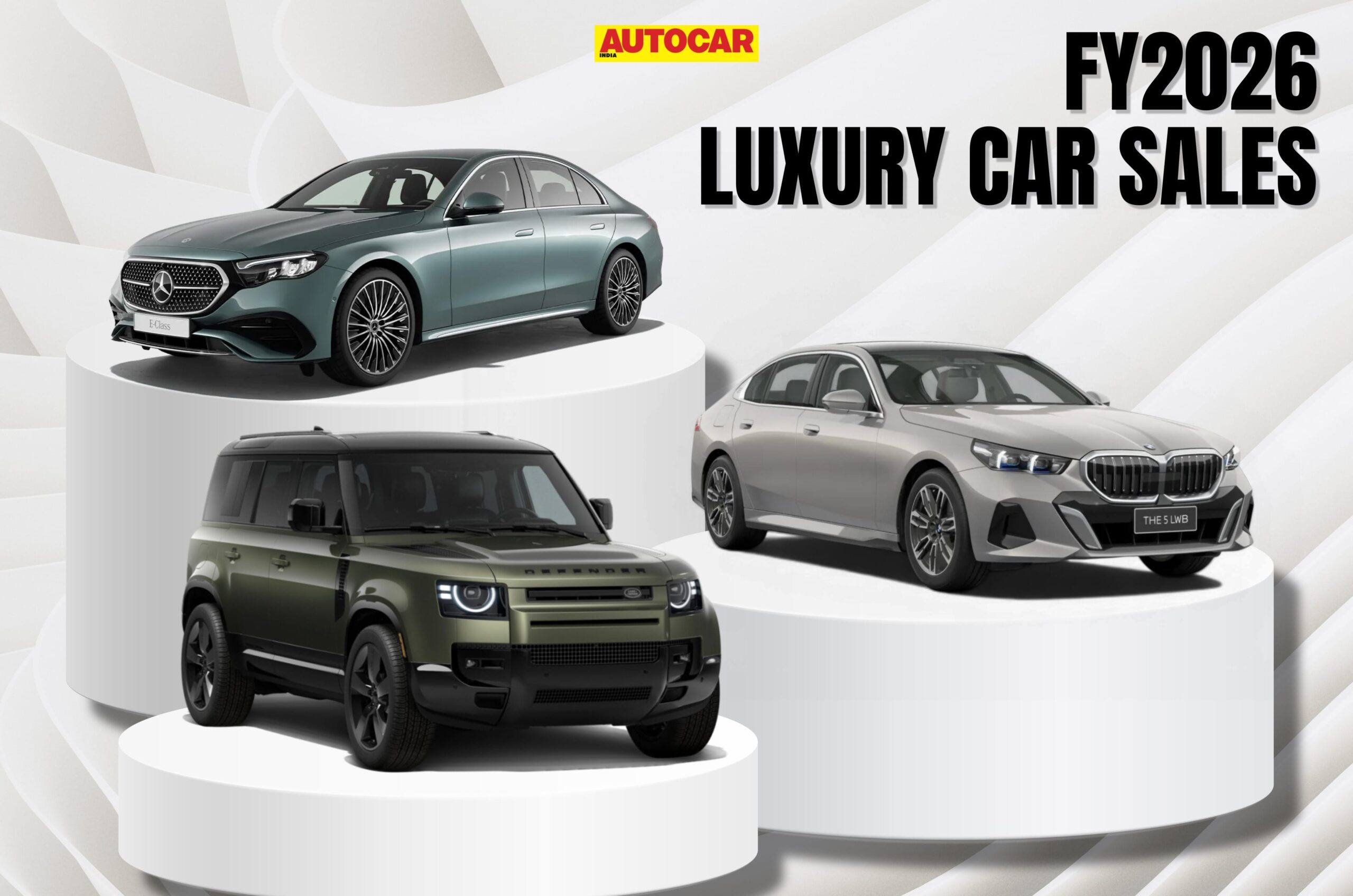
The E-Class Long Wheelbase (LWB) variant continued to be a cornerstone of Mercedes-Benz’s success, maintaining its status as the bestselling luxury car in India throughout FY2026. This sustained popularity highlights the strong demand for comfort-oriented and premium sedans in the Indian market.
BMW: Strong Growth Driven by Key Models and EVs
BMW India emerged as a significant gainer in FY2026, registering the highest YoY sales increase among luxury car manufacturers at nearly 14.5 percent. The German marque sold 17,301 units, up from 15,114 units in the previous fiscal year.
This robust performance also allowed BMW to slightly enhance its market share. A considerable factor contributing to this success was the remarkable surge in BMW’s electric vehicle (EV) sales, which sky-rocketed by 124 percent YoY.
The substantial growth in EV sales significantly boosted BMW’s standing in the luxury EV market. Its share in this segment climbed from 47 percent in FY2025 to over 65 percent in FY2026, underscoring a strategic focus on electrification.
Key models like the iX1 Long Wheelbase (LWB) and the 5 Series LWB were identified as major demand drivers for BMW during FY2026. The strong performance of these specific models, including their electrified variants, resonated well with luxury car buyers.
Jaguar Land Rover (JLR): Steady Gains with Land Rover Leading
Jaguar Land Rover (JLR) India reported a healthy 6.5 percent YoY increase in sales for FY2026, selling 5,698 units compared to 5,350 units in FY2025. This growth signifies a positive trajectory for the combined luxury brand.
Currently, Land Rover models are substantially driving JLR’s sales performance in India. Jaguar, meanwhile, has a limited portfolio, with only the F-Pace SUV available for sale in the Indian market.
Despite the overall sales increase, JLR’s market share experienced a minor dip in FY2026. The brand’s future portfolio expansion remains a key point of interest, particularly concerning potential additions like the upcoming Type 00 EV.
Industry watchers anticipate that Land Rover will continue to be the primary volume generator for JLR throughout FY2027. The ongoing India-UK Free Trade Agreement (FTA) is also a factor that could influence Land Rover’s sales performance in the coming year, potentially offering new avenues for growth or market access.
Volvo: Marginal Decline Amidst Model Refresh
Volvo India’s sales saw a slight decrease of 1.1 percent in FY2026, with the company recording sales of 1,647 units. This is a minor dip from its FY2025 performance.
In 2025, Volvo introduced several updated models to the Indian market, including the facelifted XC90 and XC60 SUVs, alongside the all-new EX30 electric SUV. These launches aimed to invigorate its product lineup.
Out of the total 1,647 vehicles sold by Volvo in FY2026, electric vehicles constituted 382 units. This represented a 5 percent YoY decrease in EV sales for the brand.
Porsche: Ambiguous Growth Amidst Data Gaps
Porsche India sold 697 units in FY2026. However, a precise YoY comparison is challenging as the German performance car manufacturer did not publicly disclose its India-specific sales figures for FY2025.
Despite the lack of comparative data, Porsche reported a 2 percent increase in its EV sales for FY2026. EVs accounted for 8 percent of the brand’s total sales volume in India during the fiscal year.
Audi: Significant Sales Slump
According to FADA data, Audi India experienced a dramatic downturn in sales during FY2026, with a decline of nearly 40 percent. The brand sold only 248 units in the fiscal year.
Audi’s electric vehicle sales in FY2026 stood at 17 units. This figure was remarkably close to the sales volume reported by ultra-luxury marque Rolls-Royce, which sold 15 units, despite the substantial difference in their respective average vehicle price points.
FY2026 Luxury Car Sales Data Summary
The table below provides a consolidated view of the luxury car sales performance for FY2026 and FY2025, including unit sales, YoY change, and market share.
| Brand | FY26 Sales | FY25 Sales | YoY Change | FY26 Market Share | FY25 Market Share |
|---|---|---|---|---|---|
| Mercedes-Benz | 19,363 | 18,928 | 2.3 percent | 0.39 percent | 0.43 percent |
| BMW | 17,301 | 15,114 | 14.47 percent | 0.37 percent | 0.36 percent |
| JLR | 5,698 | 5,350 | 6.5 percent | 0.12 percent | 0.13 percent |
| Volvo | 1,647 | 1,665 | -1.1 percent | -0.04 percent | NA |
| Porsche | 697 | NA | NA | NA | NA |
| Audi | 248 | 412 | -39.8 percent | 0.01 percent | 0.01 percent |
*Data sourced from OEMs and Federation of Automotive Dealers Association (FADA). All prices are ex-showroom, India.
Frequently Asked Questions (FAQ)
Who led the luxury car sales in India in FY2026?
Mercedes-Benz maintained its leading position in the luxury car sales charts for FY2026, selling 19,363 units. This marks a continued dominance in the premium segment.
Which manufacturer showed the highest year-on-year sales growth in FY2026?
BMW recorded the most significant year-on-year sales increase in FY2026, with a growth rate of nearly 14.5 percent. This was driven by strong demand for models like the iX1 LWB and 5 Series LWB.
How did Jaguar Land Rover (JLR) perform in FY2026?
JLR reported a 6.5 percent year-on-year sales increase in FY2026, selling 5,698 units. Land Rover models were the primary contributors to this growth.
What was the sales trend for Audi in FY2026?
Audi experienced a substantial decline in sales in FY2026, with figures dropping by nearly 40 percent. The brand sold 248 units during the fiscal year.
Which models were key growth drivers for BMW in FY2026?
The BMW iX1 LWB and the 5 Series LWB were identified as the key models that garnered significant demand and contributed to BMW’s strong sales performance in FY2026.
Did Mercedes-Benz’s market share increase or decrease in FY2026?
While Mercedes-Benz retained its top sales position, its overall market share slightly decreased from 0.43 percent in FY2025 to 0.39 percent in FY2026.
What was the performance of Volvo’s electric vehicles in FY2026?
Volvo sold 382 electric vehicles in FY2026, which represented a 5 percent year-on-year decrease in its EV sales for the period.