
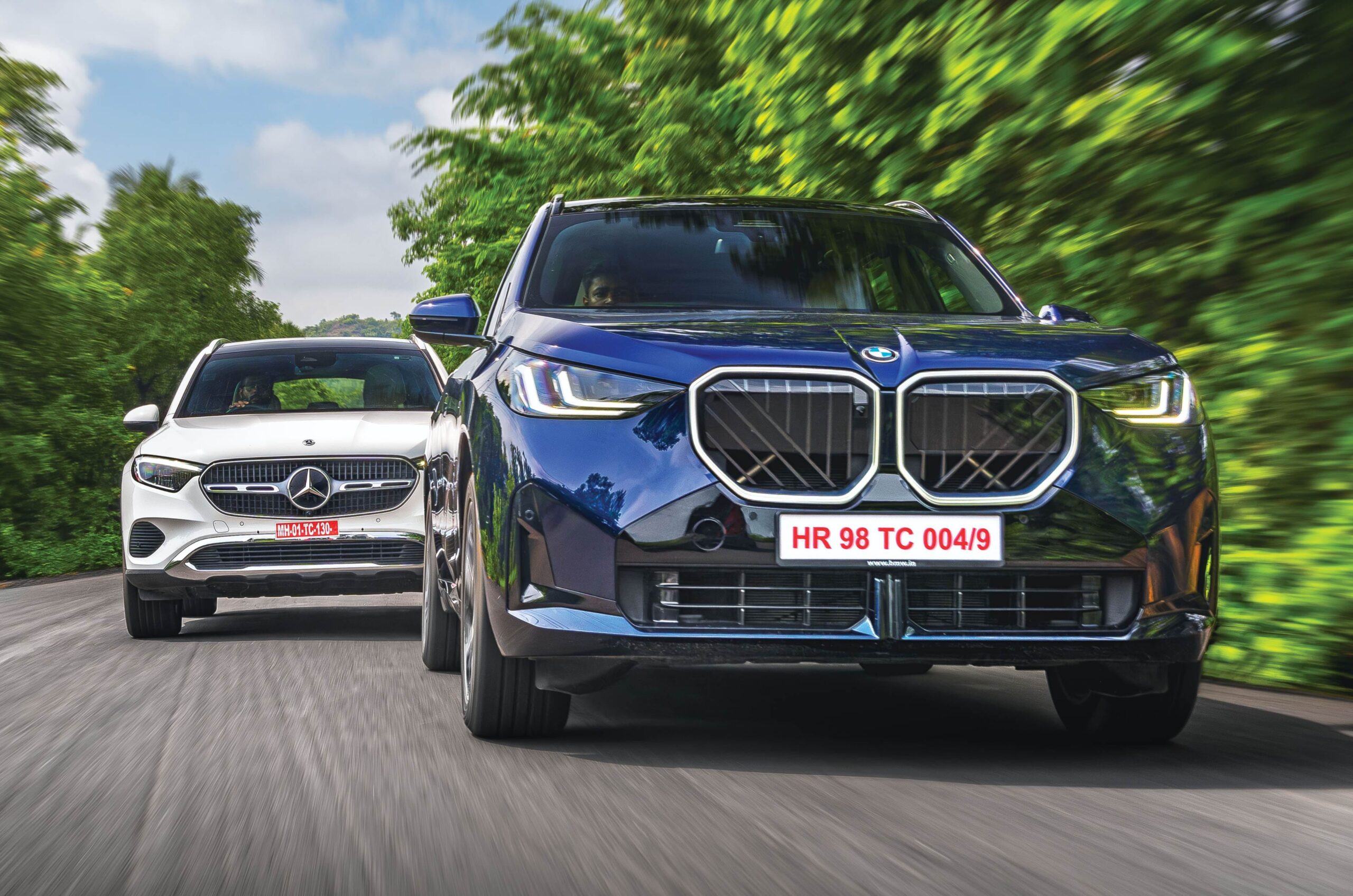
The perennial rivalry between Mercedes-Benz and BMW intensifies when their popular SUVs, the GLC and X3 respectively, go head-to-head. For years, the Mercedes-Benz GLC has been a consistent bestseller for the brand, a status now challenged by the all-new BMW X3. This latest iteration of the X3 boasts increased dimensions and, in true BMW fashion, a distinctive and assertive character. This comparison delves into which of these premium SUVs emerges as the superior choice for discerning buyers.
Mercedes GLC vs. BMW X3: Exterior Design and Road Presence
The X3 commands a stronger road presence due to its larger dimensions.
The newly designed BMW X3 presents a more imposing figure compared to its predecessor, exhibiting greater length, width, and height than the Mercedes-Benz GLC. While its wheelbase is slightly shorter than the GLC’s, its overall presence is undeniable. Both SUVs maintain their respective brand’s design philosophies. The BMW X3 features a moderately sized, illuminated kidney grille complemented by sharp LED headlamps. In its M Sport guise, the X3 is further distinguished by angular bumpers, contributing to a more upright and robust front fascia.

In stark contrast, the Mercedes-Benz GLC adopts a more fluid and curvaceous design language. Its grille is adorned with a generous amount of chrome, and pronounced power lines accentuate the bonnet, hinting at its dynamic capabilities. The side profile reveals the X3’s advantage in terms of road presence, stemming from its increased length, height, and ground clearance. The X3’s boxy silhouette and upright roofline contribute to a classic SUV aesthetic. The GLC, however, offers a sleeker profile with its tapering, almost coupé-like roofline.
Both models are equipped with 19-inch wheels, with the BMW’s design leaning towards a sportier appeal. At the rear, the X3 continues with sharp lines and creases, while the GLC retains its signature flowing curves. This divergence in styling extends seamlessly into their respective interiors.
| Dimensions | Mercedes GLC 300 4Matic | BMW X3 xDrive 20 M Sport |
|---|---|---|
| Length | 4716mm | 4755mm |
| Width | 1890mm | 1920mm |
| Height | 1640mm | 1660mm |
| Wheelbase | 2888mm | 2865mm |
| Boot Capacity | 640 litres | 570 litres |
Mercedes GLC vs. BMW X3: Interior Space and Features
The Mercedes-Benz GLC features a prominent portrait-styled touchscreen.
Inside the new BMW X3, the design ethos leans towards minimalism, presenting a sporty and contemporary dashboard. A notable design element is the extensive use of recycled polyester on the upper dashboard, which mimics a carbon fibre texture. While visually appealing, its rough texture might not resonate with all users, and its porous nature could pose a challenge for dust accumulation in certain conditions.
In line with modern BMW interiors, the X3 integrates the infotainment screen into a single-piece curved display that also houses the digital instrument cluster. A unique, albeit complex, feature is the touch control for airflow direction at the AC vents, which are manually adjustable for direction. This approach feels over-engineered for a frequently used function. The cabin is enhanced by ambient lighting, with crystal elements that illuminate to create a special atmosphere in the dark.
From a comfort standpoint, the X3’s front seats offer superior support and a more accommodating feel than those in the GLC. The additional under-thigh extension and adjustable side bolsters, combined with soft cushioning, make the X3’s seats ideal for long journeys.
The Mercedes-Benz GLC’s interior, in contrast, embraces a more traditional design, which contributes to a perception of greater plushness and luxury. The extensive use of wood and metal accents throughout the cabin elevates both the visual appeal and the tactile experience, giving the GLC a more opulent feel compared to the X3.

The GLC’s 11.9-inch touchscreen, resembling an iPad, is crisp, intuitive, and easy to operate. The overall quality of materials in the GLC is exceptionally high. However, its seats, while comfortable, lack the enhanced support and adjustability found in the X3. The GLC does offer both heating and ventilation for the front seats, whereas the X3 provides only ventilation.
The GLC incorporates ‘seat kinetics’ technology, which, while not a full massage function, effectively reduces fatigue during extended drives. A notable ergonomic drawback in the GLC is its compact footwell, particularly the short dead pedal. Drivers with larger shoe sizes (over UK 10) may find it challenging to comfortably rest their left foot, which can become tiresome on long drives.
Both SUVs lack a reclinable rear backrest.
Despite its growth in size, the latest-generation X3 has a shorter wheelbase than the GLC. Nevertheless, it offers ample kneeroom and width in the rear. The upright roofline ensures generous headroom, and the larger seat base provides better under-thigh support. The X3’s rear seating position is more upright. Both SUVs unfortunately omit the convenience of a reclinable rear backrest.
The central passenger in both the X3 and GLC will have to contend with a substantial centre tunnel. Both vehicles feature large windows and manual sunblinds. The X3’s expansive glass roof significantly enhances the sense of spaciousness within the cabin.

The Mercedes-Benz GLC benefits from a longer wheelbase, translating into superior rear-seat legroom. Scooped-out front seats further contribute to this enhanced kneeroom. While the rear backrest is also upright, it offers slightly better support than the X3’s. However, the short seat squabs in the GLC limit under-thigh support. The GLC’s split-opening panoramic sunroof, while not offering an uninterrupted sky view, effectively ventilates the cabin. The use of high-quality materials, harmoniously blended with wood and metal, distinguishes the GLC’s interior. The BMW’s textured panels, though modern, lack the same plush tactile quality.
In terms of luggage capacity, the Mercedes-Benz GLC leads with a substantial 640 litres, compared to the X3’s 570 litres. Both SUVs come with a space-saver spare wheel located beneath the boot floor. However, the X3 offers more convenient access to its boot, owing to a wider opening and a lower load floor.
Key vehicle functions are integrated into the central touchscreens of both SUVs.
Both the GLC and X3 rely heavily on their touchscreen infotainment systems for controlling most functions, including climate control and vehicle settings, with minimal physical buttons. The Mercedes-Benz MBUX system in the GLC is notably more user-friendly than the X3’s system. Basic functions like climate control are readily accessible on the GLC’s screen. In contrast, the BMW system often requires multiple taps, and its small font size can lead to accidental selections while driving.
The GLC further enhances its usability with an off-road mode that intelligently adjusts traction and a ‘transparent bonnet’ feature. This function uses front camera feeds to display an under-car view, proving useful for parking and navigating uneven terrain. Both SUVs offer park assist, but the X3’s system is generally considered easier to operate.
| Features and Safety Kit | Mercedes GLC 300 4Matic | BMW X3 xDrive 20 M Sport |
|---|---|---|
| LED Headlamps | Yes | Yes |
| Powered Seats | Yes | Yes |
| Climate-control Seats | Ventilated and heated | Ventilated |
| Massage Seats | Seat kinetics | NA |
| Panoramic Sunroof | Split-opening | Fixed glass roof |
| Electronic Steering Adjust | Yes | NA |
| Head-Up Display | Yes | Yes |
| Apple CarPlay/Android Auto | Wireless | Wireless |
| Climate Control | 2-zone | 3-zone |
| Rear Backrest Recline | NA | NA |
| Rear Sunblinds | Yes | Yes |
| Electric Tailgate | Yes | Yes |
| Spare Wheel | Space-saver | Space-saver |
| Adaptive Suspension | NA | Yes |
| ADAS | Yes | Yes |
| Off-road Mode | Yes | NA |
| Airbags | 10 | 8 |
Mercedes GLC vs. BMW X3: Performance and Refinement
The GLC offers superior power and quicker acceleration to 100 kph.
For a harmonious blend of performance and refinement, the petrol variants of these luxury SUVs are compelling choices. Both are powered by a 2.0-litre turbo-petrol engine, but with a significant difference in output. The Mercedes-Benz GLC 300 produces 258hp, considerably more than the BMW X3’s 190hp. Furthermore, the GLC boasts an additional 90Nm of torque, which aids its acceleration capabilities.
This power advantage translates into a tangible performance difference: the GLC accelerates to 100 kph nearly 2 seconds faster than the X3. Both SUVs are equipped with all-wheel-drive systems for optimal traction. More importantly, the GLC demonstrates quicker in-gear acceleration, making overtaking manoeuvres more effortless and responsive.
Both vehicles incorporate a 48V mild-hybrid system, providing an additional torque boost during acceleration and in Sport modes to sharpen powertrain responses. The X3 specifically features a ‘Boost’ mode, which offers a 10-second surge of acceleration when the paddle is held. Additionally, the X3 includes an ‘Individual’ drive mode, allowing drivers to customise engine response and steering weight for a personalized driving experience. While the Mercedes offers a straightforward setup, the X3’s customization requires navigating through Sport mode settings.
However, the X3 possesses a key advantage with its adaptive dampers for the suspension system, which significantly influences its ride and handling characteristics.
| Engine Specifications | Mercedes GLC 300 4Matic | BMW X3 xDrive 20 M Sport |
|---|---|---|
| Engine | 4-cylinder, 1999cc petrol | 4-cylinder, 1998cc petrol |
| Power | 258hp (+23hp mild-hybrid) at 5800rpm | 190hp (+18hp mild-hybrid) at 4400-6500rpm |
| Torque | 370Nm (+23hp mild-hybrid) at 5800rpm | 310Nm (+200Nm mild-hybrid) at 1500-4000rpm |
| Gearbox | 9-speed automatic | 8-speed automatic |
| Suspension (Front) | Independent, MacPherson struts with coil springs | Independent, MacPherson struts with coil springs, adaptive dampers |
| Suspension (Rear) | Independent, multi-link, anti-roll bar with coil springs | Independent, multi-link, anti-roll bar with coil springs and adaptive dampers |
| Acceleration (in seconds) | Mercedes GLC (seconds) | BMW X3 (seconds) |
|---|---|---|
| 0-20 kph | 0.83 | 0.98 |
| 0-40 kph | 1.78 | 2.29 |
| 0-60 kph | 3.16 | 3.86 |
| 0-80 kph | 4.82 | 5.94 |
| 0-100 kph | 6.96 | 8.68 |
| 0-120 kph | 9.68 | 12.03 |
| 20-80 kph | 4.2 | 5.67 |
| 40-100 kph | 4.88 | 6.79 |
Mercedes GLC vs. BMW X3: Ride Comfort and Handling
The X3’s firmer suspension setup provides composed handling, particularly in corners.
Both SUVs aim to strike an optimal balance between performance and comfort, with comfort often taking slight precedence. The Mercedes-Benz GLC is equipped with a passive suspension tuned for a soft setup, resulting in a more compliant ride over uneven surfaces and less pronounced body movement at lower speeds. The BMW X3, conversely, features a firmer suspension. Even in its Comfort mode, it is not as softly sprung as the GLC. However, when driven at higher speeds, the X3 excels with a flat and composed ride, especially noticeable during cornering.
The GLC performs admirably, but the X3’s enhanced stiffness in Sport mode gives it a distinct advantage in handling dynamics. While body roll is minimal in both SUVs, the X3 further distinguishes itself with its precise steering setup and adaptive dampers. For drivers who prioritize engaging handling, the X3 offers a more compelling proposition.
The adaptive dampers in the X3 contribute significantly to its ability to maintain a flat attitude during cornering, enhancing driver confidence and providing a more dynamic experience. This technological advantage allows the X3 to better manage body movements, even under spirited driving conditions.
Mercedes GLC vs. BMW X3: Price and Verdict
The price difference between the two SUVs is negligible, just Rs 50,000.
With the Mercedes-Benz GLC priced at Rs 75.30 lakh and the BMW X3 at Rs 75.80 lakh, their prices are virtually identical, making the decision less about cost and more about preference. Both vehicles are remarkably close in almost every other aspect, presenting a challenging choice for potential buyers.
The BMW X3, with its larger dimensions and contemporary design, commands a stronger road presence. The Mercedes-Benz GLC, with its softer, more rounded aesthetic, appeals to a different sensibility. Internally, the BMW’s cabin offers a sporty ambiance, but the GLC ultimately edges ahead with its more opulent interior and superior material quality.
In terms of interior space, the GLC offers more room, yet the BMW X3 provides superior seating comfort. On the road, the GLC’s softer suspension delivers a plusher ride, while the X3’s sharper handling around bends offers a more engaging driving experience. However, the GLC’s significant power advantage makes it the more exciting of the two in terms of outright performance.
Considering its elegant styling, more luxurious interior, compliant ride, and a more potent engine, the Mercedes-Benz GLC delivers more of what typical buyers seek in this premium SUV segment. Therefore, the GLC emerges as the winner in this closely contested comparison.