
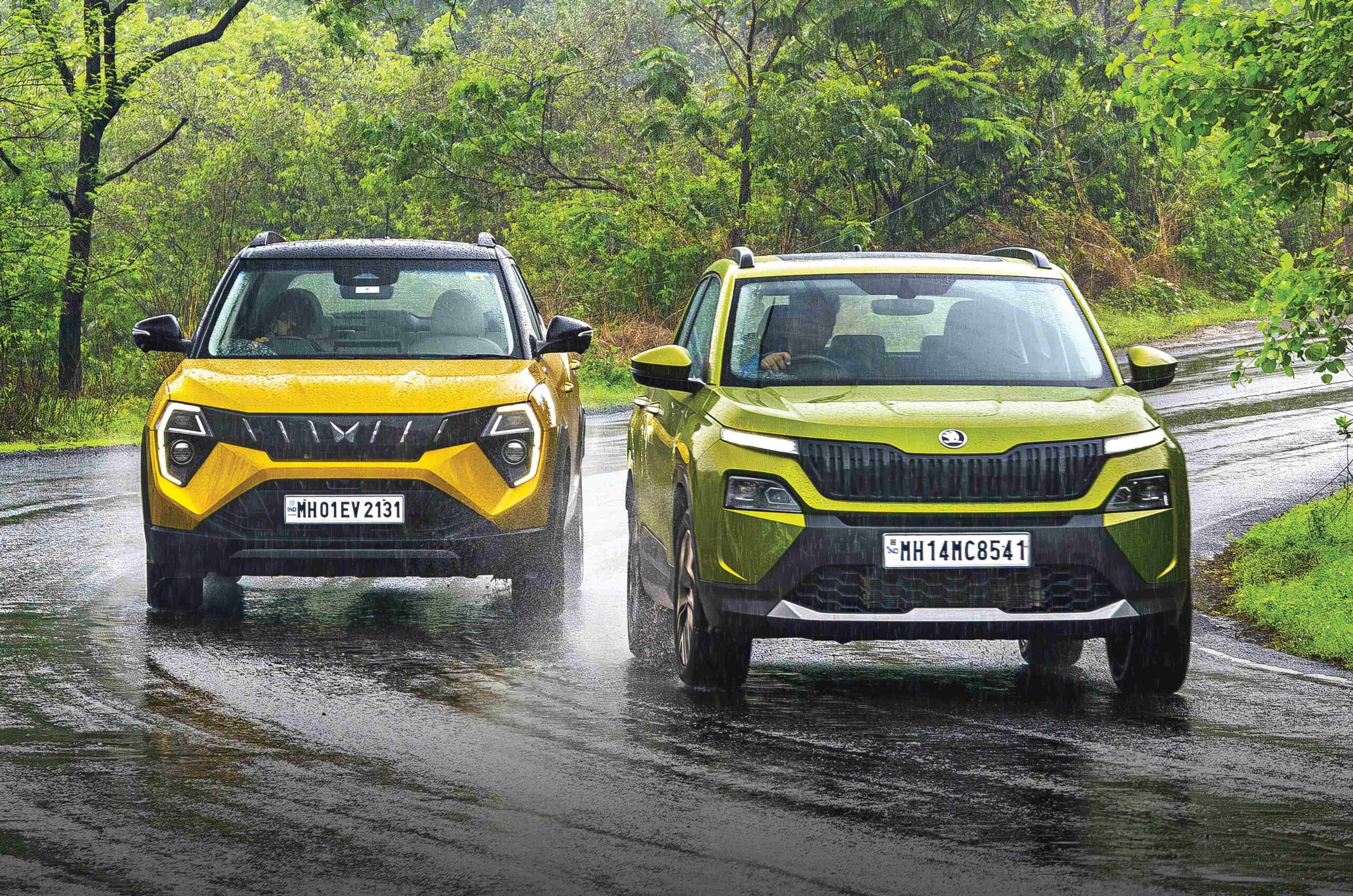
The compact SUV segment in India continues its robust expansion, attracting new contenders and intensifying competition. The latest entrant vying for a piece of this lucrative market is the Skoda Kylaq. Positioned as a more compact and accessible offering, the Kylaq aims to replicate the appeal of its larger sibling, the Skoda Kushaq. This raises a crucial question for potential buyers: how does the new Skoda Kylaq stack up against the reigning champion of our previous compact SUV comparison, the Mahindra XUV 3XO?
Skoda Kylaq vs Mahindra XUV 3XO: Exterior Design and Engineering Insights
Kylaq presents a proportionate and mature aesthetic, while the 3XO boasts a distinctive, bold styling.

Examining their exterior appeal, both models fall under the 4-meter length mark, a key factor for India’s tax structure. However, the Skoda Kylaq strikes a more balanced and proportionate visual chord. Its design is characterized by a signature wide front grille, distinctive split headlamps, and a robust bumper, all contributing to a strong road presence. The side profile is enhanced by 17-inch alloy wheels, substantial body cladding, and roof rails, lending it a rugged, outdoorsy feel. A faux scuff plate at the rear further emphasizes this adventurous persona. Despite these elements, the somewhat small, square tail-lights might lead some to perceive it more as a hatchback than a full-fledged crossover.
XUV 3XO Styling: A Distinctive Choice That May Divide Opinions
In contrast, the Mahindra XUV 3XO’s rear profile appears more sharply defined, a consequence of its platform being derived from the longer, 4-meter plus SsangYong Tivoli. Aligning with Mahindra’s recent design language, the XUV 3XO features a polarizing, yet undeniably unique aesthetic. Its front fascia is marked by vertically oriented headlights, striking C-shaped daytime running lights, and a sharply sculpted bumper, creating a memorable and distinctive face. Similar to the Skoda, the Mahindra also sports 17-inch wheels, protective body cladding, and roof rails to enhance its SUV credentials. The rear is distinguished by a full-width LED light bar and a robust bumper design.
While both SUVs measure just under 4 meters, the XUV 3XO presents a visually more substantial impression. It holds the distinction of being the widest vehicle in its segment and boasts the longest wheelbase, measuring 2,600 mm compared to the Kylaq’s 2,566 mm. The Mahindra also offers a higher ground clearance of 201 mm, surpassing the Skoda’s 189 mm. However, the Skoda Kylaq takes a notable lead in cargo capacity, offering a generous 360 liters of boot space up to the parcel shelf, whereas the XUV 3XO provides 295 liters. Both models benefit from split-folding rear seats to expand cargo volume, but the Skoda’s deeper boot offers greater practicality.
Skoda Kylaq vs Mahindra XUV 3XO: Interior Space and Comfort Comparison
Kylaq Interior: Robust Build Quality Meets an All-Black Scheme
The Kylaq’s cabin exudes a sporty vibe with its all-black theme and subtle green accents, complemented by solid build quality.
Internally, both SUVs adopt distinct approaches. The Skoda Kylaq’s interior strongly echoes the design philosophy of the Kushaq, featuring familiar elements such as the high-quality two-spoke steering wheel, a digital instrument cluster, and an intuitive touch-based panel for climate control. Skoda has injected a dose of flair with distinctive olive green inserts adorning the dashboard, door panels, and center console, set against a textured fascia. The overall design is clean, uncluttered, and exudes a sense of solid construction, further reinforced by the reassuring ‘thud’ experienced when closing the doors.
Despite a dual-tone theme, the predominantly black upholstery can contribute to a feeling of being somewhat enclosed, particularly when compared to the more airy XUV 3XO. The Kylaq’s interior is highly practical, featuring large door bins, numerous storage cubbies, and signature Skoda ‘Simply Clever’ touches. These include convenient phone slots on the front seatbacks, a ticket holder on the windshield, and thoughtful organizers.

Headroom and kneeroom are adequate, but the cabin’s width comfortably accommodates only two passengers in the rear.
The front seats in the Kylaq offer superior support and come equipped with electric adjustment and ventilation, providing a distinct advantage over the XUV 3XO in this regard. However, in terms of rear-seat comfort, the Kylaq lags behind the Mahindra. While it provides sufficient legroom and headroom for average-sized adults, the narrow cabin and seat contouring make it best suited for two occupants. Rear passengers are treated to their own AC vents, Type-C charging ports, adjustable headrests, and a convenient center armrest with cupholders.
XUV 3XO Cabin: An Airy and Premium Ambiance
The XUV 3XO’s cabin feels more premium, thanks to the use of soft-touch materials and a lighter upholstery scheme.
In comparison, the Mahindra XUV 3XO’s interior offers a more upmarket look and feel. The lighter-colored upholstery significantly enhances the sense of spaciousness, a feeling further amplified by the panoramic sunroof. However, the ivory seats may present a challenge in maintaining cleanliness. Higher variants feature soft-touch materials on the dashboard and a generous application of gloss black trim. Elements such as the steering wheel, window switches, and light/wiper stalks exude a premium quality. A welcome inclusion is the XUV 3XO’s retention of physical buttons and knobs for the dual-zone climate control, offering tactile user interaction. Much like the Kylaq, the XUV 3XO provides ample storage solutions within the cabin, including large door bins and a well-sized, cooled glovebox.

The XUV 3XO’s rear seat offers more room, comfortably accommodating three adults.
Occupants will appreciate the commanding view from the XUV 3XO’s cabin, with the bonnet flares contributing to a definitive SUV driving sensation. While the front seats are well-cushioned, they may not offer the same level of support as the Kylaq’s, and the absence of electric adjustment and ventilation is a noticeable omission. The most significant advantage for the Mahindra lies in its rear seating. The broader cabin comfortably accommodates three adults abreast, and the extended wheelbase ensures ample legroom. The only slight compromise is in headroom for taller individuals exceeding 6 feet, attributable to the mechanism for the panoramic sunroof. Rear amenities include AC vents, a center armrest with cupholders, a 12V power outlet, and a USB Type-C charger.
Skoda Kylaq vs Mahindra XUV 3XO: Features and Safety Assessment
Both the Skoda Kylaq and the Mahindra XUV 3XO, in their top-spec configurations, are impressively equipped. Common features across both models include LED headlamps, 17-inch alloy wheels, a sunroof, wireless phone charging, a digital instrument cluster, a touchscreen infotainment system with wireless smartphone integration, leatherette upholstery, automatic climate control, six airbags, traction control, and ISOFIX child seat mounts. Significantly, both the Kylaq and the XUV 3XO have earned a 5-star BNCAP safety rating, underscoring their commitment to occupant protection. However, each vehicle also offers unique features that set them apart.
Kylaq’s Advantage: Powered and Ventilated Front Seats
Ventilated front seats are a unique comfort feature offered exclusively by the Skoda Kylaq.
The Skoda Kylaq distinguishes itself with powered and ventilated front seats, a feature absent in the XUV 3XO. The audio system in the Skoda, comprising 4 speakers and 2 tweeters, delivers a more consistent sound output. While the Kylaq utilizes smaller 10-inch and 8-inch screens for infotainment and the instrument cluster respectively, its system boasts a newer user interface compared to its counterparts, offering a slick operation and pleasing graphics.
XUV 3XO’s Advanced Suite: Level 2 ADAS, 360-Degree Camera, and More
The XUV 3XO’s panoramic sunroof is a significant draw for buyers seeking an expansive cabin experience.
The Mahindra XUV 3XO, specifically the featured AX7 L variant, offers a larger panoramic sunroof, expansive 10.25-inch screens for both the infotainment system and digital cluster, an electronic parking brake, a 360-degree camera, enhanced connected car technology, a premium 7-speaker Harman Kardon audio system, rear disc brakes, and the advanced Level 2 ADAS suite. The ADAS system includes features like a blind-spot monitor, autonomous emergency braking, and lane-keep assist, offering a significant safety and convenience boost over the Kylaq’s top-tier Prestige variant. These ADAS features perform effectively on well-marked roads and can be deactivated for drivers who prefer manual control. The blind-spot monitor, displayed within the instrument cluster, proved to be particularly useful during testing.
Skoda Kylaq vs Mahindra XUV 3XO: Performance and Refinement Comparison
Both SUVs are propelled by 3-cylinder, direct-injection, turbo-petrol engines, differing in displacement and power output. The Skoda Kylaq is equipped with a 1.0-liter engine generating 115 horsepower and 178 Nm of torque. In contrast, the Mahindra XUV 3XO features a larger 1.2-liter engine that produces 131 horsepower and 230 Nm of torque. Both tested variants utilized the same Aisin-sourced 6-speed torque converter automatic transmission.
The 131hp 1.2L engine in the XUV 3XO delivers strong performance throughout the rev range.
Given the difference in power and torque figures, the Mahindra XUV 3XO exhibits superior acceleration, completing the 0-100 kph sprint in 11.05 seconds, compared to the Skoda Kylaq’s 11.69 seconds. In mid-range acceleration tests, specifically the 20-80 kph run, both SUVs recorded an identical time of 6.38 seconds, although the Skoda was marginally slower in the 40-100 kph acceleration.
Skoda 1.0 TSI Engine: Punching Above Its Weight
The 115hp 1.0 TSI engine in the Kylaq demonstrates impressive performance for its size.
The Kylaq’s engine exhibits a slightly slower response at lower speeds, an aspect drivers may need to adapt to in city traffic. However, once past the initial lag, power delivery becomes smooth, facilitating effortless progress. The 1.0 TSI engine consistently punches above its weight, offering significantly more grunt than its displacement might suggest, particularly evident in the mid-range. The inclusion of paddle shifters enhances driver engagement and allows for better utilization of the mid-range power. Even in fully automatic mode, the gearbox operates smoothly. While the Kylaq’s engine is refined in isolation, it is noticeably noisier when compared to the XUV 3XO’s unit.
XUV 3XO: Punchier Performance at Lower Speeds
The Mahindra XUV 3XO benefits from a substantial advantage in power and torque, which is palpable right from the start. The vehicle’s drive modes allow for further customization of the driving experience. In city driving conditions, the XUV 3XO feels more responsive at lower speeds, especially in ‘Zip’ mode, which offers the smoothest power delivery. Engaging ‘Zap’ or ‘Zoom’ modes in tight traffic can lead to an abrupt surge of power, which might be less desirable in congested scenarios.
The selectable drive modes influence both engine response and steering feel.
When the road opens up, switching to ‘Zap’ or ‘Zoom’ mode allows the engine to breathe more freely, delivering a distinct surge in performance. While the Kylaq’s engine excels in the mid-range, the XUV 3XO’s motor feels potent throughout the entire rev band. It remains alert and responsive from low RPMs, providing a consistent and steady stream of power even in the mid-range, negating the need to work the engine excessively to extract performance.
Paddle shifters contribute to the engaging driving dynamics of the Skoda Kylaq.
The XUV 3XO is undeniably quick and enjoyable to drive, though the absence of paddle shifters is a notable omission for enthusiasts. Gear shifts via the selector lever are sufficiently responsive. A remarkable aspect of the Mahindra’s engine is its refinement; even when pushed hard, it exhibits minimal vibration, defying expectations for a 3-cylinder unit.
Skoda Kylaq vs Mahindra XUV 3XO: Fuel Efficiency Figures
XUV 3XO Proves More Frugal in City Conditions
The Kylaq achieved better mileage on the highway, while the XUV 3XO consumed less fuel in city driving.
In our comprehensive fuel efficiency tests conducted in Mumbai city and on the highway, the Mahindra XUV 3XO emerged as the more economical option in urban driving, achieving 9.9 kpl. The SUV’s auto start-stop system likely contributed to this improved city mileage by conserving fuel during idle periods. The Skoda Kylaq recorded 8.7 kpl in city conditions. However, on the highway, the Kylaq slightly edged ahead, delivering 13.3 kpl compared to the XUV 3XO’s 13 kpl.
Skoda Kylaq vs Mahindra XUV 3XO: Ride Comfort and Handling Dynamics
Kylaq Excels in Cornering, While XUV 3XO Offers Superior High-Speed Stability
On winding roads, the Skoda Kylaq offers a more engaging driving experience. Lacking steering modes, the Kylaq features a lighter, yet precise and smooth steering wheel, making cornering a delightful affair. The chassis feels robust enough to handle more powerful engine options, hinting at potential for higher-performance variants. On the highway, the Kylaq rides with the composure of a larger vehicle. However, over uneven surfaces, it exhibits more vertical movement compared to the XUV 3XO. In terms of low-speed ride comfort, the Kylaq proves more absorbent, particularly over bumps and potholes, with a slightly greater wheel travel evident.
The XUV 3XO’s drive modes significantly alter the steering feedback and overall driving dynamics.
The Mahindra XUV 3XO also provides an enjoyable experience on twisty roads. Its drive modes effectively modulate steering weight, offering progressive resistance. Drivers experience a strong sense of control through the steering wheel, and the vehicle’s grip around corners is a standout feature, allowing for confident high-speed cornering. At higher speeds, the XUV 3XO feels poised and composed, benefiting from a comparatively flatter ride than the Kylaq. On the downside, its low-speed ride is marginally firmer than the Skoda’s, though not to a degree that would be considered a significant drawback.
Skoda Kylaq vs Mahindra XUV 3XO: Pricing and Final Verdict
Compact SUVs Offer Competitive Pricing with Feature Trade-offs
While both SUVs offer compelling driving experiences, the Mahindra XUV 3XO feels like a more comprehensive package overall.
In terms of pricing, the Skoda Kylaq and Mahindra XUV 3XO are positioned competitively for comparable trim levels. The range-topping XUV 3XO AX7 L, as tested, comes with a premium price tag of Rs 15.79 lakh (ex-showroom, Mumbai). However, opting for the AX7 variant, which omits ADAS, the 360-degree camera, and the electronic parking brake, brings the price down to Rs 13.99 lakh. This price point is identical to that of the top-spec Skoda Kylaq Prestige AT. When comparing variants at similar price points, there are feature variations, but the overall value proposition remains very close.
Both vehicles deliver closely matched driving experiences, with the XUV 3XO holding a slight edge in outright acceleration, while the Kylaq offers more engaging handling and a marginally more absorbent ride. Where the XUV 3XO pulls ahead is in its more plush interior, greater engine refinement, and superior passenger space. The advantage in fuel economy further tips the scales in Mahindra’s favor. While both SUVs will undoubtedly appeal to driving enthusiasts, the Mahindra XUV 3XO ultimately provides a greater sense of overall value for money.