
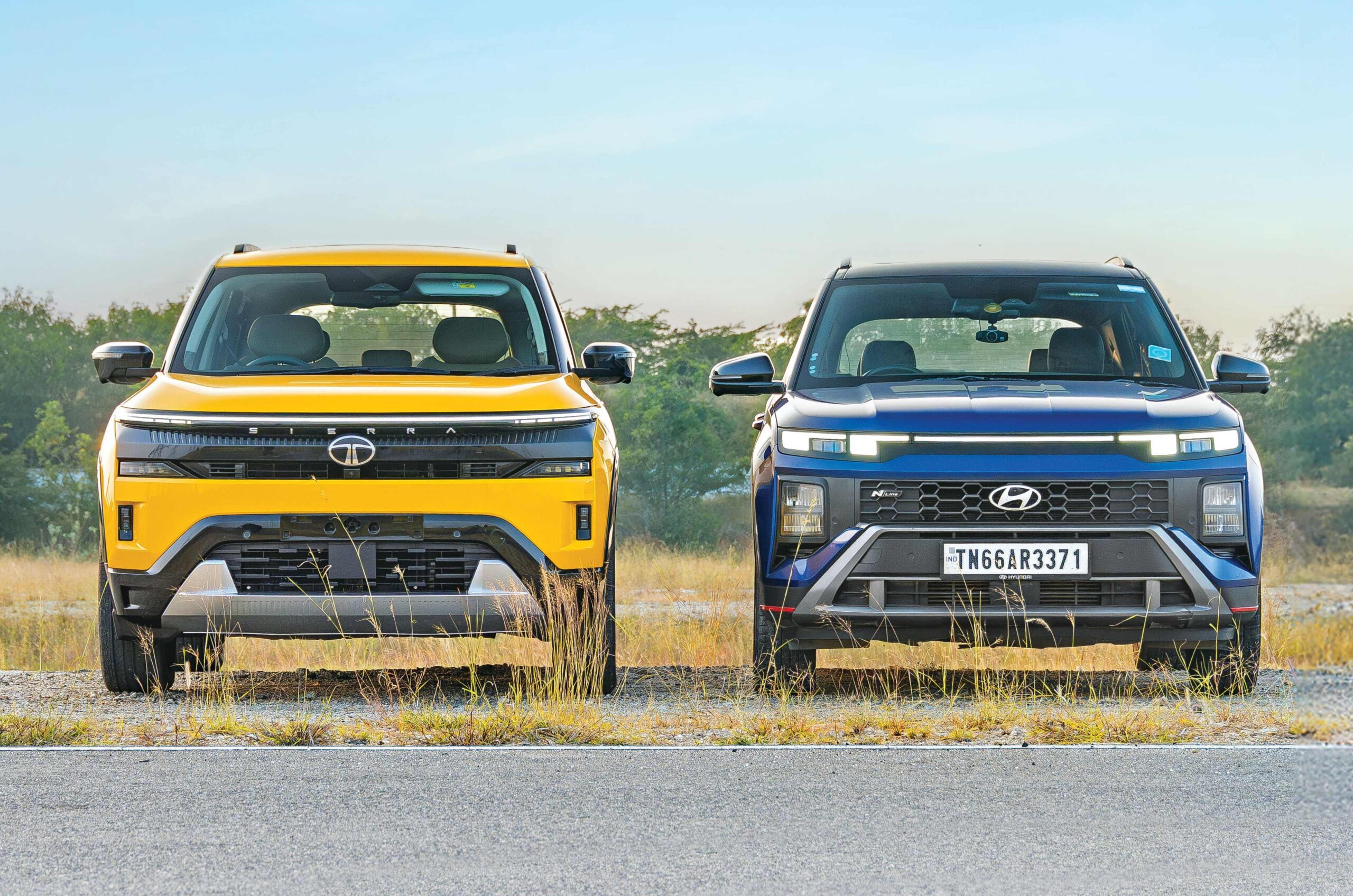
The Hyundai Creta has long been the undisputed leader in the fiercely competitive midsize SUV segment in India. Despite facing numerous challengers over the years, the Creta has consistently held its ground. Now, a formidable new rival has emerged, aiming to dethrone the segment benchmark.
Introducing the Tata Sierra
The all-new Tata Sierra has arrived, generating significant excitement. It revives a legendary moniker and boasts a striking design that pays homage to its iconic predecessor while incorporating modern styling cues. Inside, the Sierra offers an upmarket cabin, an extensive equipment list, and multiple powertrain options, suggesting Tata Motors is well-prepared to take on the established players.

For this head-to-head comparison, we feature the top-spec Tata Sierra Accomplished Plus variant, equipped with a 1.5-litre direct-injection turbo-petrol engine paired with an automatic transmission. It faces off against the sportiest variant of the Hyundai Creta – the N Line N10 dual-tone. The Creta N Line is powered by a 1.5-litre direct-injection turbo-petrol engine and is priced at Rs 20.09 lakh (ex-showroom). The Sierra’s list price stands at Rs 20.99 lakh. While their specifications appear closely matched on paper, their on-road characters reveal distinct differences.
Exterior Design: Presence vs. Sportiness
Tata Sierra: Commanding Road Presence
The Tata Sierra undeniably makes a stronger visual statement due to its larger dimensions. Its taller stance, imposing proportions, 19-inch alloy wheels, and the eye-catching ‘Andaman Adventure’ yellow paint on the test vehicle contribute to significant road presence. The design cleverly blends nostalgia with modernity, featuring a wraparound glass effect reminiscent of the original Sierra, alongside clean surfacing and upright proportions that feel contemporary. However, the bluff rear design might be a point of contention for some.
Hyundai Creta N Line: Sporty Aesthetics
In contrast, the Hyundai Creta N Line presents a sportier facade. The facelifted Creta, launched in 2024, receives a dose of aggression with red accents, revised bumpers, twin muffler tips, unique badging, and sportier alloy wheels. While it may not command the same immediate attention as the Sierra, the Creta N Line feels cohesive and polished, exhibiting tighter panel gaps and consistently strong fit and finish.
Interior and Features: A Tale of Two Cabins
Tata Sierra: Premium and Tech-Focused
The Sierra’s cabin exudes a distinctly modern ambiance, with Tata Motors’ evident efforts to elevate perceived quality. The material quality and overall finish are arguably the best seen from the brand to date. The dashboard is dominated by a seamlessly integrated triple-screen layout. The relatively low-set dashboard, combined with a commanding seating position, enhances forward visibility. The front seats are broad and supportive, with adjustable under-thigh support contributing to comfort for taller occupants.
Infotainment and Convenience in the Sierra
The infotainment system is slick and responsive, featuring sharp resolution and one of the segment’s best 360-degree camera displays. The dedicated passenger screen adds a touch of luxury. Furthermore, the Dolby Atmos sound system delivers robust output, though some might find its bass-heavy tuning slightly overwhelming.
However, usability isn’t entirely flawless. The gear selector lacks tactility and can be slow to respond, occasionally shifting to neutral during quick parking manoeuvres. The touch-sensitive HVAC control panel is less user-friendly while driving. The wireless charging pad, positioned ahead of the centre console, is a smart concept but compromised by its smooth base, causing phones to slide out under acceleration or cornering.

Rear Seat Space and Boot Capacity
At the rear, space is a clear advantage for the Sierra. Thanks to its longer wheelbase, it offers generous knee room and excellent headroom. The bright upholstery, coupled with the expansive panoramic sunroof, enhances the sense of airiness. Seating three abreast is more comfortable, with all occupants receiving adjustable headrests.
Tata claims a boot capacity of 622 litres up to the roof, but measured below the parcel shelf, it is approximately 450 litres. While its loading lip is slightly higher, the Sierra’s squarer cargo area makes it more accommodating for luggage.
Hyundai Creta N Line: Sporty and Functional
The Creta N Line’s cabin adopts a contrasting approach with all-black upholstery and red accents, reinforcing its sporty theme. While the darker tones can limit the sense of spaciousness, the design is effective, and the overall fit and finish are exemplary. However, it doesn’t offer the same generous use of soft-touch materials as the Sierra.
Infotainment and Usability in the Creta
The dual displays are crisp and intuitive. While the infotainment system requires a wired connection for Apple CarPlay and Android Auto (lacking wireless functionality without an aftermarket adapter), its user interface remains among the best in the segment. Crucially, Hyundai retains physical buttons for climate control and other key functions, offering a significant advantage in everyday usability. The controls operate with impressive finesse.

Cabin Space and Boot Comparison
The Creta’s cabin is slightly narrower, and a larger central tunnel compromises middle-seat comfort. The front seats are supportive, but the fixed armrest can slightly detract from long-distance comfort. Rear space is adequate, but the Sierra holds a noticeable advantage in headroom and cabin width.
The Creta’s 433-litre boot is smaller and feels less usable compared to the Sierra’s cargo area.
Powertrain and Performance: A Surprising Outcome
Engine Specifications
Both SUVs are powered by a 1.5-litre direct-injection turbo-petrol engine that produces 160 hp. Torque figures are nearly identical, with the Sierra at 255 Nm and the Creta at 253 Nm. However, a significant differentiator is their weight: the Sierra weighs 1,552 kg, making it 183 kg heavier than the Creta.
Sierra’s Performance and Refinement
Despite its weight disadvantage, Tata’s new 1.5-litre Hyperion engine impresses with its performance, refinement, and smoothness. Power delivery is linear and strong at lower revs, building speed progressively without abrupt surges. The 6-speed torque converter automatic complements this relaxed character, delivering smooth and unobtrusive shifts, even during kickdown. It prioritizes comfort over urgency, upshifting relatively early and not revving as high as the Creta’s engine.
On the highway, the Sierra feels effortless, with ample power available for overtakes. Its added mass tends to mask the sensation of speed. Despite this, it is a surprisingly quick vehicle, accelerating from 0-100 kph in just 9.49 seconds – a remarkable 0.59 seconds quicker than the Creta. This performance gap widens further at higher speeds.
Creta N Line’s Engaging Performance
Switching to the Creta N Line, the difference in engine character is apparent. Its turbo-petrol engine feels more eager, freer revving, and delivers its performance in a more dramatic fashion. While both cars offer drive modes, the Sport mode in the N Line sharpens responses more noticeably.
Although the Hyundai’s 7-speed dual-clutch automatic isn’t the quickest, it feels more responsive than the Sierra’s torque converter, which is tuned more for smoothness. The Creta’s paddle shifters offer better manual control, enhancing driver engagement significantly more than the Sierra’s paddles, which often fail to respond promptly due to a more conservative calibration.
On the flip side, in stop-and-go city traffic, the Hyundai’s gearbox can occasionally feel a bit jerky.
Ride Comfort: Sierra Excels
Tata Sierra’s Superior Ride Quality
Like many modern Tata vehicles, the Sierra excels in ride comfort. Aided by frequency-selective dampers, it absorbs road imperfections with confidence. While there’s a hint of firmness at low speeds, especially with the 19-inch wheels, the Sierra feels composed and robust even over broken surfaces. Its high 205mm ground clearance enhances driver confidence on rough roads. Handling is stable, and its mature road manners contribute to its touring capabilities, although the steering, while light, lacks sharpness.
Hyundai Creta N Line’s Agile Handling
Being the lighter car, the Creta N Line feels considerably more agile and playful. It is more nimble, with a more direct steering and better front-end response. In terms of ride comfort, the N Line feels stiffer, and its ability to absorb bumps is not as forgiving as the Sierra’s, particularly on badly broken roads.
Verdict: A New Benchmark Emerges
The Hyundai Creta’s long-standing dominance in the midsize SUV segment is a testament to its well-rounded package. It successfully appeals to buyers with its user-friendliness, spaciousness, comfort, refinement, extensive features, and Hyundai’s extensive service network.
With a price range of Rs 10.79 lakh to Rs 20.20 lakh, the Creta caters to a broad spectrum of customers, offering multiple powertrain choices including petrol, turbo-petrol, and diesel engines, with both manual and automatic transmissions. The Creta remains an easy recommendation, a vehicle that is hard to go wrong with.
Our test Sierra experienced minor issues, such as the sunroof failing to operate on a few occasions. Tata Motors needs to ensure a more consistent user experience. However, despite these small concerns, the Sierra presents a compelling package.
It appears Tata has taken the successful Creta formula and refined it further. The Sierra offers a stronger road presence, greater interior space, superior rear-seat comfort, and a genuinely premium-feeling cabin. Its new engine also helps the Sierra outperform the Creta N Line in acceleration, and it delivers a better ride quality. While the Sierra comes at a premium, its enhancements and overall package justify the cost. Tata has finally created a rival that doesn’t just compete; it arguably edges ahead. The ball is now in Hyundai’s court.