
Electric vehicles (EVs) are rapidly becoming part of mainstream transportation. Governments are promoting them to reduce emissions, automakers are investing billions in electrification, and buyers are increasingly curious about switching from petrol or diesel cars.
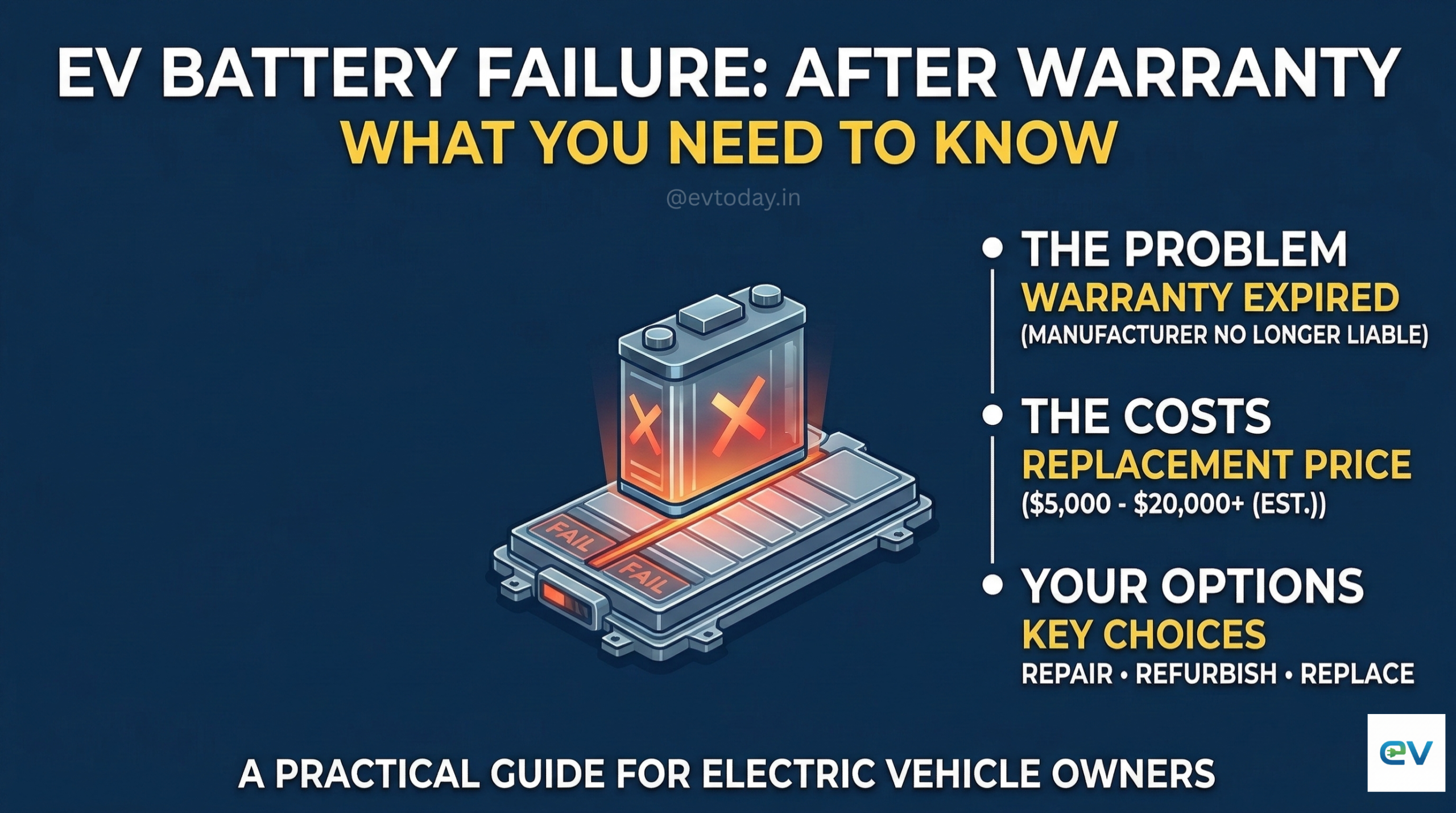
Yet one question consistently comes up among potential buyers: What happens if the EV battery dies after warranty?
The battery pack is the most expensive component in an electric vehicle. Unlike internal combustion cars that rely on engines and transmissions, EV performance and range depend heavily on battery health. When the warranty period ends, many owners worry about replacement costs, repair options, and whether the vehicle will still be worth keeping.
The reality is more nuanced than the fear suggests. Batteries rarely fail suddenly, replacement is not always necessary, and new business models are emerging to address long-term concerns. Here’s a practical look at what EV owners can realistically expect.
Understanding EV Battery Warranty
Before discussing what happens after warranty, it’s important to understand how EV battery coverage works.
Most electric car manufacturers provide battery warranties of around 8 years or 160,000–200,000 kilometers, whichever comes first. These warranties usually guarantee that the battery will maintain at least 70–80% of its original capacity during the warranty period.
If the battery degrades below that threshold or develops a manufacturing fault within the warranty window, the manufacturer typically repairs or replaces the battery pack at no cost to the owner.
This relatively long warranty period exists because battery health is critical to EV reliability. Automakers want to reassure buyers that the technology will remain usable for many years.

How Long Do EV Batteries Actually Last?
Battery lifespan is one of the biggest concerns among first-time EV buyers. However, real-world data suggests that most EV batteries last longer than expected.
Typically, modern lithium-ion EV batteries are designed to last 8–10 years or roughly 1.6–2 lakh kilometers, depending on usage conditions.
In many cases, they continue functioning well beyond that period, though the driving range gradually decreases as the battery degrades over time.
Key factors affecting battery lifespan
Battery health depends on several variables:
- Charging habits (frequent fast charging vs slow charging)
- Climate and temperature exposure
- Driving style and load
- Depth of discharge (running the battery to 0% frequently)
- Quality of the battery management system (BMS)
Because EV batteries degrade gradually rather than failing instantly, most owners experience reduced range rather than complete battery failure.
What Happens When the Battery Dies After Warranty?
When an EV battery reaches the end of its useful life after warranty, several outcomes are possible. Replacement is only one of them.
1. Battery Replacement
The most straightforward solution is replacing the battery pack.
However, this is also the most expensive option. In India, EV battery replacement typically costs between ₹3 lakh and ₹8 lakh depending on the vehicle model, and premium EVs can exceed ₹10 lakh.
For example:
- Entry-level EVs: ₹4–6 lakh
- Mid-range EVs: ₹6–10 lakh
- Premium EVs: ₹15 lakh or more
Battery costs largely depend on capacity measured in kilowatt-hours (kWh). The larger the battery pack, the higher the replacement price.
Despite the cost, full battery replacement is relatively rare during the typical lifespan of a vehicle.
2. Partial Battery Repair or Module Replacement
Many modern EV batteries are built using modular structures.
Instead of replacing the entire battery pack, service centers can sometimes replace only the faulty modules or cells, significantly reducing repair costs. Some automakers already refurbish packs by replacing defective modules rather than installing a completely new battery.
This option is becoming increasingly common as EV repair ecosystems mature.
3. Reduced Range but Continued Use
In many cases, the battery does not fail completely.
Instead, the vehicle continues operating with reduced range. For instance, a car originally capable of 400 km may only deliver 300 km after years of degradation.
For drivers with shorter daily commutes, this reduced range may still be acceptable, allowing them to keep the vehicle without replacing the battery.
4. Battery Leasing or Battery-as-a-Service
Another emerging solution is Battery-as-a-Service (BaaS).
Under this model, buyers purchase the vehicle without owning the battery and instead pay a subscription fee based on usage. Some automakers are already exploring this strategy to reduce upfront costs and remove long-term battery risk for customers.
If the battery fails, the provider replaces it as part of the subscription model.
Key Highlights
- Most EV batteries last 8–10 years or longer.
- Battery warranties usually cover 8 years or 160,000 km.
- Replacement costs can range from ₹3 lakh to ₹10 lakh+ depending on the car.
- Complete battery failure is uncommon; degradation happens gradually.
- Repairs, module replacements, and leasing models provide alternatives to full replacement.
Real Replacement Cost Examples
To understand the economics better, here are approximate examples based on common EV categories.
Small EVs
Smaller electric cars with battery packs around 20–30 kWh have lower replacement costs. Some entry-level models may require around ₹3–4 lakh for a new battery pack.
Mid-range EVs
Popular models with 30–50 kWh battery packs may cost ₹5–7 lakh for replacement.
For instance, estimates for certain compact electric SUVs in India place battery replacement costs at roughly ₹5.5–7 lakh.
Premium EVs
Luxury EVs with large battery packs can cost significantly more to replace, sometimes ₹15–20 lakh depending on the model.
These figures highlight why battery durability and warranty coverage are so important for EV buyers.
Expert Insight: Should Buyers Really Worry?
From a practical standpoint, battery failure after warranty is possible but relatively uncommon.
Industry experts often highlight three important realities:
1. Most batteries outlast their warranty
Manufacturers design battery packs to exceed the warranty period. In many cases, the battery remains usable well beyond 10 years.
2. Battery prices are gradually falling
The cost of lithium-ion batteries has declined dramatically over the past decade. As production scales up globally, replacement costs are expected to drop further.
3. New technologies are improving durability
Advancements in battery chemistry, thermal management, and battery management systems are improving lifespan and reliability.
For buyers planning to keep a vehicle for 6–8 years, battery replacement may never become an issue.
Practical Tips to Extend EV Battery Life
Owners can significantly extend battery lifespan through good charging habits.
Recommended practices
- Avoid charging to 100% every day unless necessary
- Do not regularly drain the battery to 0%
- Prefer slow charging for routine use
- Park in shaded or cooler areas
- Limit frequent fast charging when possible
These habits reduce stress on the battery and help maintain long-term capacity.
The Future of EV Battery Ownership
The EV industry is evolving quickly, and battery ownership models are changing as well.
Several trends may reduce long-term battery concerns:
Battery recycling: Old EV batteries are increasingly recycled to recover valuable materials such as lithium, nickel, and cobalt.
Second-life applications: Used EV batteries can be repurposed for energy storage systems even after they are no longer ideal for vehicles.
Battery swapping networks: Some manufacturers are experimenting with battery swapping stations to eliminate battery aging concerns entirely.
As these systems develop, EV ownership could become even more convenient and predictable.
Conclusion
The idea of an EV battery dying after warranty often sounds alarming, but the real situation is far less dramatic.
Most EV batteries last close to a decade or longer, and degradation usually happens gradually rather than suddenly. Even when problems occur, owners often have several options — from module repairs to leasing models — rather than immediately paying for a full battery replacement.
While battery replacement can cost several lakhs depending on the vehicle, falling battery prices, better technology, and new ownership models are steadily reducing this concern.
For most buyers, the key takeaway is simple: battery life should be considered when purchasing an EV, but it should not be the sole reason to avoid electric mobility.
FAQs
1. How long does an EV battery last?
Most EV batteries last 8–10 years or about 160,000–200,000 km, depending on usage and maintenance.
2. How much does it cost to replace an EV battery in India?
Battery replacement typically costs ₹3 lakh to ₹8 lakh for mass-market EVs, while premium models may exceed ₹10 lakh.
3. Do EV batteries suddenly fail?
No. EV batteries usually degrade gradually, reducing driving range over time rather than failing suddenly.
4. Can EV batteries be repaired instead of replaced?
Yes. In many cases, technicians can replace faulty battery modules or cells instead of replacing the entire pack.
5. Is EV battery replacement common?
Not really. Most owners sell or upgrade their vehicle before needing a full battery replacement.