
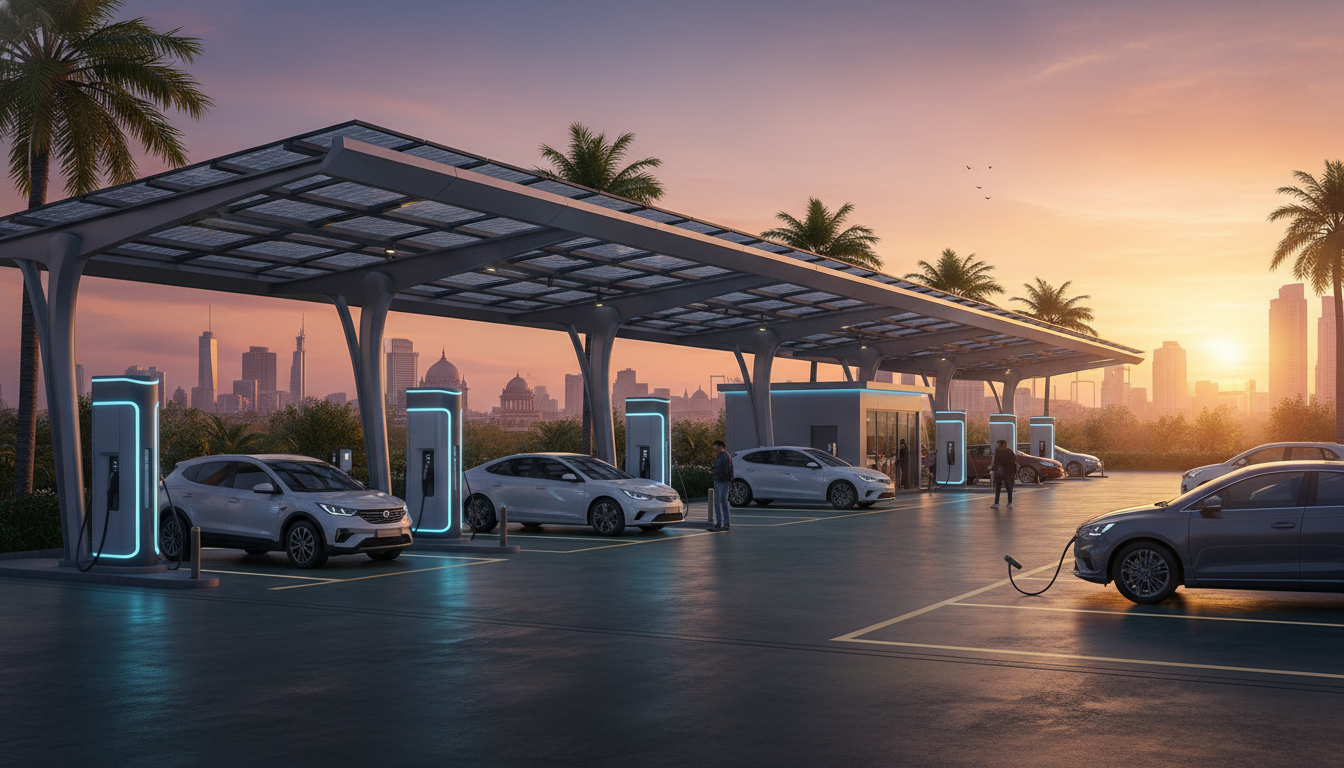
India’s EV Charging Revolution: PM E-DRIVE Scheme Targets 72,300 Charging Stations by 2028
India is on the cusp of a transformative shift in its electric vehicle (EV) ecosystem, and at the heart of this transformation lies one of the most ambitious infrastructure programmes the country has ever undertaken. The PM E-DRIVE (Electric Drive Revolution in Innovative Vehicle Enhancement) scheme is set to reshape the national EV charging landscape by funding the deployment of 72,300 public charging stations by 2028 — a move that could fundamentally change how millions of Indians power their electric vehicles.
The Current State of India’s EV Charging Infrastructure
As of early 2026, India has approximately 27,737 registered public EV charging stations, of which around 22,753 are currently operational. While these numbers represent significant growth from just a few years ago, the reality is sobering when viewed against the backdrop of rapid EV adoption across the country.

The current charger-to-EV ratio stands at approximately 1:235 — meaning there is just one public charger for every 235 electric vehicles on Indian roads. This figure lags dramatically behind global benchmarks, where leading EV markets maintain ratios of between 1:6 and 1:20. For Indian EV owners, this translates to very real challenges: range anxiety, long queuing times at available chargers, and significant inconvenience during long-distance travel.
The inadequacy of charging infrastructure has consistently been cited as one of the top barriers to EV adoption in India, alongside high vehicle purchase prices and battery range limitations. Addressing this bottleneck is therefore not merely an infrastructure exercise — it is a prerequisite for India achieving its ambitious EV penetration targets.
PM E-DRIVE Scheme: Scale, Funding, and Scope
Launched with an overall outlay of Rs. 10,900 crore, the PM E-DRIVE scheme is a comprehensive government initiative aimed at accelerating EV adoption through both demand-side incentives and supply-side infrastructure investment. Of this total, Rs. 2,000 crore has been specifically earmarked for charging infrastructure deployment.
The scheme’s charging infrastructure targets are broken down as follows:
- 48,400 charging points for electric two-wheelers and three-wheelers
- 22,100 fast chargers for electric passenger cars
- 1,800 high-capacity chargers for electric buses and commercial trucks
These are not slow, overnight chargers — the scheme mandates fast charging standards across all categories, compliant with the IS 17017 series of Indian standards:

- Two/three-wheelers: Light EV DC (IS-17017-2-6) or Light EV AC/DC Combo (IS-17017-2-7) up to 12 kW
- Passenger cars: CCS-II (IS-17017-2-3) from 50 kW up to 250 kW
- Buses and trucks: High-power CCS-II (IS-17017-2-3) from 250 kW to 500 kW, with a minimum of 120 kW per charging gun
This standardisation is critical. By mandating compliance with established technical standards, the government aims to prevent the fragmentation that has plagued EV charging markets in other countries, where competing connector types created confusion and incompatibility for drivers.
The Unified Bharat e-Charge Platform: India’s UPI for EV Charging
Deploying thousands of charging stations across the country is only half the challenge. Making them accessible and user-friendly for a billion-plus population is the other half. This is where the Unified Bharat e-Charge (UBC) platform comes in.
Developed by Bharat Heavy Electricals Ltd (BHEL) under the Ministry of Heavy Industries, and supported by the National Payments Corporation of India (NPCI), the UBC platform is designed to be the UPI equivalent for EV charging. Just as UPI unified India’s fragmented digital payments ecosystem into a single, interoperable interface, UBC aims to do the same for EV charging networks.
The UBC platform utilises the open-source Beckn protocol — the same decentralised protocol that powers other digital public infrastructure in India. This technical choice means that no single operator can lock users into a proprietary ecosystem. Instead, any charge point operator, OEM, or app developer can plug into the network using open standards.
Key Features of the Bharat e-Charge Platform
- Single app access: Locate, book, and pay for charging across all participating networks through one unified application
- Real-time charger availability: Live status updates showing which chargers are operational and available
- Standardised pricing: Transparent, comparable pricing across different operators
- Integrated digital payments: Seamless payment across UPI, cards, and wallets
- Network interoperability: Eliminates the need for multiple, network-specific apps
An initial rollout was planned for May 12, 2026, in Bengaluru, though the launch was subsequently deferred to a later event in New Delhi. When fully deployed, the platform promises to make the charging experience as seamless as ordering food online or paying a friend digitally.
Challenges on the Road Ahead
Despite the ambitious targets and substantial funding, significant challenges remain. As of mid-2026, the large-scale expenditure under the PM E-DRIVE scheme’s charging infrastructure component is still pending, with authorities focused on building the digital infrastructure — particularly the UBC platform — before accelerating physical station deployment.
Infrastructure reliability remains a persistent concern. Studies and user surveys consistently find that a significant proportion of existing public chargers are non-operational at any given time, due to hardware failures, connectivity issues, or maintenance gaps. Simply installing 72,300 chargers will not solve the problem if a large fraction are out of service.
Other key challenges include:
- Geographic distribution: Ensuring chargers are placed in tier-2 and tier-3 cities, not just metropolitan areas
- Grid capacity: Local electricity distribution infrastructure may need upgrades to support high-power DC fast chargers
- Land availability: Securing appropriate sites for charging stations in dense urban environments
- Private sector participation: Incentivising charge point operators to co-invest and maintain stations over the long term
Why This Matters for India’s EV Future
India sold over 271,116 electric vehicles in May 2026 alone, with EV penetration touching a record 10.7%. Electric two-wheelers are surging at 69% year-on-year, and electric four-wheelers have grown 82% year-on-year. This explosive growth in EV adoption makes the urgency of charging infrastructure expansion all the more acute.
If the PM E-DRIVE targets are met, India will go from a charger-to-EV ratio of 1:235 today to a dramatically improved ratio by 2028 — assuming EV sales growth is also factored in. Combined with the Unified Bharat e-Charge platform’s promise of seamless, interoperable access, the overall user experience for Indian EV owners could undergo a step-change improvement.
International experience suggests that robust public charging infrastructure creates a virtuous cycle: better charging availability reduces range anxiety, which drives higher EV adoption, which justifies further charging investment. India now has the policy framework to initiate this cycle at national scale.
Conclusion
The PM E-DRIVE scheme’s target of 72,300 charging stations by 2028, backed by Rs. 2,000 crore in government funding and the Unified Bharat e-Charge digital platform, represents India’s most serious effort yet to build a world-class EV charging ecosystem. The ambition is clear; the funding is allocated. Execution — ensuring reliability, geographic reach, and genuine interoperability — will be the defining factor in whether India’s EV charging infrastructure truly keeps pace with the country’s electric mobility revolution.
Stay tuned to EV Today for the latest updates on India’s EV charging infrastructure, government policies, and electric mobility news.