
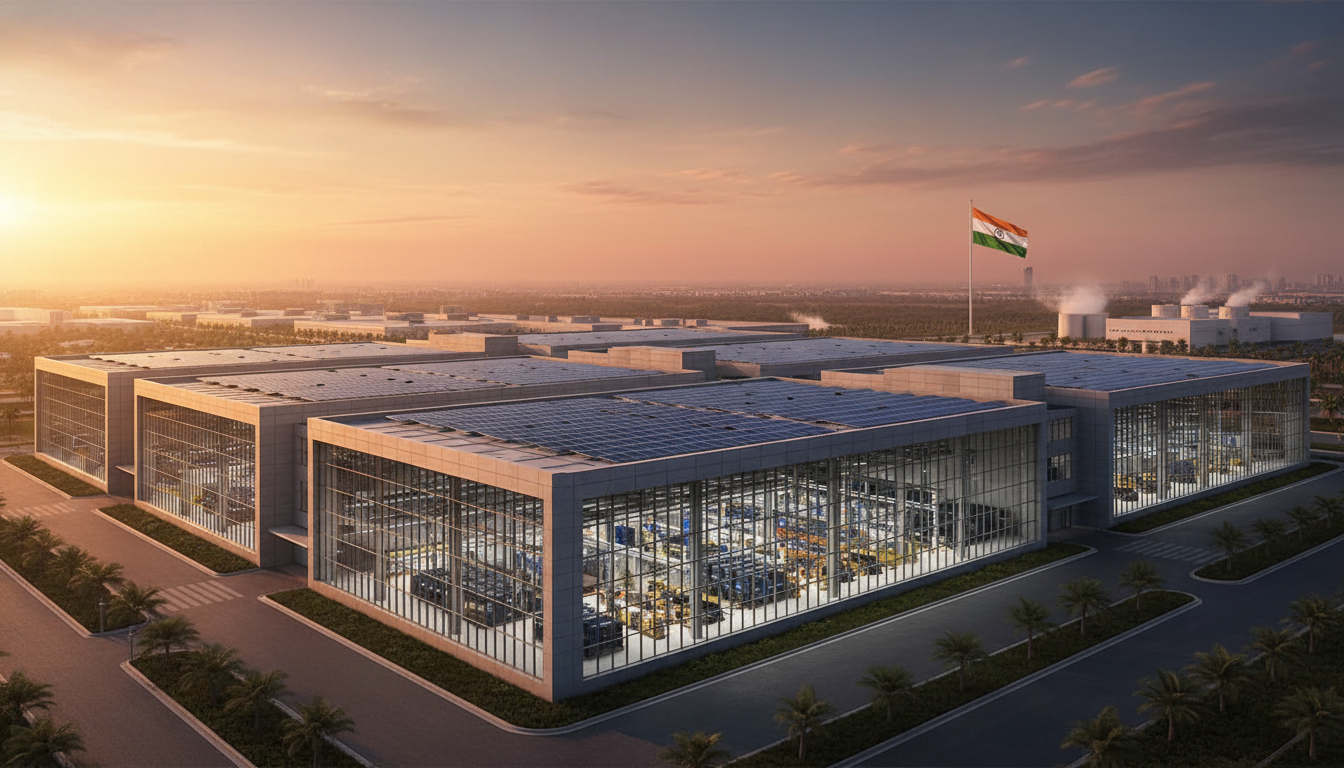
India stands at a pivotal crossroads in its electric vehicle journey. While EV adoption is accelerating rapidly — with sales penetration crossing 10.7% in May 2026 — the country’s battery supply chain remains dangerously dependent on imported cells, primarily from China. The transition to Lithium Iron Phosphate (LFP) chemistry and the push to activate the Advanced Chemistry Cell (ACC) Production Linked Incentive (PLI) scheme are now central to India’s energy security and its ambitions to become a global EV manufacturing hub.
India’s EV Battery Demand: A 10x Growth Forecast by 2032
India’s EV battery demand currently stands at approximately 20 GWh per year (2025), driven by a rapidly expanding fleet of electric two-wheelers, three-wheelers, buses, and passenger cars. Industry analysts project this figure will surge to 200 GWh annually by 2032 — a tenfold increase in just seven years. This explosive growth is fuelled by government mandates, rising fuel prices, falling battery costs, and a widening range of affordable EV models from Tata Motors, Mahindra, TVS, Bajaj Auto, Ather Energy, and Ola Electric.

Meeting this demand domestically is not merely a cost-saving exercise; it is a matter of strategic importance. China currently accounts for over 70% of global lithium-ion cell production and more than 80% of the supply chain for critical battery minerals and components. India’s heavy dependence on Chinese imports creates supply chain vulnerability, currency risk, and geopolitical exposure that policymakers are now urgently addressing.
Why LFP? The Chemistry Shift Reshaping India’s EV Market
For years, the dominant battery chemistry in Indian EVs was Nickel Manganese Cobalt (NMC), favoured for its high energy density. However, the industry is undergoing a decisive pivot to Lithium Iron Phosphate (LFP) chemistry, and for good reasons:
- Cost Advantage: LFP cells cost approximately 20–30% less per kWh than NMC cells, making them ideal for budget-conscious Indian consumers.
- Safety: LFP chemistry is significantly more thermally stable, with a much lower risk of thermal runaway — a critical concern after high-profile EV fire incidents in India in 2022–2023.
- Longevity: LFP batteries typically offer 2,000–3,000 charge cycles versus 1,000–1,500 for NMC, meaning longer vehicle lifespans.
- Raw Material Security: LFP does not use cobalt or nickel, whose supply chains are dominated by the Democratic Republic of Congo and a few other nations, reducing raw material risk.
- Local Chemistry Alignment: India has significant lithium deposits in Rajasthan, Jammu & Kashmir, and Chhattisgarh, and the KABIL initiative is securing overseas lithium sources, making LFP a logical domestic play.
Tata Motors has already transitioned most of its EV lineup — including the Nexon EV, Tiago EV, Punch.ev, and Harrier EV — to LFP battery packs. Mahindra’s upcoming BE and XEV series also feature LFP chemistry. Ola Electric and Ather Energy are actively evaluating LFP for their scooter platforms to reduce costs and improve safety.
Reliance Industries: The LFP Gigafactory Ambition
Reliance Industries Ltd (RIL), led by Mukesh Ambani, has announced an ambitious target of 40 GWh of LFP battery production capacity. Reliance’s New Energy arm is constructing an integrated giga-complex at Jamnagar, Gujarat, that will encompass solar panels, fuel cells, and battery cells under one roof. The company is sourcing technology from global LFP leaders and has made strategic acquisitions in the battery technology space.
If realised, Reliance’s 40 GWh LFP plant alone would supply 20% of India’s projected 2032 demand. Combined with other players entering the space — including Ola Electric (4.8 GWh), Exide Energy (12 GWh), Amara Raja (16 GWh), and Tata AutoComp — India could realistically achieve 80–100 GWh of domestic cell manufacturing capacity by 2030.
The ACC PLI Scheme: Promise vs. Reality
The Government of India launched the Advanced Chemistry Cell (ACC) PLI scheme in 2021 with an outlay of Rs 18,100 crore (approximately USD 2.2 billion) to incentivise domestic battery cell manufacturing. The scheme targets 50 GWh of new ACC capacity, offering incentives of Rs 3,500 per kWh for 5 years to companies meeting localisation thresholds.
However, the scheme’s progress has been slower than anticipated. As of mid-2026, only 1.4 GWh of capacity has been commissioned domestically under the ACC PLI — a fraction of the 50 GWh target. Several awardees have faced delays due to:
- Challenges in securing technology licensing from established cell manufacturers
- High capital expenditure requirements for gigafactory construction
- Difficulty in meeting local value addition requirements
- Supply chain gaps for separator, electrolyte, and cathode active materials
- Uncertainty about long-term demand volumes
Despite these setbacks, the government has shown flexibility by extending timelines and working with awardees to resolve bottlenecks. The second tranche of ACC PLI disbursements is expected to unlock as companies ramp up commissioning through 2026–2027.
The Localisation Challenge: Beyond Cell Assembly
India’s current battery “manufacturing” is largely limited to battery pack assembly — integrating imported cells into modules and packs. True localisation requires manufacturing cells from scratch, including the cathode, anode, electrolyte, and separator components. This deep supply chain development is the core challenge.
The government has taken steps to address this via:
- Production Linked Incentives for White Goods covering battery component manufacturing
- KABIL (Khanij Bidesh India Ltd) for securing lithium, cobalt, and nickel overseas
- Customs duty restructuring to make cell imports cheaper while incentivising domestic production
- National Battery Mission coordinating R&D across IISc, IITs, and CSIR laboratories
Global Context: India vs. China, the USA, and EU
China’s CATL and BYD together account for over 50% of global battery cell production, with Chinese companies controlling the entire value chain from lithium mining to cell manufacturing. The USA’s Inflation Reduction Act (IRA) has catalysed USD 100+ billion in battery investment, while the EU’s Battery Regulation mandates increasing local content.
India is playing catch-up, but the trajectory is promising. The combination of ACC PLI incentives, falling LFP cell costs, strong domestic EV demand growth, and strategic corporate investments from Reliance, Tata, and Ola Electric suggests India could emerge as a meaningful battery manufacturing hub by 2030 — particularly for the South and Southeast Asian markets.
What This Means for Indian EV Buyers
For Indian consumers, the battery technology shift to LFP has tangible benefits: lower-cost EVs with longer warranties, reduced fire risk, and better resale values. Tata Motors’ decision to offer lifetime battery warranties on LFP-equipped vehicles (Nexon EV, Punch.ev, Tiago EV refreshes) signals confidence in the chemistry’s durability.
As domestic cell production scales up over the next 5–7 years, battery costs are expected to fall further — potentially enabling electric passenger cars priced below Rs 8 lakh by 2030, a price point that would dramatically accelerate mass-market EV adoption across India.
Conclusion: A Critical Decade for India’s Battery Ecosystem
India’s shift to LFP chemistry and the push to activate the ACC PLI supply chain represent the most consequential strategic decisions in the country’s EV transition. The next three to five years will determine whether India becomes a genuinely self-reliant battery manufacturing powerhouse or remains dependent on imported cells. With Reliance’s gigafactory, the ACC PLI scheme’s ramp-up, and strong corporate investment momentum, India has the ingredients for success — but execution will be everything.
For EV stakeholders — from automakers and fleet operators to investors and policymakers — the India battery technology story in 2026 is one of enormous potential confronting real structural challenges. The outcome will shape the cost, availability, and energy security of electric mobility in the world’s third-largest automobile market for decades to come.