
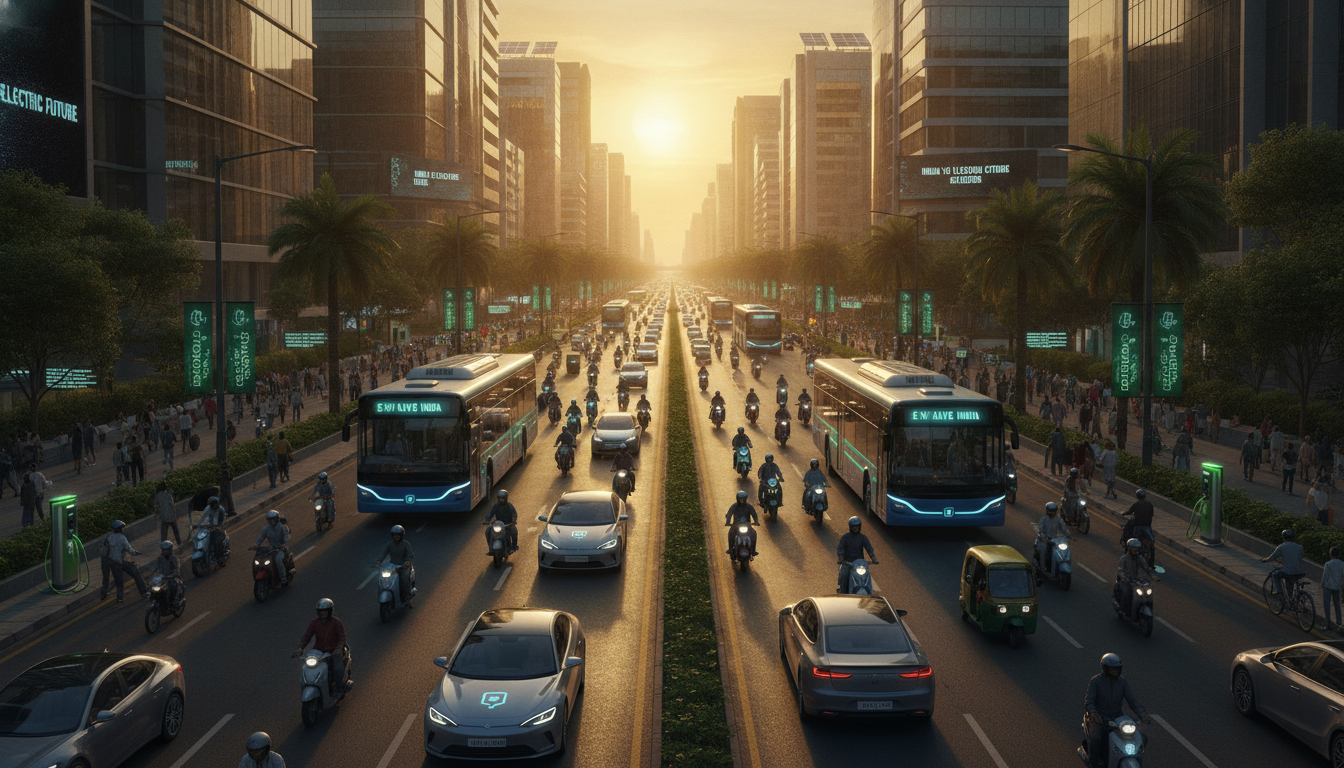
India’s Electric Vehicle Market Reaches a Historic Milestone
India’s electric vehicle (EV) sector has achieved a landmark achievement in May 2026, with EV retail penetration surpassing the 11% mark for the very first time. This monumental milestone reflects the accelerating shift of Indian consumers toward electric mobility, driven by a combination of fuel price hikes, government incentives, and a rapidly expanding product portfolio across all vehicle segments.
According to the Federation of Automobile Dealers Associations (FADA) and industry data, total EV sales across all categories reached 271,682 units in May 2026 — a staggering 45% year-on-year increase compared to May 2025. This surge places India firmly among the world’s fastest-growing EV markets.
India’s EV charging infrastructure has grown significantly, with thousands of new charging points added in 2026.
What Is Driving the 11% EV Penetration Milestone?
Several converging factors have propelled India’s EV market to this unprecedented 11% penetration level:
1. Rising Fuel Prices
Petrol and diesel prices in India have continued to remain elevated in 2026, pushing cost-conscious consumers toward EVs as a more economical long-term choice. The total cost of ownership for EVs has become increasingly competitive with internal combustion engine (ICE) vehicles, especially for two-wheelers and small cars used for daily commuting.
2. Expanding Product Portfolio
The Indian EV market in mid-2026 offers an unprecedented variety of electric vehicles across all price points. From the budget-friendly Tata Punch.ev at Rs 9.69 lakh to mid-range offerings and premium models like the Tesla 2026 Model Y at Rs 50.89 lakh, consumers now have genuine choices that match their requirements and budgets. Toyota’s entry with the Urban Cruiser Ebella at Rs 23.60 lakh has further validated the segment.
3. Government Incentives and PM E-DRIVE Scheme
The central government’s PM E-DRIVE (Electric Drive Revolution in Innovative Vehicle Enhancement) scheme has played a pivotal role in making EVs accessible to the masses. The scheme provides direct purchase subsidies for electric two-wheelers, three-wheelers, and electric buses, significantly reducing the upfront cost barrier. With the two-wheeler incentive deadline set for July 31, 2026, many consumers rushed to take advantage of the scheme, contributing to May’s record sales numbers.
4. Dealer Inventory Squeeze and Waiting Periods
The demand surge has been so intense that dealer inventories have dropped to single-digit day levels for popular EV models, with waiting periods extending to several weeks for top-selling vehicles. This supply-demand imbalance underscores the genuine grassroots momentum behind India’s EV transition, distinguishing it from earlier adoption phases driven primarily by early adopters and fleet operators.
Indian EV dealerships are experiencing unprecedented demand, with customers facing waiting periods for popular models.
Segment-Wise EV Sales Breakdown — May 2026
The 271,682 total EV units sold in May 2026 are distributed across multiple vehicle categories:
- Electric Two-Wheelers: Continue to dominate EV sales, accounting for the majority of units. Key players include Ola Electric, TVS Motor Company, Bajaj Auto’s Chetak, Hero MotoCorp’s Vida, and Ather Energy.
- Electric Three-Wheelers: The commercial segment remains a strong contributor, particularly for last-mile delivery and passenger transport in urban areas.
- Electric Passenger Cars: The four-wheeler EV segment is growing fastest in percentage terms, with brands like Tata Motors, Hyundai, MG Motor, and Maruti Suzuki all expanding their EV lineups.
- Electric Buses: State transport undertakings and private operators are rapidly electrifying their fleets, aided by PM E-DRIVE bus subsidies and CESL (Convergence Energy Services Limited) tenders.
Challenges Behind the Record Numbers
While the 11% EV penetration milestone is cause for celebration, industry experts caution that several challenges must be addressed to sustain this growth trajectory:
Supply Chain Constraints
The rapid demand surge has exposed bottlenecks in EV supply chains, particularly for battery cells and power electronics components. India’s dependence on imported lithium-ion battery cells — primarily from China — remains a vulnerability. Only 1.4 GWh of battery manufacturing capacity has been commissioned against the ACC (Advanced Chemistry Cell) PLI (Production Linked Incentive) scheme’s target of 50 GWh, highlighting the urgency of domestic battery manufacturing scale-up.
Charging Infrastructure Gaps
India currently has approximately 27,737 public EV charging stations — a figure that sounds impressive until compared to the rapidly growing EV fleet. The current charger-to-EV ratio stands at approximately 1:235, far below the global benchmark of 1:6 to 1:20. “Range anxiety” remains a real concern for potential EV buyers, particularly in Tier-2 and Tier-3 cities and on inter-city highway routes. The PM E-DRIVE scheme aims to install 72,300 additional charging points by March 2028, but execution speed will be critical.
India’s EV Penetration in Global Context
India’s 11% EV penetration in May 2026 places it among leading emerging markets in the global EV transition. While this still lags behind Norway (where EVs account for over 90% of new car sales) and China (around 50%), it represents extraordinary progress for a price-sensitive, diverse market of India’s scale. Just three years ago, India’s EV penetration was below 3%, making the journey to 11% a remarkable achievement.
Analysts at BloombergNEF and IEA (International Energy Agency) have highlighted India as one of the most consequential EV growth stories of the decade. The combination of a large population, urbanization, rising incomes, air quality imperatives, and government policy alignment creates a structural tailwind that is likely to sustain EV growth well into the next decade.
What’s Next: Road to 20% Penetration?
With the momentum established in May 2026, industry leaders and analysts are now looking ahead to the 20% EV penetration target set by the government’s FAME (Faster Adoption and Manufacturing of Electric Vehicles) policy framework. Key enablers for reaching this target include:
- Scaling up domestic battery cell manufacturing under the ACC PLI scheme
- Expanding the public charging network through PM E-DRIVE and private investment
- Continued product launches across mass-market price points (Rs 6-15 lakh)
- Strengthening the EV servicing and after-sales ecosystem, especially in smaller cities
- Maintaining and expanding purchase incentives for two-wheelers, three-wheelers, and electric buses
Expert Reactions
Industry commentators have responded enthusiastically to India’s record EV penetration figures. Several analysts noted that the 11% milestone is particularly significant because it signals that EV adoption in India has crossed the “chasm” from early adopter territory into mainstream consumer acceptance — a tipping point that typically presages exponential growth in a market.
Tata Motors, which has been instrumental in popularizing affordable EVs in India through models like the Nexon EV and Punch.ev, expressed confidence that the overall industry trajectory will help the company scale production to meet surging demand. Ola Electric, despite a challenging FY26 that saw significant operational headwinds, appears to be stabilizing following a Rs 780 crore QIP fundraise and a narrowed net loss of Rs 500 crore.
Conclusion: A Turning Point for India’s EV Journey
May 2026 will be remembered as the month India’s EV revolution entered mainstream consciousness. With 271,682 EVs sold, 11% retail penetration, and 45% year-on-year growth, the data tells an unambiguous story: India’s electric vehicle transition is no longer a future possibility — it is a present reality. The challenge now shifts from sparking demand to sustainably fulfilling it, building the infrastructure to support millions of EV users, and ensuring that the supply chain, manufacturing, and charging ecosystem keep pace with an electrified future that has arrived ahead of schedule.
Stay updated with the latest India EV news and electric vehicle launches on EVToday.