
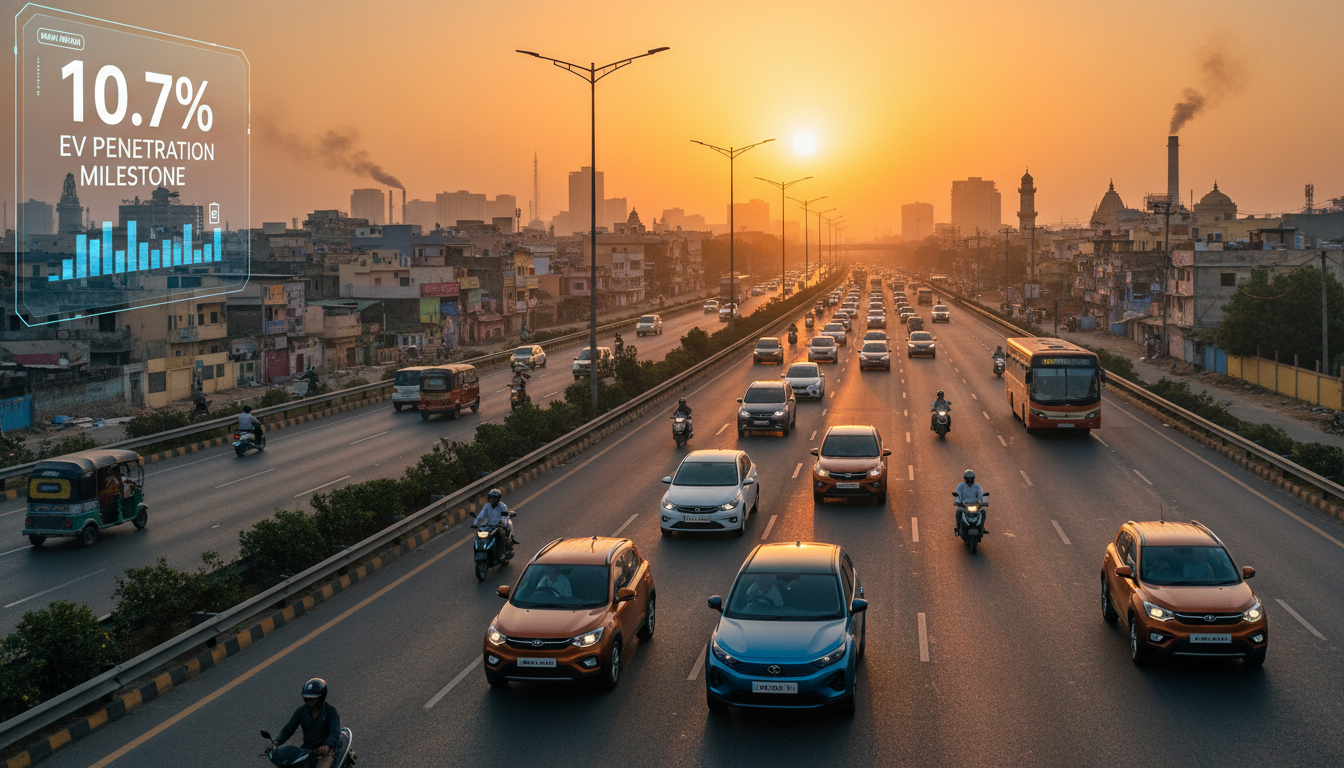
India’s electric vehicle market achieved a landmark milestone in May 2026, recording an all-time high penetration rate of 10.7% — the first time the country has crossed the double-digit barrier in monthly EV market share. With a total of 271,116 electric vehicles sold across all segments, May 2026 will be remembered as the month India’s EV revolution truly came of age.
Record-Breaking EV Sales: The Numbers That Matter
The 10.7% penetration figure means that more than 1 in every 10 vehicles registered in India in May 2026 was electric. This is a dramatic improvement from the approximately 6% penetration recorded in May 2025, demonstrating the explosive growth trajectory of the Indian EV market. The milestone has been celebrated by industry analysts, government officials, and clean energy advocates alike as a turning point for the country’s green mobility transition.

Breaking down the numbers, electric four-wheelers posted an extraordinary 82% year-on-year growth, making them the fastest-growing segment in the Indian automotive market. Two-wheelers, which form the bulk of EV sales by volume, also posted strong gains, while electric three-wheelers (primarily auto-rickshaws) continued their steady march toward full electrification in several urban markets.
Tata Motors and Mahindra: Dominant Forces in India’s EV Market
Two homegrown automakers are driving India’s electric car revolution. Tata Motors and Mahindra Electric together command approximately 62% of the electric four-wheeler market, a dominance built on years of early investment in EV technology and a deep understanding of Indian consumer preferences.
Tata Motors’ lineup — comprising the Nexon EV, Tiago EV, Punch.ev, Curvv EV, and Harrier EV — offers one of the most diverse range of electric vehicles from any single manufacturer in India. The company recently launched refreshed versions of the Tiago EV and Punch.ev with updated features and lifetime battery warranties, a move that significantly boosted consumer confidence and triggered a surge in bookings. Reports indicate Tata Motors has seen a 2.5x increase in EV bookings since the fuel price hikes of early 2026.
Mahindra Electric, with its XEV series — including the XEV 9e and BE 6e — has also made a powerful impact. The XEV 9e, in particular, has garnered rave reviews for its futuristic design, large battery options, and advanced driver assistance systems. Mahindra’s commitment to building EVs on a dedicated electric platform has paid dividends, and the company continues to expand its manufacturing capacity to meet growing demand.
Rising Fuel Prices: The Catalyst for EV Adoption
One of the key drivers behind the surge in EV sales has been rising petrol and diesel prices across India. As of June 2026, fuel prices in major cities have crossed ₹110–₹120 per litre in several states, making the total cost of ownership of electric vehicles significantly more attractive compared to their internal combustion engine (ICE) counterparts.
For the average Indian consumer who drives 40–60 km per day, the switch to an EV can result in monthly savings of ₹3,000–₹6,000 on fuel alone, depending on the vehicle and driving patterns. When combined with lower maintenance costs (no engine oil changes, fewer brake pad replacements due to regenerative braking), EVs now offer a compelling financial case even before considering any government subsidies.
Government Support: PM E-DRIVE and Other Schemes
The Indian government’s proactive policy support has been instrumental in accelerating EV adoption. The PM E-DRIVE scheme, announced in late 2024 and fully operational in 2025–26, has provided targeted subsidies for electric two-wheelers, three-wheelers, and buses. The scheme also funds the deployment of fast-charging infrastructure across highways and urban centres.
Beyond PM E-DRIVE, state governments in Maharashtra, Gujarat, Delhi, Tamil Nadu, and Telangana have introduced their own EV policies offering additional incentives including road tax exemptions, registration fee waivers, and direct purchase subsidies. Several states have also mandated that a percentage of government vehicle fleets be electrified by 2027, providing a guaranteed off-take market for domestic EV manufacturers.
New Model Launches Driving Consumer Interest
May 2026 also benefited from a confluence of exciting new model launches and refreshes that generated significant consumer interest. Key launches and updates during or just before this period include:
- Tata Curvv EV — Tata’s stylish coupe-SUV EV continues to attract buyers with its premium positioning and impressive range of up to 585 km.
- Mahindra BE 6e — Mahindra’s sporty electric coupe-SUV with a 79 kWh battery and 656 km claimed range has been a runaway success.
- Maruti Suzuki e Vitara — Maruti’s first electric SUV, developed with Toyota, finally launched in India and attracted massive pre-booking interest.
- MG Windsor EV — MG’s battery-as-a-service model has democratised EV ownership by slashing the upfront purchase price.
- BYD Seal — BYD’s latest electric sedan has found a niche audience among premium car buyers seeking Tesla-like features at more competitive prices.
Two-Wheelers and Three-Wheelers: Volume Champions
While four-wheelers grab headlines with their impressive growth rates, electric two-wheelers remain the backbone of India’s EV market by volume. In May 2026, electric two-wheeler registrations crossed 1.70 lakh (170,000) units, a 69% year-on-year surge. TVS Motor Company led the segment with a 25% market share, driven by strong sales of the iQube range, followed by Bajaj Auto at 23% with its Chetak platform. Ola Electric, despite facing some operational challenges, maintained its position among the top three players.
Electric three-wheelers — predominantly cargo vehicles and passenger auto-rickshaws — also posted healthy numbers. As cities like Delhi, Bangalore, and Mumbai push to phase out petrol/CNG autorickshaws in certain zones, the electric three-wheeler segment is set for multi-year growth. Companies like Mahindra Last Mile Mobility, Piaggio, and several EV startups are competing fiercely in this segment.
Charging Infrastructure: Keeping Pace with Demand
One of the critical enablers of higher EV penetration is the parallel growth of charging infrastructure. India now has over 27,000 public EV charging stations across the country, with a strong focus on expressways, city parking facilities, and commercial hubs. The PM E-DRIVE scheme targets expanding this to 72,300 stations by 2028, which would dramatically improve range anxiety concerns for potential EV buyers.
Home charging remains the primary mode of energy replenishment for most EV owners. The proliferation of AC wall boxes and the increasing availability of affordable home charger installations have made the daily charging experience highly convenient. For long-distance travel, DC fast chargers on national highways have improved significantly, with many offering 50–150 kW outputs capable of charging most EVs from 20% to 80% in 30–45 minutes.
The Road Ahead: Can India Sustain This Growth?
The achievement of 10.7% EV penetration in May 2026 is not just a number — it represents a fundamental shift in how India thinks about personal mobility. Industry analysts project that EV penetration in India could reach 20–25% by 2030, driven by improving battery technology, falling costs, expanding model choices, and continued policy support.
However, challenges remain. The EV charging infrastructure still needs significant expansion, particularly in tier-2 and tier-3 cities. Battery supply chains remain a concern, with India still heavily dependent on imported lithium-ion cells from China. The government’s Advancing Chemical Cells (ACC) Production Linked Incentive (PLI) scheme aims to build domestic battery manufacturing capacity, but meaningful volumes are still 2–3 years away.
Despite these challenges, the May 2026 milestone is a powerful affirmation of the direction India’s automotive industry is headed. The combination of rising fuel prices, exciting new EV models, improving charging infrastructure, and strong government support has created a virtuous cycle that is accelerating the pace of electrification well beyond earlier forecasts.
Conclusion
India’s electric vehicle market has turned a corner. The 10.7% penetration milestone in May 2026 is a historic achievement that signals mainstream acceptance of electric mobility in the world’s third-largest automotive market. With Tata Motors and Mahindra leading the charge, supported by a rapidly growing ecosystem of new entrants, infrastructure providers, and supportive government policies, India is well on its way to becoming a global EV powerhouse. The journey has just begun, and the destination — a greener, cleaner, and more energy-secure India — has never seemed more achievable.