
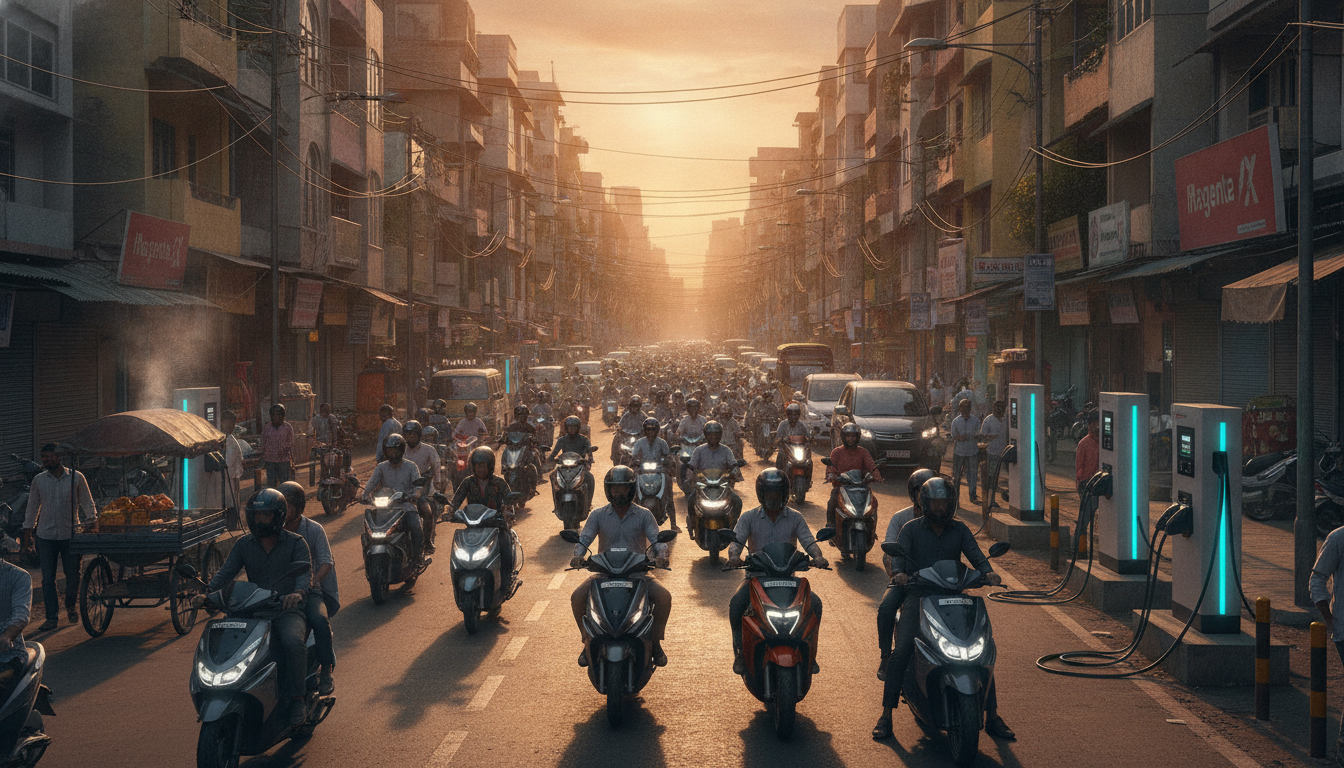
India’s electric two-wheeler (E2W) segment has recorded a landmark 69% year-on-year surge in registrations in May 2026, with 1.70 lakh units sold — cementing the nation’s position as one of the world’s fastest-growing EV markets. Fuelled by rising fuel prices, improved product offerings, and rapidly expanding demand in tier-2 and tier-3 cities, the segment is rewriting India’s urban mobility story.
Record-Breaking Sales in May 2026
May 2026 saw India’s electric two-wheeler registrations climb to approximately 1.64–1.70 lakh units, the highest monthly figure on record for the segment. The 69% year-on-year growth represents a dramatic acceleration from the already impressive numbers recorded in 2025. Analysts attribute this surge to multiple converging factors: surging petrol and diesel prices, government incentives, widening product portfolios, and a shift in consumer perception from early-adopter curiosity to mainstream acceptance.

Market Leaders: TVS, Bajaj, and the Competitive Landscape
TVS Motor Company leads the electric two-wheeler market with a commanding 25% market share, having sold 42,443 units in May 2026. The company’s flagship iQube range — priced between Rs. 1.11 lakh and Rs. 1.71 lakh — continues to dominate the urban commuter segment with its proven technology, extended range, and strong after-sales network.
Close on TVS’s heels is Bajaj Auto, holding 23% of the market with 39,105 units sold. The Bajaj Chetak, priced from approximately Rs. 96,000 to Rs. 1.35 lakh, has established itself as a reliable, stylish option for commuters across metro and non-metro India alike.
Ather Energy continues to carve a premium niche, recording 28,190 units and maintaining its reputation for performance-focused scooters. Hero MotoCorp’s electric arm, Vida, posted 19,052 units, while Ola Electric registered 15,139 units as it navigates market recalibration after rapid early growth.
New Entrants Reshaping the Segment
Perhaps the most anticipated launch of 2026 is the Royal Enfield Flying Flea C6, which debuted on April 9, 2026. Priced at Rs. 2.79 lakh for the outright purchase or Rs. 1.99 lakh under Royal Enfield’s innovative Battery-as-a-Service (BaaS) model, the Flying Flea C6 targets a younger, lifestyle-oriented buyer who values both performance and heritage branding. With Royal Enfield’s iconic brand equity and extensive dealer network, the Flying Flea is expected to expand the premium electric two-wheeler segment significantly.
Yamaha’s EC-06, positioned as a sporty urban electric scooter, is also entering the Indian market as part of the Japanese manufacturer’s global EV strategy. Yamaha’s focus on design-forward, feature-rich scooters gives it strong potential in metros and college towns alike.

Tier-2 and Tier-3 Cities: The New Growth Engine
Historically, EV adoption in India was concentrated in metro cities — Delhi, Bengaluru, Hyderabad, and Pune. But 2026 is witnessing a decisive geographic shift. Tier-2 cities such as Lucknow, Indore, Jaipur, Coimbatore, and Surat are now among the fastest-growing EV markets. This spread is driven by several key factors:
- Lower total cost of ownership: With petrol prices staying elevated, the economics of electric two-wheelers are compelling even for budget-conscious buyers in smaller cities.
- Improved financing options: Banks and NBFCs have expanded EV loan products, lowering the barrier to purchase.
- Expanding charging infrastructure: Government-backed schemes and private operators are rapidly deploying charging points beyond metros.
- Local dealer network expansion: Brands like TVS, Bajaj, and Ather have prioritised dealer footprint growth in tier-2 markets.
Expert Perspective: From Early Adoption to Lifestyle Choice
Industry experts note that India’s electric two-wheeler market has matured past the early-adopter phase. “The conversation has shifted from ‘should I buy an EV?’ to ‘which EV best fits my lifestyle and performance needs?'” said a senior analyst at a leading automotive research firm. This maturation is reflected in the growing diversity of offerings — from entry-level scooters under Rs. 1 lakh to premium electric motorcycles above Rs. 2.5 lakh.
The market is also seeing a shift from incentive-driven purchasing to organic demand, a sign of genuine product-market fit. The government’s FAME III policy framework and state-level EV policies continue to provide crucial support, but consumer confidence in product quality and after-sales service is increasingly the primary purchase driver.
Challenges Ahead
Despite the impressive growth trajectory, the sector faces real challenges. Charging infrastructure in tier-2 and tier-3 cities — while growing — still lags behind consumer demand. Battery range anxiety remains a concern for long-distance riders. Component supply chains, particularly for battery cells, remain vulnerable to global disruptions. And the transition of millions of ICE two-wheeler jobs to EV manufacturing requires coordinated policy and industry effort.
Outlook: 2026 and Beyond
With India targeting significant EV penetration across vehicle categories by 2030, the electric two-wheeler segment is set to remain the vanguard of the country’s clean mobility transition. The combination of competitive pricing, government support, lifestyle-oriented new models from marquee brands, and organic demand growth from smaller cities makes the Indian E2W market one of the most dynamic in the world.
As Royal Enfield, Yamaha, and other legacy brands join TVS, Bajaj, Ather, and Ola in the electric space, 2026 may well be remembered as the year India’s two-wheeler market truly went electric — not just in numbers, but in consumer culture and everyday choice.