
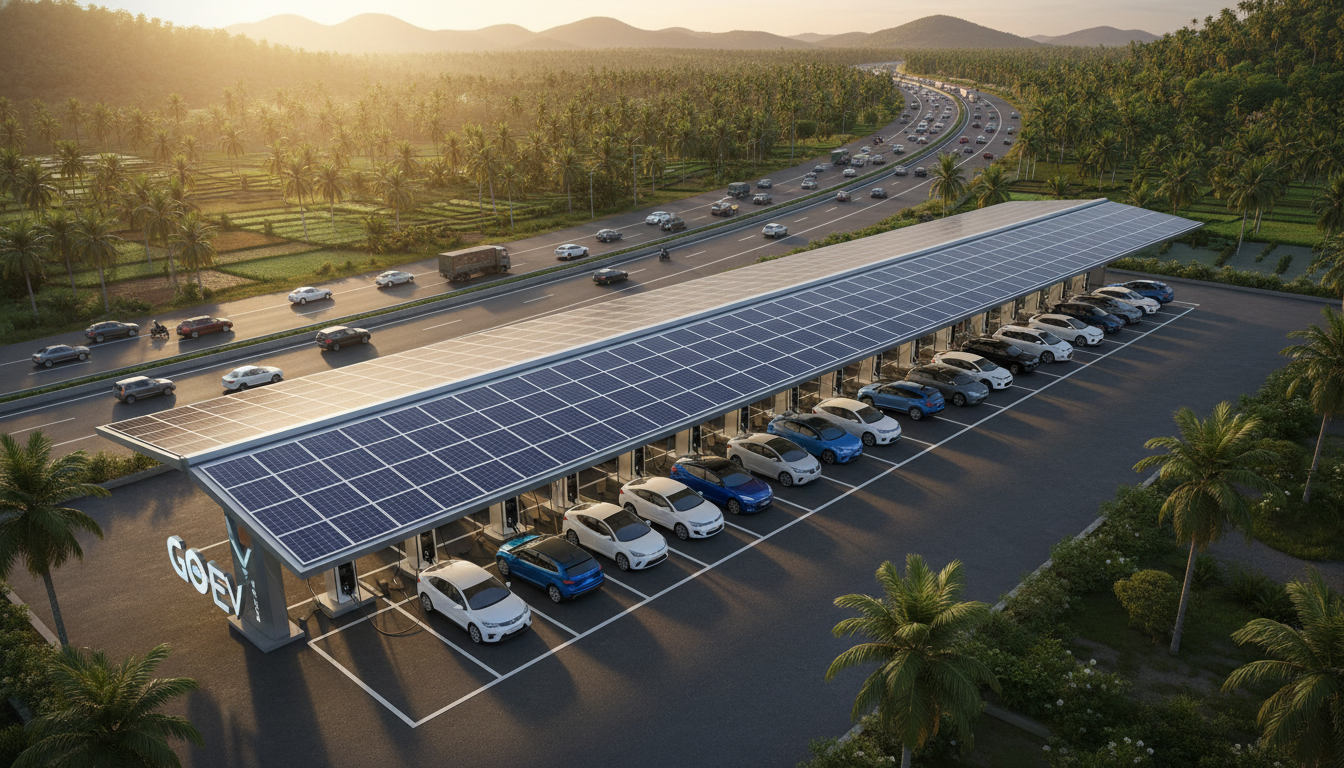
India’s EV Charging Network: A Snapshot of Progress and Challenges
India’s electric vehicle (EV) revolution is accelerating at an unprecedented pace. With EV sales hitting record highs in 2026, the focus has now shifted to a critical enabler of this transition: charging infrastructure. As of March 2026, India has 27,737 public EV charging stations across the country — a number that sounds impressive until you compare it with the rapidly growing EV fleet on Indian roads.
The charger-to-EV ratio in India currently stands at approximately 1:235 — meaning there is one charging point for every 235 electric vehicles. This ratio falls drastically short of the global benchmark of 1:6 to 1:20, underscoring the enormous infrastructure gap that needs to be bridged for a sustainable EV ecosystem.

Public EV charging infrastructure across Indian cities is expanding but still lags behind demand.
Why the Infrastructure Gap Matters
The lack of adequate charging infrastructure is one of the biggest barriers to EV adoption in India. Range anxiety — the fear of running out of charge mid-journey — continues to deter potential buyers, especially for long-distance travel. Unlike petrol and diesel vehicles that can refuel in minutes at any of India’s 80,000+ fuel stations, EV owners must carefully plan routes around available chargers.
Key challenges facing India’s EV charging ecosystem include:
- Uneven geographic distribution: Most charging stations are concentrated in metro cities like Delhi, Mumbai, Bengaluru, and Hyderabad. Tier-2 and Tier-3 cities, as well as rural areas, remain grossly underserved.
- Slow AC chargers dominate: A significant majority of the 27,737 stations are slow AC chargers (3.3 kW to 7.4 kW), taking 6-8 hours for a full charge. Fast DC chargers, which can charge an EV to 80% in 30-60 minutes, are far fewer.
- Multiple payment platforms: Different charging networks have their own apps and payment systems, creating friction for users. A unified payment solution is still being developed.
- Grid reliability issues: Power outages and voltage fluctuations in many parts of India make charging unreliable, particularly in smaller towns.
- High capital costs: Setting up a fast DC charger costs Rs 8-15 lakh per unit, making it expensive for small operators without government support.
PM E-DRIVE Scheme: The Government’s Response
To address these challenges, the Indian government has launched the PM E-DRIVE (Electric Drive Revolution in Innovative Vehicle Enhancement) scheme with a total outlay of Rs 10,900 crore. As part of this scheme, the government has set an ambitious target of establishing 72,300 charging points by March 2028 — nearly tripling the current count.
The scheme covers:
- Highway charging corridors: Every 25 km along major national highways will have at least one fast-charging station, enabling long-distance EV travel across India.
- Urban charging hubs: Multi-unit charging stations in high-footfall areas like malls, airports, railway stations, and government parking lots.
- Two-wheeler and three-wheeler charging: Dedicated charging points for electric two-wheelers and three-wheelers, which make up over 62% of all EV sales.
- Subsidies for charger installation: Financial incentives for companies and municipalities to set up charging infrastructure, lowering the barrier for private investment.
The PM E-DRIVE scheme targets 72,300 charging points across India by March 2028.
Bharat e-Charge: India’s Unified Charging App
A game-changing initiative under development is the Bharat e-Charge app — a unified platform that aims to bring all public EV charging networks under a single interface. This app will allow EV owners to:
- Locate the nearest charging station on a real-time map
- Check charger availability and compatibility with their vehicle
- Make payments through a single unified interface
- View pricing across different networks for cost comparison
- Book charging slots in advance at premium hubs
The Bharat e-Charge initiative draws inspiration from similar unified platforms in countries like the Netherlands and Germany, where interoperability has dramatically increased charger utilization rates. Once launched, this app could significantly reduce range anxiety and improve the overall EV ownership experience in India.
Private Sector Leading the Charge
While the government provides the policy framework, private companies are rapidly building out charging networks. Key players in India’s EV charging space include:
- Tata Power EZ Charge: Over 6,500 charge points across 400+ cities, the largest network in India.
- ChargeZone: Known for its high-power DC fast chargers (60 kW to 240 kW) on national highways.
- Ather Grid: Ather Energy’s dedicated charging network, primarily serving its scooter fleet.
- BPCL, IOCL, HPCL: Public sector oil companies converting fuel stations into EV charging hubs.
- Reliance BP Charge: Joint venture targeting urban fast-charge hubs with advanced OCPP 2.0 protocol.
- Statiq: Technology-first EV charging startup with smart fleet management solutions.
The entry of oil marketing companies (OMCs) into the EV charging space is particularly significant. OMCs have land assets at over 80,000 fuel stations across India — a ready-made network that can be converted to include EV charging points with relatively low capital expenditure.
State Governments Driving Progress
Several state governments have taken proactive steps to accelerate charging infrastructure deployment:
- Maharashtra: Mandated EV charging provisions in all new residential complexes and commercial buildings.
- Delhi: Over 1,000 public charging stations, with a target of 18,000 charging points by 2024.
- Karnataka: Bengaluru has emerged as India’s EV capital, with the highest density of public chargers.
- Gujarat: Developed an EV charging corridor along the Delhi-Mumbai Industrial Corridor (DMIC).
- Tamil Nadu: Chennai has one of the fastest-growing charging networks in South India.
The Road Ahead: What India Needs
To achieve its goal of 30% EV penetration by 2030, India needs to dramatically accelerate its charging infrastructure buildout. Experts estimate that India will need at least 2 million charging points by 2030 to support the projected EV fleet of 40+ million vehicles.
Key priorities for bridging the infrastructure gap include:
- Fast-track permitting: Reduce the time and cost of setting up charging stations through single-window clearances.
- Renewable energy integration: Connect charging hubs to solar and wind power to reduce grid stress and costs.
- Battery swapping ecosystems: Expand battery swapping for two- and three-wheelers as a faster alternative to wired charging.
- Smart grid investments: Upgrade local distribution infrastructure to handle increased power loads from charging hubs.
- Public-private partnerships: Leverage government land and infrastructure with private capital and technology.
Conclusion
India’s EV charging infrastructure story is one of remarkable progress but also urgent challenge. From 27,737 charging stations in March 2026, the country needs to reach 72,300 by March 2028 — and ultimately 2 million by 2030. The PM E-DRIVE scheme, the Bharat e-Charge app, and the rapid expansion of private networks like Tata Power and ChargeZone signal strong momentum.
The gap between India’s current charger density (1:235) and the global benchmark (1:10) is wide, but with the right combination of government policy, private investment, and technological innovation, India has the potential to build one of the world’s most comprehensive EV charging networks within this decade. The future of India’s roads is electric — and the infrastructure is beginning to match that ambition.
Stay updated with the latest EV news, charging infrastructure developments, and government policies at EVToday.in.