
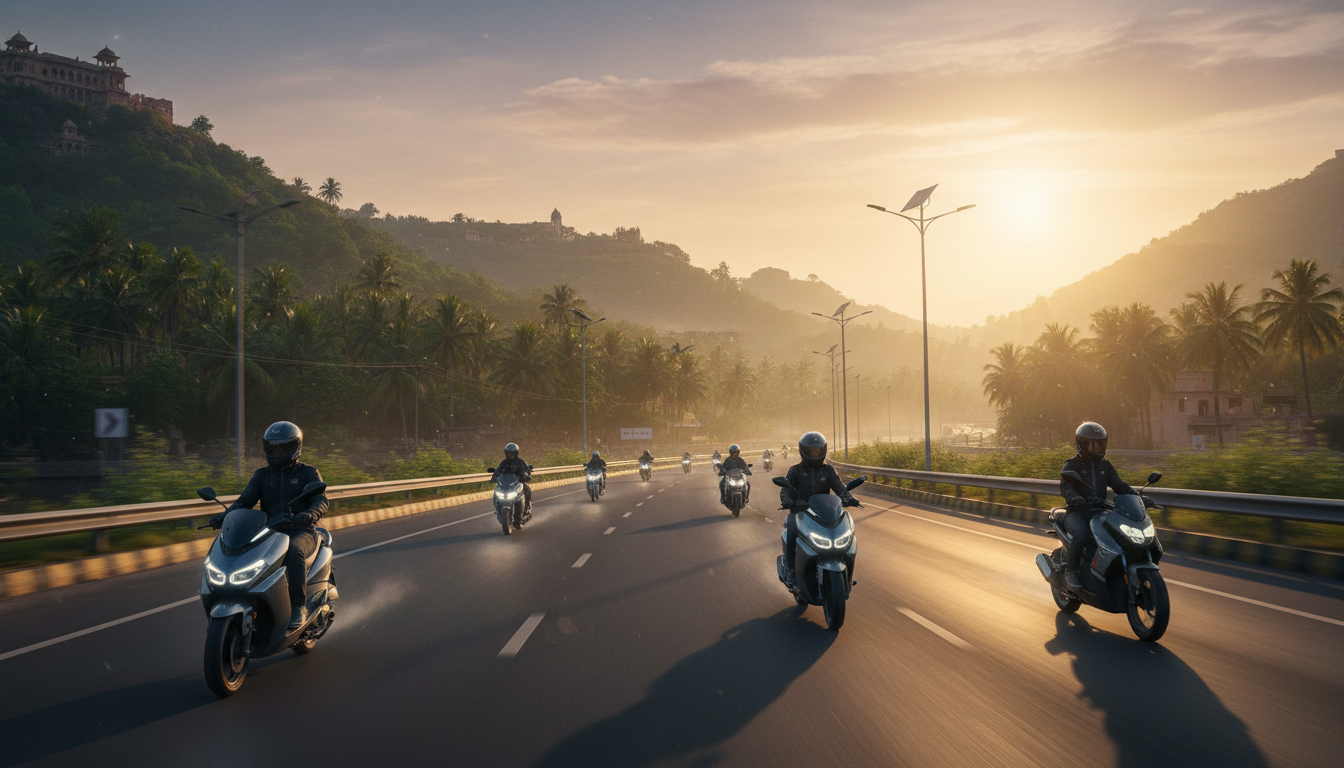
India’s electric two-wheeler (E2W) market has delivered a landmark performance in May 2026, with registrations surging 58% year-on-year to reach approximately 1.64 lakh units. This remarkable growth underscores the accelerating shift toward electric mobility in the world’s largest two-wheeler market, driven by competitive pricing, government incentives, expanding charging infrastructure, and an increasingly diverse product lineup.
May 2026 Sales Figures: A Historic Milestone
Electric two-wheeler registrations totaled 1,64,000 units in May 2026, compared to around 1.04 lakh units in May 2025 — a massive 58% jump that has exceeded industry forecasts. On a monthly basis, the numbers also reflect a strong recovery, signaling robust underlying demand. The broader EV market in India hit a record 10.7% overall penetration in May 2026, with electric two-wheelers accounting for over 62.9% of all EV sales — a testament to the segment’s dominance in India’s EV transition.

Market Leaders: TVS, Bajaj, and Ather Lead the Charge
TVS Motor Company emerged as the dominant force with a commanding 25% market share in May 2026. The company’s iQube series continues to attract urban commuters with its reliable performance, smart connectivity features, and a nationwide service network. TVS sold an estimated 41,000+ electric scooters during the month, propelled by new color variants and a competitive price range of Rs 1.02–1.70 lakh. TVS’s investment in charging infrastructure and battery swap pilot programs has also strengthened consumer confidence.
Bajaj Auto held firm in second place with a 23% share, largely driven by the Chetak Electric range. Bajaj’s Chetak — now available in Premium, Urbane, and the sporty Chetak 35 Series — has resonated strongly in Tier 1 and Tier 2 cities. Bajaj sold approximately 37,700 units in May, benefiting from its widespread dealership network spanning over 3,000 cities and strong brand trust built over decades.
Ather Energy maintained its reputation for performance-focused electric scooters, with the Ather 450X and Rizta series driving strong numbers. Ather’s focus on fast-charging infrastructure (Ather Grid with 1,900+ fast chargers across India), over-the-air software updates, and consistent build quality continues to attract tech-savvy buyers. The company has also expanded production capacity at its Hosur plant to meet surging demand.
Hero MotoCorp’s Vida brand is expanding rapidly, with the Vida V1 and V2 scooters gaining traction across multiple cities. Hero’s massive distribution network — the largest in India with over 6,000 dealerships — is helping Vida reach markets previously underserved by EV brands. Hero’s aggressive pricing strategy and financing options have further broadened its appeal to first-time EV buyers.
Ola Electric, despite facing quality concerns and service challenges in previous quarters, continues to hold a significant position in the market. The company’s S1 series remains one of the best-selling electric scooters in India, supported by its direct-to-consumer model and competitive pricing starting at Rs 74,999. Ola has ramped up its service network to address customer feedback, opening hundreds of new service centers across India.
Exciting New Launches Energizing the Segment
Two highly anticipated new entrants are set to further electrify the Indian market in the coming months, adding premium options to an already vibrant product ecosystem:
Royal Enfield Flying Flea C6
Royal Enfield — synonymous with iconic motorcycles — has made its bold electric debut with the Flying Flea C6, a neo-retro electric motorcycle that blends classic RE styling with modern EV technology. Priced competitively in the premium segment, the Flying Flea C6 features a mid-drive motor, a removable battery pack for home charging convenience, and a claimed range of 130+ km on a full charge. It targets adventure riders and urban commuters who want the Royal Enfield experience without the emissions. Pre-bookings opened in April 2026, with deliveries expected from July 2026. The launch has sparked enormous enthusiasm among RE’s loyal fanbase and new EV converts alike, with over 50,000 pre-bookings reported in the first month.
Yamaha EC-06
Global two-wheeler giant Yamaha entered India’s electric scooter space with the EC-06, a stylish and feature-rich urban commuter scooter. Building on Yamaha’s strong engineering heritage, the EC-06 offers a smooth 6 kW motor, a swappable battery system compatible with Yamaha’s battery exchange network, and Yamaha’s signature sporty aesthetics. Priced at approximately Rs 1.10–1.30 lakh, the EC-06 is positioned as a premium alternative in the mid-segment, competing directly with TVS iQube and Bajaj Chetak. Yamaha’s India entry is expected to intensify competition and raise the bar for quality and after-sales service in the electric scooter segment.
Policy Tailwinds: PM E-DRIVE Scheme
A critical enabler of this growth is India’s PM E-DRIVE scheme, which replaced the earlier FAME-II subsidy program. With a total outlay of Rs 10,900 crore, the scheme provides subsidies of Rs 5,000 per electric two-wheeler until July 2026, making EVs more accessible to price-sensitive Indian consumers. State-level incentives from states like Maharashtra, Gujarat, Delhi, and Karnataka provide additional support, with some states offering direct purchase subsidies of up to Rs 10,000 and reduced registration fees, bringing effective prices down significantly.
Charging Infrastructure: Growing to Meet Demand
India currently has over 27,737 public EV charging stations as of March 2026, with rapid expansion underway. The PM E-DRIVE scheme targets 72,300 new charging points by March 2028. For two-wheelers, the growing availability of home charging (standard 5A plug charging overnight) reduces range anxiety. Additionally, battery-swapping networks from companies like Bounce Infinity, SUN Mobility, and Yamaha’s upcoming exchange network are making daily EV ownership far more convenient for commuters who lack dedicated home parking.
Outlook for the Rest of 2026
Industry analysts project that electric two-wheeler sales in India could cross 25 lakh units in FY2026-27, up from approximately 18 lakh units in the previous fiscal year. The combination of new model launches (Royal Enfield Flying Flea, Yamaha EC-06, new TVS and Bajaj models), continued policy support, improving charging infrastructure, and falling battery costs creates a highly favorable environment for sustained growth. Battery prices are expected to fall below $100/kWh by late 2026, which will further reduce EV prices and broaden accessibility.
The 58% YoY surge in May 2026 is not an outlier — it reflects a structural shift in how Indians are choosing to commute. With fuel prices remaining elevated, the total cost of ownership for electric two-wheelers now comfortably undercuts petrol equivalents over a 3-year ownership period, making the financial case for going electric increasingly compelling for Indian households.
Conclusion: India’s Electric Two-Wheeler Revolution is Unstoppable
May 2026 has been a watershed month for India’s electric two-wheeler industry. The 58% YoY growth to 1.64 lakh units, led by TVS (25% share), Bajaj (23%), Ather Energy, Hero Vida, and Ola Electric, backed by exciting new launches from Royal Enfield and Yamaha, and supported by government policy and growing consumer acceptance, signals that India’s electric mobility revolution is well and truly underway. For consumers, fleet operators, and investors, the message is clear: the future of two-wheelers in India is electric, and that future is arriving faster than anyone predicted.